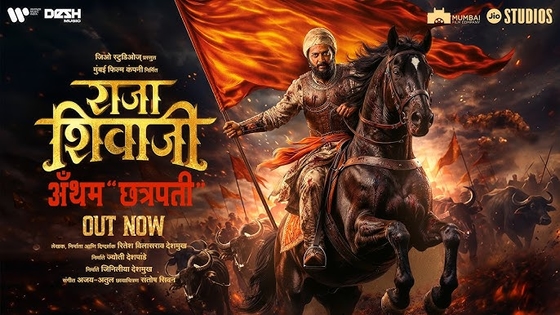
With the release of the Raja Shivaji Hindi trailer, and the film’s rousing anthem, we are witnessing a fascinating, and somewhat brutal, case study in cinematic acoustics.
On one side, we had the polarising musical outing of Chhaava, helmed by AR Rahman. On the other, there is Riteish Deshmukh’s passion project, powered by an Ajay-Atul exhilarating score that seems to have captured, at least going by the popular response on social media, the pulse of an empire.
To be clear, what we are going to attempt is not just a comparison of two soundtracks. But, perhaps, it will be a study in how music can either bridge the gap between history and the modern viewer or leave them stranded in a state of clinical detachment.
But, to start off, some background on the film. In keeping with the times of overt nationalism on screen, Raja Shivaji, looks to be an ambitious project on a relatively better known chapter from Indian history. Directed by Riteish Deshmukh, who also portrays the titular role of Chhatrapati Shivaji Maharaj, the film is set for a worldwide theatrical release on May 1, coinciding with Maharashtra Day.
The film boasts a high-profile ensemble cast, including Abhishek Bachchan as Shivaji’s elder brother, Sanjay Dutt as Afzal Khan, and Vidya Balan as Badi Begum. Genelia Deshmukh stars as Saibai, while the couple’s son, Rahyl Deshmukh, makes his acting debut portraying the younger version of the Maratha warrior. Adding to the buzz, Salman Khan is set for a cameo, reportedly as the legendary warrior Jiva Mahala.
Going by the trailer, the film seems to be mounted on a lavish scale and it features intense action sequences, focusing on the early struggle for Swarajya.
For the record, Chhaava, released in early 2025, chronicled the life of Chhatrapati Sambhaji Maharaj, the eldest son of Chhatrapati Shivaji Maharaj and the second ruler of the Maratha empire. Starring Vicky Kaushal in the titular role, the film focused on Sambhaji’s nine-year reign, highlighting his military brilliance, his fierce resistance against the Mughal Emperor Aurangzeb, and his unwavering commitment to the dream of Swarajya.
When craft becomes distant
When Chhaava announced AR Rahman as its music director, the industry assumed that we were in for an interesting take on the Maratha roar. However, there is a fine line between sophisticated and detached. Rahman’s score for Chhaava felt like a high-concept experiment. It was polished, orchestral, and perhaps too global for a story that was inherently local.
It lacked that visceral, gut-punching energy required to mirror the rugged terrain of the Sahyadri. The criticism, we repeat, was less about quality and more about mismatch. In the context of a story rooted in Maratha valour, where geography, community, and confrontation are central, the music felt curiously unmoored.
What was happening on the screen demanded a sense of kinetic urgency. What we got instead was something more atmospheric, almost meditative. The surge of adrenaline that the audiences were perhaps expecting did not arrive.
To be fair, Rahman often works in a more pan-Indian (and increasingly global) sonic vocabulary. That universality is usually his strength. In Chhaava, it may have worked against the film’s need for specificity.
Ajay-Atul and the grammar of assertion
In contrast, Ajay-Atul’s work in the Raja Shivaji trailer, and the film’s anthem sounds rooted. As noted by many responses on social media, the trailer seems to be a redemption arc for the Maratha brand. By choosing the sons of the soil, Ajay and Atul, Deshmukh seems to have prioritised authenticity over optics. And Ajay-Atul’s score is unapologetically Maharashtrian in texture. Its rhythmic base, its vocal attack and its emotional grammar carry the Marathi flavour.
The anthem doesn’t leave emotional work to the listener. Every beat insists, every chorus reinforces, every swell of instrumentation is calibrated to lift.
Ajay-Atul have spent decades mastering the art of the powerful percussion. From Agneepath to Sairat and Tanhaji, they have brought to screen the sonic identity of Maharashtra. Their use of the Tutari, a trumpet-like instrument used to announce royalty, isn’t just a sound effect. It is verily a clarion call. It shows that they have understood that the story demands blood and thunder.
The sound of the Dhol-Tasha, even if predictable in the scheme of things, gives the anthem the much-needed local emotional fervour and reality. Unlike the European-orchestral feel of Chhaava, even if musically different, this anthem uses a rising crescendo that builds anticipation until it reaches a fever pitch. The percussion, as we keep saying, remains rooted in Maharashtrian folk traditions, but is also embedded within a more expansive orchestral framework. Strings surge, brass punctuates, and the chorus takes on a more structured, almost liturgical quality.
Dialogue and music in sync
We are not privy to what brief was given to Rahman when he was asked to handle the musical baton for Chhaava. But in Raja Shivaji, the message seems to have gone out loud and clear. For the music shows that this story doesn’t need aesthetic beats. It demands high-octane devotion and the Tutari to sound like a warning to an empire. And that is what we have got.
The standout moment of the Raja Shivaji trailer is the synchronisation of dialogue and music. When Riteish Deshmukh roars as the eponymous Shivaji, Marathon ne gairon ki marzi rakhna chhod diya hai, the score explodes behind it.
By leaning into the raw, unpolished power of Ajay-Atul’s signature style, Deshmukh has effectively redeemed the genre’s soundscape.
Lesson for the pan-Indian era
This divergence between Chhaava and Raja Shivaji is more than a gossip-column comparison. It’s a study in how music shapes historical imagination. In an era where Baahubali has set the bar for visual grandeur, filmmakers are learning that you cannot intellectualise a war cry. Rahman approached his project with a clinical vocabulary. Ajay-Atul, meanwhile, have leaned into their signature raw power style.
As Raja Shivaji builds towards its release, what this early contrast — after all what we have heard is only the anthem and the trailer — reveals is not just a difference in musical style, but a difference in understanding audience instinct. Subtlety has its place in musical score. But when history is summoned on screen, audiences still gravitate towards music that feels immediate, collective, and rooted.
In the Battle of the BGMs in India those who stay closest to the soil, invariably, and ironically, come out on top.


