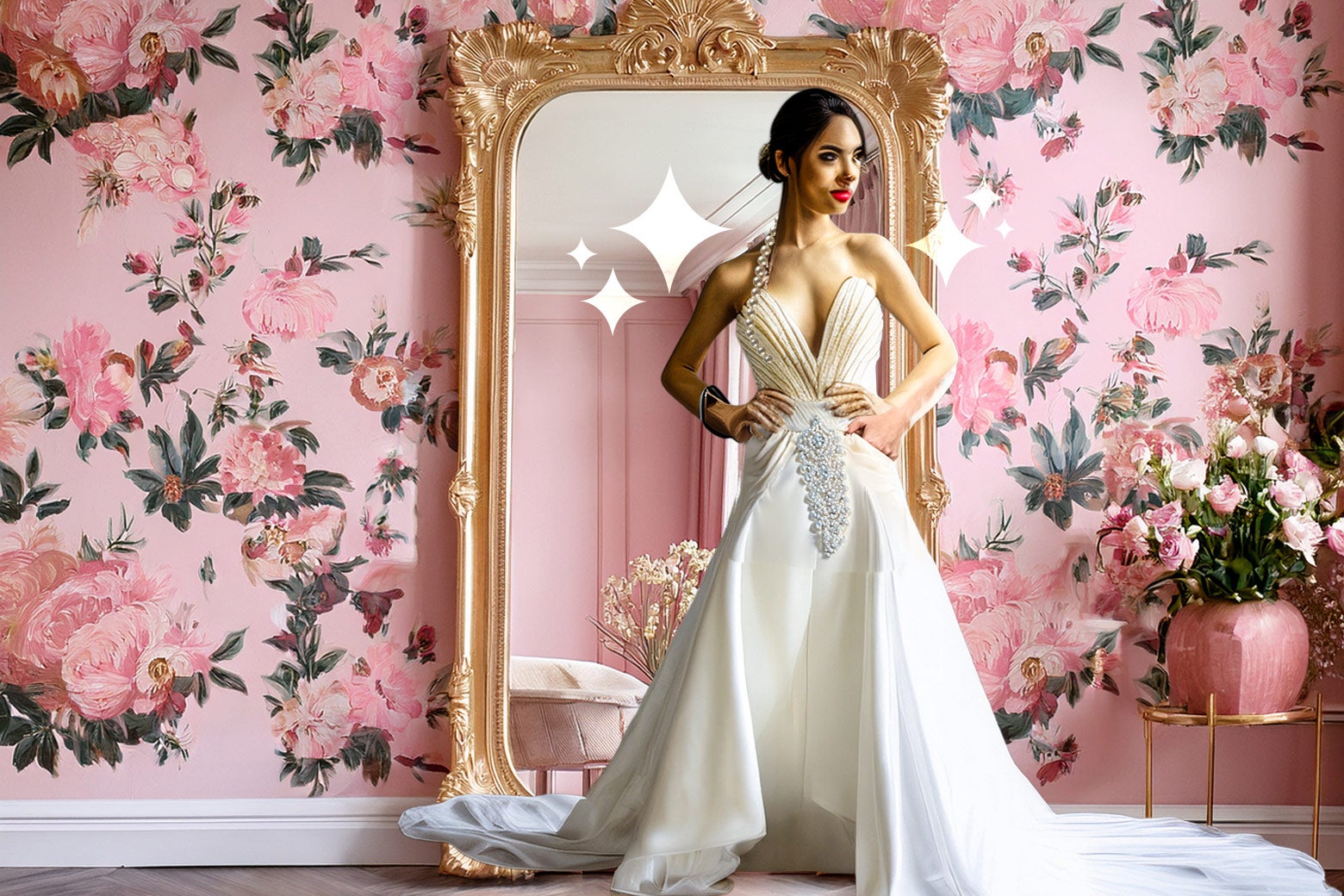
Here are a few small things no one told me about wedding dress shopping. No one told me that most of it is by appointment only, and you have to pay for some of those appointments. No one told me that since many wedding dresses are made to order (which can take four to eight months) and then require additional alterations (another two to three months), I technically should have started looking for mine a full seven months before I got engaged. No one told me, and why would they have, that often salons have you stand on a platform to take in the mirror image of the dress you’ve tried on, and some stylists, maybe just the bad ones, will hold a dress open for you and make you both step into it and onto the platform at the same time, a perilous undertaking for both you and the dress. Oh, and the slop. Absolutely no one told me about wedding dress slop.
Wedding dress … slop?, you may be asking. What I mean by that is photos of wedding dresses that have either been designed or enhanced by A.I. I’m talking about all the dresses I’ve seen on Pinterest over the last few months that defy the laws of physics, the ones I’ve seen on Etsy set against suspiciously perfect ethereal garden backdrops, and the ones selling for $200 on strange websites I’ve never heard of and that I could swear I’ve seen elsewhere going for 10 times as much. If you’re shopping for a wedding dress in 2026, you’re almost guaranteed to encounter at least a little slop along the way. Getting engaged anytime soon? Prepare to start reverse-image-searching everything. Best-case scenario, even if you’re tempted by the very attractive prices, you’ll be smart enough to steer clear. Worst-case scenario, you fall for a slop dress.
That’s what happened to Maddy, a 27-year-old pastry chef in Montreal who is getting married in August. She found a dress on Etsy that she thought was the one: She loved the color, which was red; the lace; and the way the halter neck would show off her arm tattoos. “It looked very just airy and flowy and fun,” she told me. But the seller didn’t have any reviews, and she knew the photos were at the very least heavily edited.
Maddy decided to post the dress in r/isthisAI, a subreddit that caters to users who want help determining whether an image is A.I.-generated. Pretty much everyone who responded was in agreement: Yep, it was A.I. They zeroed in on the tells: The model’s knee looked weird, her foot had possibly an extra toe on it, the sequins didn’t look right when you zoomed in … the list went on. Looking back, Maddy said she liked the dress so much that she must have been in denial about the obvious red flags.
I don’t know why I was so surprised when I first discovered the existence of wedding dress slop. As A.I.’s popularity with everyday consumers has grown over the past few years, it’s taken hold in seemingly every medium: articles, videos, music, books. Even knitters are having to learn to separate real patterns from the A.I.-generated ones. Of course wedding dresses aren’t immune.
Except. I shop for clothes online all the time and I don’t encounter, like, Madewell slop. But the thing about buying a wedding dress is that most of the people doing it have never done it before. We don’t have a way of distinguishing the stuff that’s strange because the bridal industry tends to be old-fashioned and a little quirky from the stuff that’s strange because it’s a scam. “This is just such a weird journey for the bride,” said Wallace Wilson, the vice president of marketing technology at Essense of Australia, a wedding gown company based not in Australia but Kansas City. “You’ve never searched for this before. You’ve never shopped for this before.” That lack of knowledge is what leaves space for the slop to get in.
Moderators on one popular wedding dress subreddit have gotten so fed up with A.I. that they banned it altogether: No A.I. inspo or using A.I. to digitally try on dresses is allowed there. The subreddit takes a hard line against A.I. because “it sets unrealistic expectations of what the dress will look like,” a moderator who wanted to remain anonymous told me. “It ignores physics and patternmaking principles. Are they beautiful? Sure, but they won’t look that way in real life, and it’s setting brides up for disappointment.” She said that the rule gets broken often; the moderators end up closing two or three threads a day for their A.I. usage.
The problem is not confined to the internet, either. “It’s becoming more and more of a topic these days between bridal store owners and designers and whatnot,” said Krista Lastrina, the owner of Lastrina Girls, a bridal salon in Middletown, Connecticut. “I have a great team of consultants here, and all of us are pretty frustrated when people come in and they say, ‘Oh, I was trying to find a dress like this, but I wanted to do a certain kind of sleeve on it.’ So they will have A.I. put that sleeve on it. It’s physically not possible to put that type of a sleeve on, say, a strapless dress, right? What’s it going to come off of? Like, that doesn’t exist. And if it were to exist, it would literally fall off your body, because it’s got nothing to hang on to.” She’s noticed a marked increase in visitors to her shop referring to A.I. over the past year, estimating that maybe 10 percent of the brides she serves now mention it.
Some A.I. dresses are more fanciful than others. Though Maddy declined to order that red Etsy dress she loved after determining that it wasn’t real, there was nothing about it, no logic-defying sleeves or ruffles, that precluded it being re-created in real life—she told me that she asked around among tailors who did custom work, and they thought building a similar dress would be doable. She ultimately decided against it though—it was too expensive.
Like it or not, A.I. is starting to replace Photoshop, to say nothing of the even more antiquated technology that is human imagination.
If brides, most of whom are presumably in their 20s and 30s, are falling for A.I., this would seem to go against the stereotypes that older people are the ones most susceptible to being tricked by it. “It’s really surprising!” the subreddit moderator said when I asked what she made of this discrepancy. “This may be a little harsh of me as a millennial, but the media/digital literacy of the younger folks, mid-to-young Gen Z, is just as bad as the boomers.” Lastrina, however, thought that maybe it isn’t that Gen Z is bad at detecting A.I., it’s that they don’t have any shame about using it. “You have these young brides who probably can spot that it’s A.I., but they just don’t care, because they want what they want.”
Wilson told me he recently gave a presentation about A.I. at a wedding industry event where he encouraged an audience of skeptical bridal shop owners to see the potential benefits of the technology. “When [brides] bring that image into the store, it’s very different than some nefarious company doing this A.I. stuff to mislead a bride,” he said. Brides are simply trying to envision what a dress might look like on them on their big day. Like it or not, A.I. is starting to replace Photoshop, to say nothing of the even more antiquated technology that is human imagination, as a method for doing so.

Photos from Canvas Bridal and generated by A.I.
Let’s get into the nefarious companies, though, the ones that steal dress designs and more than likely conjure up suspicious new retailers from whole cloth. No one knows this better than Taylor Ann Art, the Kansas City–based proprietor of Canvas Bridal, which transforms discontinued dress samples into one-of-a-kind painted gowns. “There’s pictures right now of my work online being sold that it’s so clear to me, that I can see that’s my dress they’ve run through an A.I. and put a person in it,” she told me. She shared some examples with me of photos of her dresses and the online listings that had clearly been adapted from her originals. Ann Art’s work is colorful and vibrant and, unluckily for her, apparently particularly attractive to A.I. and scammers. “It just so happens to be that A.I. also really likes ombre, so it’s created a lot of tension,” she said. People have started asking whether her dresses are A.I.–generated when she posts them online, she told me. She finds it galling to be in the position of having to prove that A.I. copied her and not the other way around.
Stolen images have been a problem on the internet for as long as there’s been an internet, but according to Taylor Ann Art, A.I. has exacerbated the issue to an unmanageable degree. Before, when her work got stolen and wound up on scam websites, she could report it, whether to Pinterest or the sites’ web providers. She would identify herself as the copyright holder, and usually within 24 hours, it would get taken down. Once a month, she would take a day to mass-report all the copycats, and that was enough to keep on top of the problem. “But now there’s this gray area where, even though I can clearly tell that that’s my image through A.I., they’re ‘different’ images, so they’re allowed to sell it, and I can’t get them taken down,” she told me.
Wilson, of Essense of Australia, described a similar experience. “Our team is constantly running searches, nonstop, with A.I. tools, with [search engine optimization] tools, with everything, just looking for mentions of our brand out there for us to find to ask to take down. But to be honest, there’s got to be hundreds of sites and hundreds of images and hundreds of things out there that we’re not even catching.”
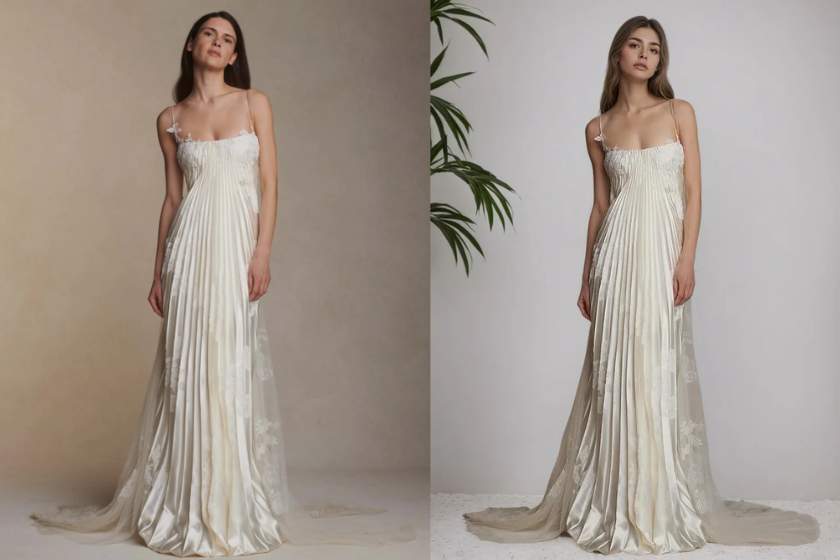

Danille Frankel, Ballbella.
Though there’s sometimes a thin line between inspiration and theft, some examples are particularly egregious: Here, a site called Ballbella has clearly doctored, likely via A.I., Danielle Frankel’s Scarlet dress, which retails for $10,990, onto a different woman and different background. Only $229! It’s the exact same price the interestingly named Whengirl is charging for what is unmistakably a Dreamers & Lovers Hayley dress (originally $2,900), whose original accompanying photo, of a blond woman, has been replaced by a brunette who is somehow standing and lifting her arms in the exact same unlikely position. When girl, indeed, but also how, why, and who, girl?
Little is known about the strange category of shady-seeming sites that sell super-cheap wedding dresses, many of which claim to be fully customizable. Good Morning America did a big story on them in 2015, so they’ve been around a while, but they’ve also continued to evolve. “It’s taking advantage of a bride looking for a good deal and just scamming them out of money [with] a low-quality dress they’re disappointed by,” the wedding dress subreddit moderator told me, adding that she believes they’re usually made in sweatshops or by unethical businesses that don’t pay fair labor wages. Jeremy Hong, who owns DiscountDressShop.com, told me he’s maintained a list of scam dress websites and red flags to look for on his site since 2008. That’s really all he can do. He’s seen some get shut down and many more spring up.
Hong said these sites are generally thought to come out of China. (They sometimes list fake addresses; I came across one that listed its address as the site of the Whole Foods in Gowanus, Brooklyn, in New York.) Many of them also sell cheap, low-quality prom dresses to unsuspecting teenagers, a scam that local news has been warning the masses about every spring for over a decade. Even on the scam scale, some are more legit than others. Some will take your money and send you nothing, while others will deliver an actual product, though rarely a quality one. Some have names that themselves seem A.I.-generated, akin to the now-widespread practice of Amazon pseudo-brands using collections of unpronounceable letters as their names.
I usually found my way to the wedding dress slop via Pinterest, whose algorithm ensures that if you click on a dress you like, dozens of similar ones will populate your screen. This is what makes it the best place on the internet to look for dress inspo—and the worst, because I suspect it’s also the main way all the links to scam dresses proliferate across the web. “Pinterest has been a cesspool for A.I. dresses because anyone can upload and re-pin inspiration pictures,” the subreddit moderator told me. She believes the site should be screening links for legitimacy and requiring retailers to post realistic images of their products that don’t use A.I. Wilson was a little more forgiving: If people find a stolen or A.I.-embellished image that they like and want to save, why should it be Pinterest’s responsibility to deny them?
Personally, I lost hours to Pinterest during my dress search. I can’t emphasize enough how different this aspect of wedding dress shopping is from the transcendent, ecstatic experience that exists in the popular imagination and in media like Say Yes to the Dress. Every dress I clicked on generated 10 more I should probably click on too, just in case one of them was the one, then each of those 10 would lead to another 10, and so on. It was like I was trapped in a math problem designed to teach exponents to fifth graders. You’re supposed to cry when you find your dream dress; if looking for dresses on Pinterest ever brought me to tears, it was because there was always another one to click on. As with dating, it turns out there are drawbacks to infinite choice. Perhaps not from Pinterest’s perspective, though—it’s in the app’s interest to keep you engaged, and the more dresses it has for you to look through, the longer you’ll stay. For Pinterest, A.I. means more images and more clicks, even if it means more garbage for users like me to sort through. (The site has options for users to limit the amount of A.I. they encounter; I attempted to exclude it and still saw a ton.)
Wilson told me that a strange aspect of the scammy sites that many Pinterest links lead to is that a number of them aren’t necessarily trying to make a quick buck on cheap dresses. Their scam may actually center on SEO or Amazon affiliate links. The bridal industry is “just another market for them to spin up these garbage sites,” he said.
Though I considered ordering an A.I. wedding dress from one or more such sites for this article, I ultimately decided I didn’t want to give any of these sites a dime, or my credit card number. If you followed the recent saga of Courtney, the woman who bought 13 wedding dresses on TikTok, you may recall that she actually bought a 14th dress that she forgot to count. That dress was A.I., and she knew it was A.I., but she ordered it anyway. “It was $59. In my weary state I thought to myself… what if…” she wrote on TikTok. No dress ever arrived. Interestingly, the particular dress she ordered, a romantic number with a skirt that seems impossible because it is, circulates constantly online and has ensnared many people. Last year, a wedding dress subreddit singled it out and begged people to stop posting it. Courtney apparently never got the memo. (Some of Courtney’s other dresses came from places that resemble some of the dubious outlets I’ve discussed in this piece, and she actually liked a bunch of them, so you never know.)
The overall effect is just cheap-looking, about as well-constructed as a Party City Halloween costume.
But some A.I. dresses do actually materialize when you order them … sort of. This recent video from YouTuber Safiya Nygaard is about A.I. dresses in general, not wedding dresses specifically, but it provides a good illustration of the difference between online listings and what might actually arrive: One purple gown’s applique flowers look nothing like the ones in the picture (and quickly start to fall off), the dramatic basque waist is much less so in person, and its skirt isn’t nearly as voluminous as advertised. The overall effect is just cheap-looking, about as well-constructed as a Party City Halloween costume.


Photos from Frisco Dresses and Taylor Ann Art/Canvas Bridal.
As platforms like Pinterest have embraced A.I.—and become overrun with it—the visibility of non-A.I. work has suffered. “I used to get 2 million views on Pinterest per month, and now it’s down to 100,000,” Taylor Ann Art told me. Sales have slowed too. “I used to sell instantly, quickly, randomly. I’ve been in business 10 years, and this last year, I’ve only been able to make sales of dresses if I’ve communicated with a customer beforehand, or if they’ve come in person to try on a dress.” Essentially, she now has to prove to people that she’s human to make a sale.
She’s hoping to combat the A.I. onslaught with a pivot. “I’m trying to open up a space where brides can come in person and try on. I’m trying to push the more real aspect, and I’m hoping that’ll save my business.”
Emphasizing the in-store experience is what Wilson recommends too. He knows bridal shops are old-fashioned—he recalled that some of them didn’t even have computers when he started at Essense of Australia 14 years ago. And he knows that Gen Z is used to instant gratification. He said his 23-year-old daughter recently told him that she wouldn’t want to visit a bridal boutique if she were looking for a wedding dress. “She just would buy three wedding dresses online, have them all come in, ‘I’d try on the one, and then I’d send the other ones back,’ ” he told me. He understands that getting these young brides to value the in-store experience when the time comes will be a challenge. While I understand that many future brides will seek out the bridal equivalent of the fast fashion they’ve grown accustomed to, I also have faith that some will appreciate the old way. Or, as columnist Ezra Klein recently argued in the New York Times, “The more automation there is, the more people value a human’s touch.” That’s where I eventually landed with my own wedding dress search.
After clicking through hundreds, maybe thousands of dresses online, some real and some fake, I ended up buying my wedding dress from a traditional bridal shop. I remember thinking the process felt a little stuffy and formal, like bridal shops were all conspiring with each other to pretend like it’s still 1996. Now I recognize what a luxury that was. Would you rather drown in a sea of wedding dress slop or spend an afternoon sipping champagne and traveling back in time? As interesting as it’s been to sift through all the slop, I know my answer. Pass me a flute, please.


