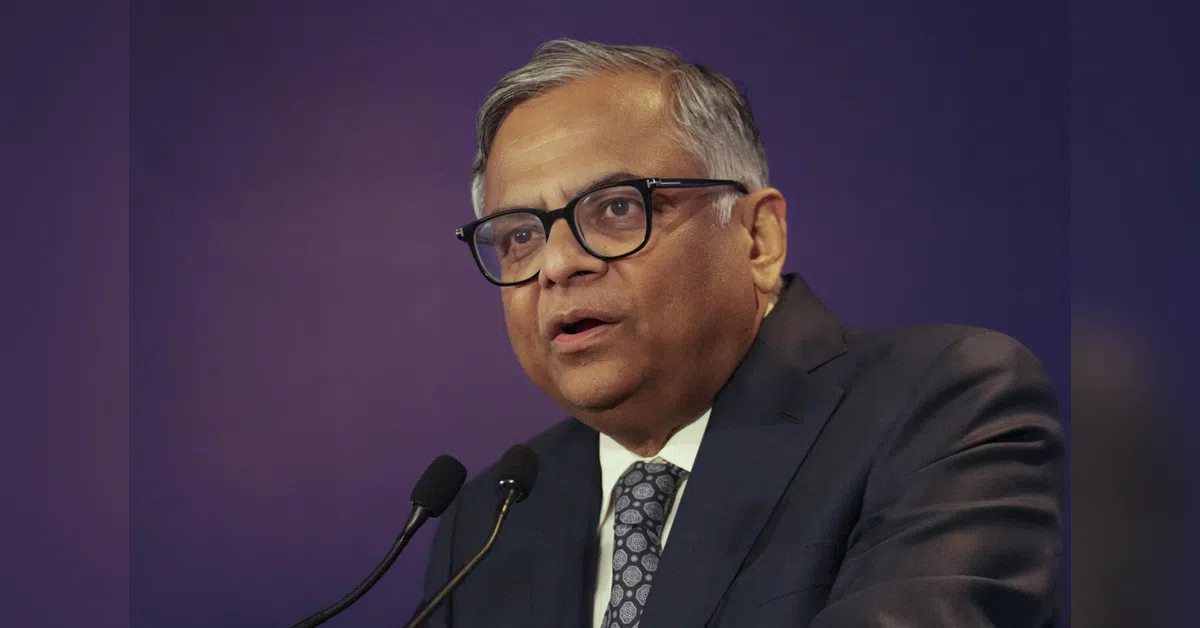
Over the next three years, Tata Consultancy Services (TCS) will have as many artificial intelligence (AI) agents as human employees, and this AI-led automation will reduce the pace of hiring at the company, said TCS Chairman N Chandrasekaran while addressing the 31st annual general meeting of the IT major.
“If the company has half a million employees, the day is not far when the company will have half a million AI agents,” he said. “The company’s employees and the AI agents will work together, and that will be the future,” he added.
Chandrasekaran, for the first time, acknowledged that the firm would hire less compared to previous years.
“The company, and the industry, is unlikely to hire the same number of people because certain portions of the work that is being done will go to the AI agents,” he said.
This is already evident in the hiring patterns of the industry and the company. Though a net hirer, the IT industry’s headcount growth is softening, reflecting the non-linearity component. The sector will have a total net addition of 135,000 people this fiscal year – a modest rise of 2.3 per cent over 2025-26 (FY26).
TCS has started its FY27 fresher hiring with a target of 25,000. Though the company may increase this number in the coming quarters, it is among the lowest since FY20. Last year TCS laid off 2 per cent or 12,000 people as the firm focused on being an AI-first firm.
Chandrasekaran, however, maintained that the impact on hiring will be restricted to the transition phase. The slowdown in hiring, he said, “does not mean there are no future opportunities… Once the transition happens, the AI world will produce so much more opportunities; there will be new talent that will be required.”
AI, he added, represents the biggest growth opportunity in TCS’ history, and the company is investing heavily in AI talent, proprietary assets, AI operating systems, and infrastructure.
TCS is seeing rapid growth in its AI business. The company’s annualised AI revenue run-rate increased from $1.5 billion in the second quarter of FY26 (Q2 FY26) to $1.8 billion in Q3, and then to $2.3 billion in Q4, Chandrasekaran said. This is a compound quarterly growth rate of about 22 per cent. He expects AI-driven revenue to grow 100 per cent year-on-year.
“By 2028-30, virtually all of TCS’ revenue will have an AI component as enterprises embed AI across business functions,” Chandrasekaran said. He added that he has no doubt that the faster the company can influence, participate in, and help customers transform to benefit from AI, the better positioned it will be. To that end, he said, TSC is making significant investments — not only in human talent but also in building assets, including an AI operating system of sorts that will feature AI agents for every industry and enable integration of new solutions with traditional IT systems.
He also explained why the company is investing in capex-heavy businesses such as a data centre. “This is necessary to be able to play an end-to-end full-stack AI solution game,” he said. Besides setting up a data centre in India, Chandrasekaran said TCS is also investing in building a sovereign cloud.
Addressing the shareholders’ concern over the sharp erosion of the company’s valuation, Chandrasekaran said he is not someone who can predict share prices, and currently, all companies across sectors have been affected by the geopolitical situation.
Within the tech industry, all IT services, software, and software-as-a-service (SaaS) companies have seen their stock values decline by roughly 35 to 45 per cent, he said. This, he added, is largely driven by a key question in the market: What is the relationship between AI and traditional technology, whether it is services, software, or SaaS?
On the company’s target, Chandrasekaran said the focus is on achieving double-digit year-on-year growth. Whether that materialises in a particular quarter, in FY27, or in FY28, remains to be seen, he said.
His “simple message,” he added, was that if the company is generating $2.3 billion in AI revenues in a quarter on an annualised basis, it should look for proof points for it to double, or even triple, in the coming quarters. “That, in turn,” he said, “will automatically drive the overall annual growth rate.”


