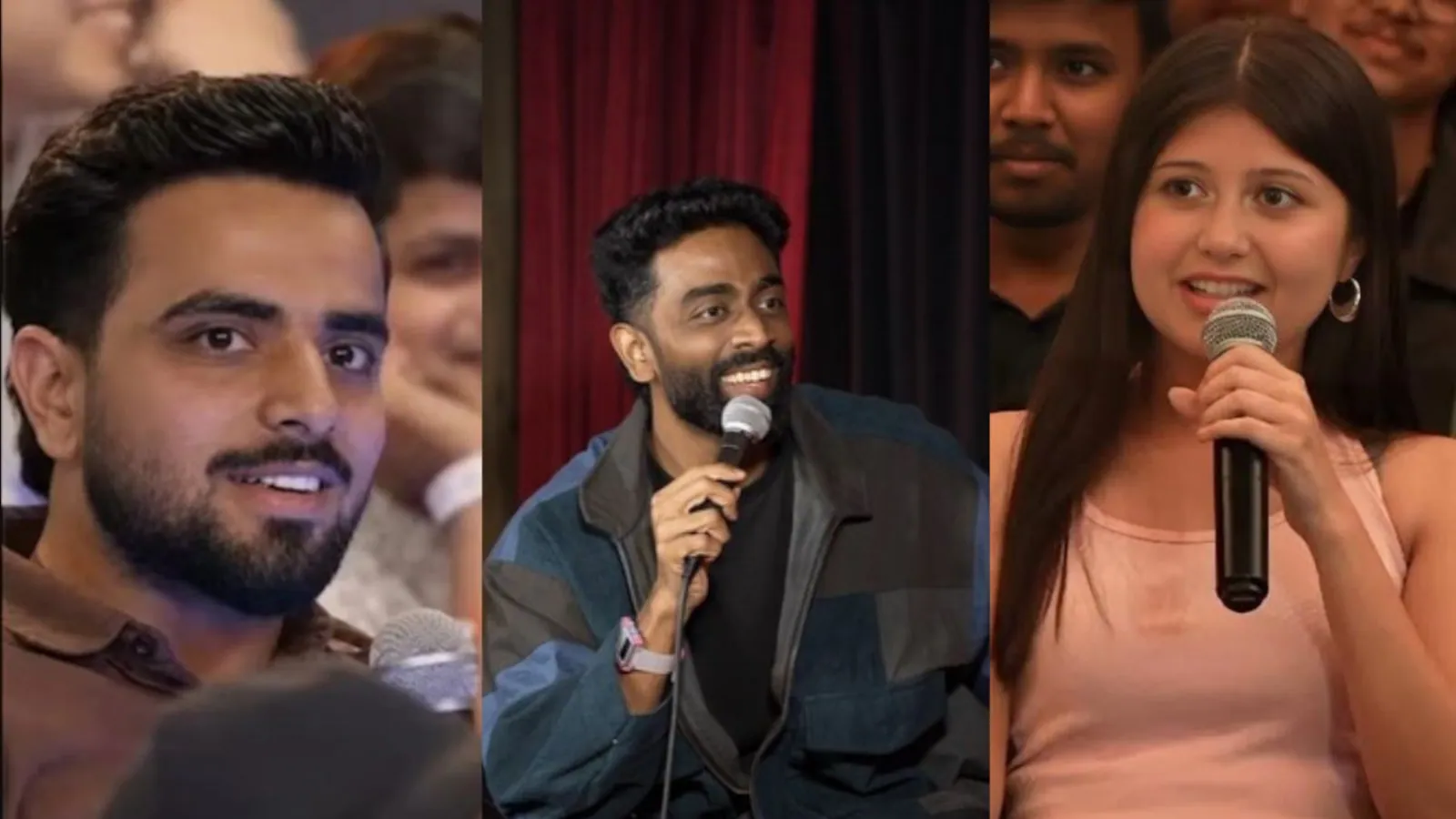
Over the last few days, comedian Pranit More’s crowd-work clip has exploded across social media, triggering criticism from viewers, fellow comedians, journalists and everyone else who is chronically online.
The now-deleted video featured an audience member recounting a date and suggesting that because he had spent around Rs 370 on biryani, he was entitled to “recover” that amount through physical intimacy.
Advertisement – Scroll to continue
The audience laughed. The comedian laughed. Pranit himself then uploaded the clip.
The audience member was a 22-year-old Gurugram resident, Himanshu Jangra.
And then the Internet did what the Internet does best: it went digging.
What began as outrage over one viral crowd-work moment soon expanded into something much bigger. People started examining older clips associated with More’s shows, eventually resurfacing another controversial video involving medical student Sejal Pawar.
In that clip, Pawar casually joked about discussing and comparing the genitalia of dead male patients with colleagues.
Viewed separately, both incidents were controversial.
Viewed together, they raised a larger question: when does a joke stop being edgy and start becoming offensive?
And perhaps more importantly, who gets to decide?
The So-Called Joke In Question
The controversy began with a seemingly routine crowd-work interaction.
The audience member, later identified as 22-year-old Gurugram resident Himanshu Jangra, narrated a dating experience during More’s show. While describing the encounter, he implied that spending Rs 370 on a meal entitled him to something in return.
His remarks were met with laughter inside the venue.
Online, however, the reaction was very different.
Critics argued that the statement reduced women to transactions and reflected a deeply ingrained sense of entitlement. The backlash was swift. Jangra apologised, deactivated his social media accounts and eventually lost his job after his employer announced his termination.
Founder Vivek Vishwakarma called the comments offensive while also urging people to leave room for reflection and growth.
“A person can be wrong. A person can make a terrible mistake. A person should face consequences. But I hope we never become a society that believes people cannot learn, reflect, apologise, or change,” he said.
More, too, apologised.
“I’ve seen the criticism regarding a recent crowdwork clip. The comments made by the audience member do not reflect my views. Looking back, I should have challenged the remark instead of laughing and moving on. That was a lapse in judgement on my part,” he wrote.
For many critics, however, the issue was not merely what was said. It was what was allowed to become entertainment.
Then Came The Dead People Clip
As the biryani controversy gained momentum, another video from More’s content library resurfaced.
This time, it featured medical student Sejal Pawar discussing dead male patients and making remarks about comparing their genitalia with colleagues. The clip quickly attracted criticism, with many arguing that if the genders were reversed, the outrage would have been immediate and overwhelming.
Pawar eventually issued a public apology and archived all her posts.
“Impact matters more than intent,” she wrote, acknowledging that the comments had come across in a way they should not have.
Even though her apology struck a notably reflective tone and rather than defending the joke, she admitted the experience had made her reconsider how she communicates about sensitive subjects.
Yet the debate had already moved beyond individual apologies.
The Internet was now asking whether these were isolated mistakes or symptoms of a larger cultural problem.
The Comedy Community Weighs In
Several prominent comedians joined the discussion.
Among the most widely shared responses came from comedian Rohan Joshi, who argued that the incident exposed attitudes many people already hold but rarely articulate publicly.
According to Joshi, the significance of the viral moment was not the remark itself but the worldview behind it.
“The male loneliness epidemic is a cage of our own making, its bars forged of our own entitlement and lack of empathy and inability to process women as whole people who don’t owe us shit,” he wrote.

Meanwhile, Aditi Mittal argued that the clip was hardly unusual.
“I can’t say that when I saw that video, I was surprised at all,” she said, adding that similar conversations happen constantly, both online and offline.
Mittal also made a broader observation about how women are often treated as communal punchlines.
“The shared humiliation of a woman is a very common male bonding ritual,” she added.
Comedian Anshu Mor shared his opinion to NDTV, explaining that the comedian is in charge of everything that’s happening in this room.
“When I saw the clip, I was like, this is not comedy,” he adds.
For Mor, the issue was not simply what happened live. It was the fact that the clip was later edited and uploaded, transforming a fleeting moment into content.
This Didn’t Come Out Of Nowhere
The biryani controversy resonated because many people saw it as part of a much larger pattern.
Over the years, Indian comedy has repeatedly found itself at the centre of debates about sexism, objectification and shock humour.
The pattern is difficult to ignore. Women, their relationships, their choices, their bodies become material.
And audiences are encouraged to treat those experiences as ‘relatable humour’.
That is why many critics argue that a young man confidently announcing that Rs 370 entitled him to something from a woman did not emerge in isolation. The idea had already been normalised, repeated and rewarded countless times.
How Stand-Up And Crowd Work Got Here
The current debate is also a reminder that stand-up comedy was never meant to be just shock value.
Long before Netflix specials and Instagram reels, comedy existed as social commentary. Ancient Greek and Roman performers used humour to mock power, question social norms and expose hypocrisy.
By the 19th century, writers such as Mark Twain were touring as comic lecturers, speaking directly to audiences in a format that closely resembles modern stand-up.
The version of stand-up we recognise today took shape during America’s vaudeville, a theatrical genre of variety entertainment, in the early 1900s. Solo performers would step in front of a curtain between larger acts and entertain audiences with observations, stories and jokes.
The term “stand-up comic” itself began appearing in American entertainment publications by the late 1940s.
India’s stand-up scene is much younger.
While comedy existed in films, theatre and television for decades, the modern stand-up industry only began taking shape around 2010 with dedicated clubs such as The Comedy Store in Mumbai. The rise of YouTube, social media and affordable mobile internet transformed what was once a niche urban art form into a massive digital industry.
Alongside stand-up’s rise came another format that would become central to modern comedy: crowd work.
Crowd Work: The Art And The Risk
Crowd work is often described as stand-up without a script.
Instead of relying entirely on prepared material, comedians interact directly with audience members, asking questions, responding to answers and building jokes in real time.
The appeal lies in unpredictability.
Every audience is different. Every response is different. Every show becomes unique.
For comedians, crowd work showcases quick thinking. For audiences, it creates the thrill of watching something unfold live.
But crowd work also carries risks.

India’s stand-up scene is much younger. Photo: Unsplash
Audience members can say offensive things. Conversations can take unexpected turns. Boundaries can blur.
That is why experienced comics often insist that crowd work requires more control, not less.
The comedian may not write the audience member’s answer, but they decide what happens next. They decide whether to challenge a comment, shut it down, redirect it or turn it into a punchline.
Critics argue that this is precisely what makes the Pranit More controversy different from a random conversation captured on camera. The interaction may have been spontaneous, but the decision to encourage it, laugh at it, edit it and upload it was not.
What Good Crowd Work Can Look Like
Ironically, crowd work itself is not the problem.
One example frequently cited online involves American comedian Rene Vaca. During a live show, a male heckler insulted a woman in the audience by shouting “for the streets”, a derogatory phrase suggesting promiscuity.
Instead of joining in, Vaca turned his attention toward the heckler and dismantled him with jokes in front of the crowd.
The woman was defended, and the heckler became the punchline.
The room still laughed.
In another example, Boston comedy club owner Courtney Pong famously stopped a show mid-performance in 2019 after performers repeatedly made jokes about domestic violence and degrading women. She refunded audience members and publicly explained that the line had been crossed.
The principle behind both incidents was simple: the person controlling the room is responsible for what happens inside it.
What Does The Law Actually Say?
One of the biggest misconceptions in comedy debates is that offensive jokes are automatically illegal.
They are not.
Indian law does not have a legal definition of what is funny or unfunny. Comedy, like other forms of artistic expression, is protected under Article 19(1)(a) of the Constitution, which guarantees freedom of speech and expression.
Comedians are generally free to joke about politics, society, relationships and even controversial subjects.

However, that freedom is not absolute.
Article 19(2) permits reasonable restrictions relating to public order, decency, morality, defamation and incitement, among other grounds.
This means a joke can be offensive without being illegal. And a joke can be legal while still being deeply unpopular.
Who Becomes The Joke?
When a man suggests a woman owes him something because he bought her dinner, many women hear a belief they have encountered repeatedly in real life. When a doctor jokes about discussing the bodies of dead patients, many viewers see professional boundaries being reduced to entertainment.
People are not debating these clips because humour often reveals what a society is willing to normalise.
Comedy has always tested boundaries. But boundaries exist.
The irony is that some of the greatest comedians in history built careers by offending people.
Stand-up has always challenged social norms. Good comedy often makes audiences uncomfortable. It questions authority, exposes hypocrisy and forces people to confront difficult truths.
The problem is that there is a difference between discomfort and dehumanisation.
That distinction is what many comedians themselves emphasise.
As Anshu Mor argued, controversial topics are not automatically off limits. Religion, politics, gender and sexuality can all become material for comedy.
The question is whether there is an actual joke beneath the controversy. “If it is just absolute crass, then anybody can get up on stage and do this,” he concludes.


