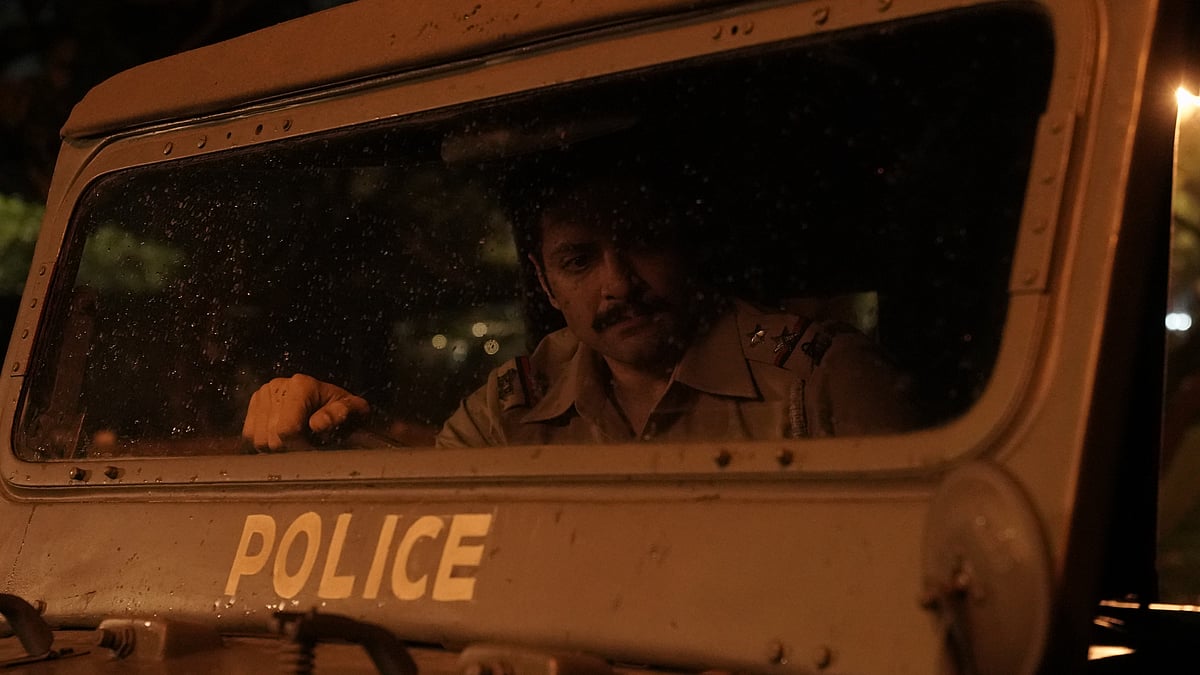
As fundamentally solid as Raakh looks, however, there is a sense of structure and convention about it. It’s as if the series derives its cinema of grimness from a genre that already exists. Once the first few episodes lay the ground for a chase, the novelty of this world is replaced by the familiarity of a ‘setting’. To echo its theme of social scale, the goodness of Raakh belongs to the second tier. Each of its tracks is a level inferior to the corresponding portions in the genre’s best titles. The track of the criminals feels a bit filmy and, at times, unnecessary: a rung below the one in Paatal Lok (which shares director Prosit Roy). The track of the reporter (a miscast Anshul Chauhan) is a rung below the ones in Scam 1992: The Harshad Mehta Story and Scoop. The track of the manhunt is a rung below the ones in Delhi Crime, Poacher and Paatal Lok. The staging of the city as a predator is a rung lower than the one in Khauf. Even the grief of the parents (Aamir Bashir, Sonali Bendre) is executed a few rungs below the core of Trial By Fire.
A show like Raakh shouldn’t be comparable by design, but the difficulty of watching it isn’t entirely earned. It’s more attached to the facts it adapts, not the truth it explores. Of the cast, Akash Makhija and Ramandeep Yadav have the more eye-catching roles as the depraved Ranga-Billa surrogates. They’re both fine; a light-eyed Makhija, as the psychopathic Babu, has a Vijay Varma-coded vibe going, though Yadav has the more complex trajectory from petty-thief cowardice to cold-blooded assault. But it’s hard to get over certain decisions (like the explicit depictions) and the creative dependence of the series on them. I get the intent, but the characterisations become a device of shock value to offset the linearity of the case. I like Ali Fazal’s portrayal of SI Jayprakash; there’s an emotional frenzy about him that supplies the stakes of needing a win. It’s a performance that could’ve sustained a full-fledged police procedural, with only passing implications of the demons he pursues. But Raakh doesn’t trust the unseen and the unsaid; it settles for the literal, a cardinal mistake for a ‘horror’ show. What else can justify Jayprakash’s girlfriend reminding him that “light” (prakash) is part of his name?
The series does well to stay rooted in the anatomy of crime in a pre-technology and early-forensics era. I often find it fascinating to watch the grammar of a 1970s investigation — the analog-styled reliance on instinct, landlines, paperwork, radio alerts, wanted posters, witness sketches, press leads, and the sheer toil of tracking the randomness of human nature. But period texture is the bare minimum for a show of this caliber. There has to be more than a final voice-over (as an article, of course), along with the crutch of curated conversation (“how did they think they’d get away?”) and verbal thought-bubbles. Perhaps we are wired to expect more. The closest Raakh comes to more is when it offers an alternate reality of the bus-stop incident. It’s a lovely little touch, one that bottles the wistfulness of a Delhi that nearly lived — and an India that almost happened.


