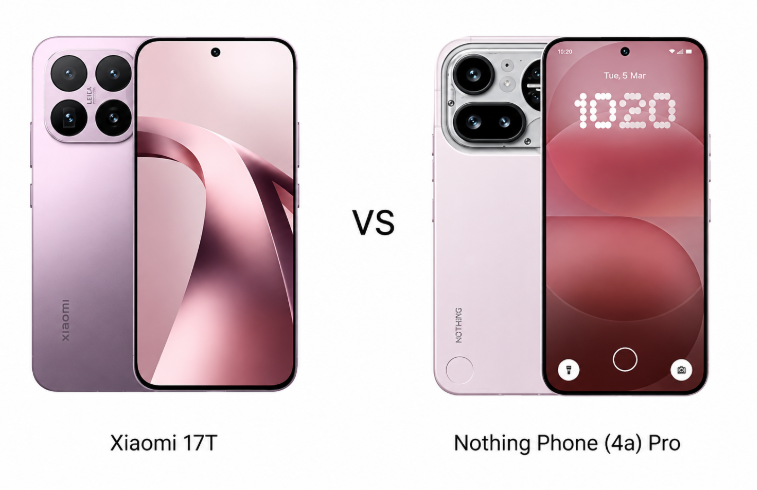
1. Design and Display
Build and Feel
The Xiaomi 17T and Nothing Phone (4a) Pro take very different approaches to design. Xiaomi focuses on a practical flagship-style build with Gorilla Glass 7i protection, IP68 water resistance, and a clean, premium appearance. The Nothing Phone (4a) Pro stands out with its aircraft-grade aluminum unibody construction and signature Glyph lighting system featuring 137 programmable LEDs. It feels more distinctive and futuristic, while Xiaomi aims for a more conventional premium look.
For users who value durability and peace of mind, the stronger IP68 rating on the Xiaomi 17T is a meaningful advantage. The Nothing device, however, offers more visual personality and instantly stands apart from most smartphones in its segment.
Display Quality
Both phones use AMOLED panels with HDR support, but the Xiaomi 17T delivers Dolby Vision support, excellent color tuning, and a sharp 1268p resolution. The Nothing Phone (4a) Pro counters with a larger 144Hz panel, higher peak brightness, and slimmer bezels for a more immersive viewing experience.
Verdict
The Nothing Phone (4a) Pro offers a more eye-catching design and larger display, while the Xiaomi 17T delivers better durability and a more balanced flagship-grade viewing experience. For most buyers, Xiaomi holds a slight edge due to its stronger protection and premium display tuning.
2. Specifications Including Battery
Performance
Performance is where the Xiaomi 17T creates significant separation. The MediaTek Dimensity 8500 Ultra is a much more powerful chipset than the Snapdragon 7 Gen 4 found in the Nothing Phone (4a) Pro. Combined with faster UFS 4.1 storage and 12GB RAM as standard, Xiaomi provides quicker app launches, smoother multitasking, and better long-term performance.
The Nothing Phone (4a) Pro remains capable for daily use, social media, streaming, and casual gaming, but it is clearly positioned as an upper-midrange device rather than a performance-focused flagship. Buyers planning to keep their phone for several years may appreciate the extra performance headroom offered by Xiaomi.
Battery and Charging
The Xiaomi 17T packs a massive 6500mAh battery globally, paired with 67W charging and reverse wired charging. The Nothing Phone (4a) Pro offers a 5400mAh battery in India and 50W charging. Both provide excellent endurance, but Xiaomi simply lasts longer between charges.
Verdict
The Xiaomi 17T wins comfortably. It delivers stronger processing power, faster storage, a larger battery, and quicker charging, making it the more future-proof choice.
3. Camera
Main and Secondary Lenses
Both smartphones feature a versatile triple-camera setup with wide, periscope telephoto, and ultrawide lenses. The Xiaomi 17T gains an advantage through its Leica-tuned imaging system, larger telephoto reach with 5x optical zoom, and higher-quality ultrawide sensor. The combination provides greater flexibility for portraits, landscapes, and long-distance photography.
Nothing’s 50MP main camera is highly capable and should produce pleasing results with strong dynamic range. However, its 3.5x telephoto lens and lower-resolution ultrawide camera are less ambitious. The camera experience feels optimized for consistency rather than maximum versatility.
Selfie Camera
Both devices feature 32MP selfie cameras, but Xiaomi extends its lead with 4K selfie video recording and HDR10+ support. The Nothing Phone (4a) Pro is limited to 1080p selfie video, which feels less competitive at this price point.
Verdict
The Xiaomi 17T offers a stronger overall camera package. Better zoom capability, Leica imaging enhancements, superior ultrawide hardware, and advanced selfie video recording make it a more complete photography-focused smartphone.
4. Pricing
The Xiaomi 17T is priced around ₹60,000 ($700), while the Nothing Phone (4a) Pro is priced around ₹40,000 ($500). This creates a substantial gap of roughly ₹20,000 between the two devices.
The Xiaomi 17T justifies its higher price through its flagship-grade chipset, larger battery, better water resistance, faster storage, superior telephoto camera, and enhanced multimedia capabilities. It is clearly targeting buyers who want premium hardware without stepping into ultra-premium flagship pricing.
The Nothing Phone (4a) Pro delivers excellent value for buyers seeking a distinctive design, smooth display, solid cameras, and a clean software experience at a lower price. The price-to-performance ratio is attractive, especially for users who do not require flagship-level power.
Verdict
The Nothing Phone (4a) Pro offers stronger value for money, while the Xiaomi 17T offers significantly better hardware. The better purchase depends on whether performance and camera upgrades justify the extra investment.
Disclaimer:
Prices are approximate and may vary based on country, region, launch timing, and applicable taxes. Always check whether the listed price is for a China unit or a global/international variant when purchasing.
5. Conclusion
The Xiaomi 17T stands out with its Leica camera system, Dimensity 8500 Ultra processor, IP68 certification, UFS 4.1 storage, and massive battery. It is built for users who prioritize flagship-level performance, long battery life, and versatile photography.
The Nothing Phone (4a) Pro differentiates itself through its unique Glyph lighting interface, aluminum unibody construction, larger 144Hz display, and significantly lower price. It delivers a refreshing alternative to traditional smartphone designs while maintaining a clean software experience.
The comparison ultimately comes down to priorities. Xiaomi focuses on delivering maximum hardware capability, while Nothing emphasizes character, design, and affordability. Both approaches are compelling, but they target slightly different audiences.
Verdict
The Xiaomi 17T is the better smartphone overall thanks to its stronger performance, larger battery, better cameras, and superior durability. However, the Nothing Phone (4a) Pro remains the smarter value-focused choice for buyers seeking a unique design and premium experience at a much lower price.
Disclaimer: This comparison is based on the specifications provided and is intended for general informational purposes. Actual performance, camera results, battery life, and overall experience may vary depending on real-world usage, software updates, and individual preferences.
Read More: