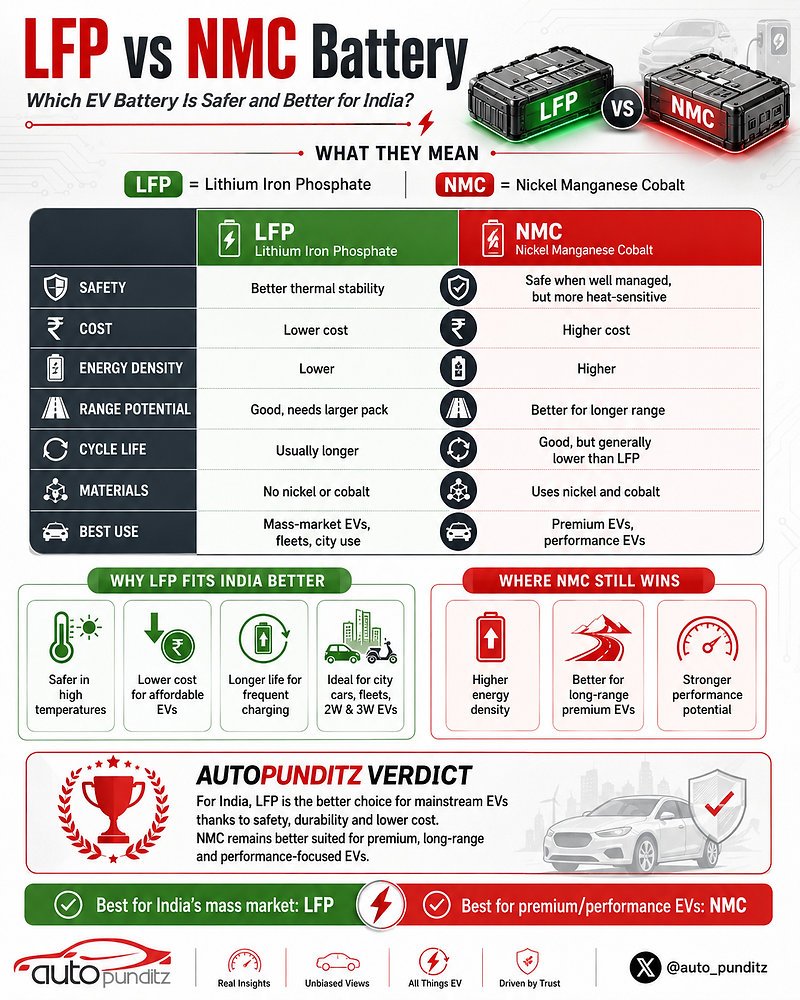
The Short Answer
For India, LFP batteries are the more practical and safer choice for mass-market EVs, especially city cars, fleet vehicles, two-wheelers, three-wheelers and affordable electric SUVs. They are more thermally stable, cheaper, longer-lasting and better suited to frequent charging in hot conditions.
However, NMC batteries still have a role in premium EVs, especially where long range, lighter battery packs, faster acceleration and high power output matter more than cost.
In simple terms: LFP is better for India’s mainstream EV market; NMC is better for performance and premium long-range EVs.
What Are LFP and NMC Batteries?
LFP stands for Lithium Iron Phosphate. It uses iron and phosphate in the cathode and avoids expensive metals such as nickel and cobalt.
NMC stands for Nickel Manganese Cobalt. It uses nickel, manganese and cobalt in the cathode. This chemistry generally offers higher energy density, which means more range can be packed into a smaller and lighter battery.
According to the IEA, LFP has now become a mainstream global EV chemistry. In 2025, LFP accounted for over 55% of EV batteries deployed globally, up from nearly 50% in 2024. Its adoption is especially strong in China and emerging markets.
Why LFP Makes More Sense for India
India is not a typical EV market. Our conditions are harsher than many developed markets: high summer temperatures, traffic congestion, inconsistent charging behaviour, price-sensitive buyers and long ownership cycles.
That is where LFP has a natural advantage. LFP batteries are widely recognised for better safety, durability and cost-effectiveness. IRENA notes that LFP batteries are praised for safety, durability and cost advantages, while also avoiding cobalt and nickel.
A 2024 comparative study published on ScienceDirect found that LFP batteries are safer, can offer life cycles beyond 2,000 cycles, and can be around 30% lower in cost than comparable battery technologies. The same study notes that NMC batteries can offer high energy density, reaching up to around 260 Wh/kg, making them suitable for high-power and performance-focused EVs.
LFP vs NMC: Quick Comparison
|
More heat-sensitive than LFP |
||
|
Good, but needs larger pack |
||
|
Good, but typically lower than LFP |
||
|
City EVs, mass-market cars, fleets, hot climates |
Premium EVs, performance EVs, long-range models |
|
|
Selective use in premium segments |
Safety: LFP Has the Edge
Battery fires are rare, but safety perception is critical for EV adoption in India. LFP batteries are generally considered safer because their chemistry is more thermally stable. They are less prone to oxygen release during overheating, which reduces the risk of thermal runaway compared to nickel-rich chemistries.
This does not mean NMC batteries are unsafe. A well-engineered NMC pack with proper cooling, battery management software, cell spacing and crash protection can be very safe. But chemistry-wise, LFP gives manufacturers a more forgiving base to work with.
For Indian buyers who park vehicles in open sunlight, charge frequently, and use EVs in stop-go traffic, this extra safety margin matters.
Cost: LFP Is Better for Affordable EVs
Battery cost remains the single biggest factor in EV pricing. LFP batteries avoid nickel and cobalt, two materials that have historically been expensive and volatile in pricing. This makes LFP attractive for affordable EVs.
That is why LFP is becoming popular globally in entry and mid-level EVs. The IEA says LFP batteries can reduce EV production costs, though the supply chain remains heavily concentrated in China.
For India, where price points below ₹15 lakh are crucial for mass EV adoption, LFP allows carmakers to offer better value, longer warranty confidence and more aggressive pricing.
Range and Performance: NMC Still Has an Advantage
NMC batteries are not outdated. Their biggest advantage is higher energy density. This means an NMC battery pack can store more energy for the same weight or volume compared to LFP.
That matters in premium EVs where buyers expect: longer highway range,faster acceleration,higher sustained performance,lighter battery packs,and better packaging efficiency.
This is why many global premium EVs and performance EVs have historically used NMC or similar nickel-rich chemistries. However, the gap is narrowing. IRENA notes that innovation in LFP is reducing the energy-density gap with NMC, and LMFP — lithium manganese iron phosphate — can sit between LFP and nickel-rich chemistries in energy density.
CATL has already shown how far LFP can go. In 2024, it unveiled the Shenxing Plus LFP battery with a claimed driving range of over 1,000 km on a single charge, showing that LFP is no longer limited to short-range EVs.
India Market Context: LFP Is Already Winning the Practicality Battle
India’s EV market is still at an early growth stage. Buyers are more concerned about battery life, safety, warranty, resale value and charging convenience than outright performance.
Tata’s Punch EV, for example, uses LFP prismatic cells in its larger battery pack, with Tata highlighting a 40 kWh LFP battery and certified range figures for the model. It is reported that Tata is using the Punch EV to push mass-market EV adoption, targeting affordability, range anxiety and charging concerns in India’s price-sensitive car market.
Mahindra has also focused on LFP for its born-electric battery packs, with reports highlighting LFP’s resilience and thermal advantages over NMC.
This points to a clear trend: for Indian mainstream EVs, LFP is becoming the default chemistry of choice.
Which Battery Is Better for Indian Conditions?
For India, the answer depends on the vehicle segment.
For electric two-wheelers, three-wheelers, city cars, fleet EVs and affordable SUVs, LFP is the better fit. These vehicles need durability, safety, lower cost and frequent charging tolerance more than extreme performance.
For premium EVs, luxury crossovers and performance cars, NMC still makes sense. These vehicles need higher energy density and stronger performance, and buyers are more willing to pay for it.
So the right answer is not “LFP is always better” or “NMC is always better”. The better answer is: LFP is better for India’s mass market; NMC is better for high-end use cases.
Auto Punditz Verdict
India’s EV growth will not be driven only by headline range figures. It will be driven by battery confidence. Buyers want EVs that are safe in summer, affordable to buy, durable over years, and dependable in daily charging cycles. On those parameters, LFP is the stronger battery chemistry for India.
NMC will continue to serve the premium and performance end of the market, but the mass adoption story in India is likely to be built around LFP, and eventually LMFP or sodium-ion for specific lower-cost use cases.


