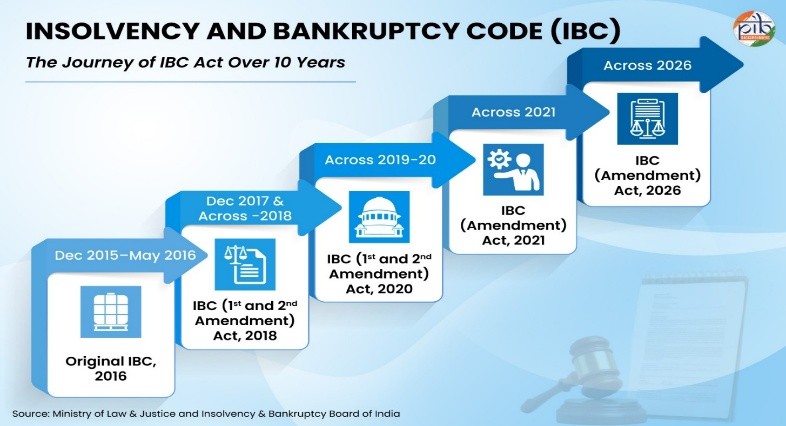
Context: The Insolvency and Bankruptcy Code (IBC), enacted in 2016, has completed a decade of operation, establishing itself as a transformative institutional shift for India’s credit markets and corporate accountability.
About The Insolvency and Bankruptcy Code (IBC) completes 10 years:
What It Is?
- The Insolvency and Bankruptcy Code (IBC) is a single, consolidated legislative framework enacted in 2016 to replace India’s older, fragmented, and slow insolvency laws.
- It provides a legally binding, creditor-driven, and time-bound mechanism to resolve insolvency and financial distress for corporate entities, partnership firms, and individuals.
Key Features of the IBC:
- Integrated Legal Consolidation: Unifies multiple legacy insolvency laws into a single code to streamline processes for corporations, partnerships, and individuals.
- Time-Bound Resolution Window: Mandates a strict timeline for completing the Corporate Insolvency Resolution Process (CIRP) to ensure asset values do not erode.
- Creditor-in-Control Model: Shifts operational control of a defaulting company away from the existing promoters to a creditor-led Committee of Creditors (CoC), fundamentally altering debtor-creditor dynamics.
- Two-Tiered Adjudication Infrastructure: Utilizes the National Company Law Tribunal (NCLT) to handle corporate insolvencies, while the Debt Recovery Tribunal (DRT) manages individuals and partnership firms.
- Institutional Support Ecosystem: Governed by the Insolvency and Bankruptcy Board of India (IBBI), utilizing licensed Insolvency Professionals (IPs) to run distressed assets alongside Information Utilities (IUs) that store verified financial data.
- Clear Priority of Payouts (Waterfall Mechanism): Establishes a transparent, structured ladder for distributing liquidation assets, ensuring secured creditors and workmen receive clear priority over equity shareholders.
Current Success Metrics of the IBC:
- Substantial Realization of Locked Capital: The framework has successfully unlocked significant stuck capital, returning frozen funds back into the formal financial system.
Example: As of March 2026, 1,419 cases yielded final resolution plans, realizing over ₹4 lakh crore for creditors—representing 95% of their fair value and 167% of liquidation value.
- Significant Reductions in Banking Non-Performing Assets (NPAs): The code’s strict rules have helped clean up bank balance sheets, driving non-performing loans down to healthier historical levels.
Example: The banking sector’s gross NPA ratio dropped to a low of 2.1% in September 2025, a massive shift from the peak of nearly 11.8% logged in 2017.
- Powerful Pre-Admission Settlement Deterrent: The threat of losing control over an enterprise forces defaulting debtors to settle their debts before formal court proceedings begin.
Example: More than 30,000 cases were resolved at the pre-admission stage through withdrawals, settling an estimated ₹14 lakh crore outside court.
- Post-Resolution Corporate Revival and Value Creation: Restructured companies show significant operational turnaround and value growth under new management.
Example: Resolved firms saw an 89% jump in sales and a 131% rise in asset turnover, expanding the market value of listed resolved firms from ₹2.8 lakh crore to ₹9 lakh crore.
Key Challenges Facing the IBC Ecosystem:
- Persistent Delays and Blocked Timelines: Despite a statutory emphasis on speed, heavy case volumes often clog up tribunal benches, extending resolutions past original targets.
Example: While pre-IBC delays spanned up to 8 years, current resolution timelines still average around 2 years, highlighting ongoing structural friction within NCLT benches.
- Erosion of Value in Forced Liquidations: When a business cannot be rescued, delays can cause its physical assets to degrade, hurting final recovery values.
Example: Out of 7,102 closed cases by March 2026, 3,003 entities ended in liquidation, highlighting cases where delays left assets to be sold piecemeal.
- Varying Recovery Outcomes Across Industry Segments: While the average post-IBC recovery rate has risen to over 30%, asset recovery success remains uneven.
Example: Even with overall improvements, the recovery rate for scheduled commercial banks fluctuated to 36.6% in 2024–25, down from higher initial resolution peaks.
Example: Around 42% of cases that reached resolution plans were previously stuck with the legacy BIFR or were already defunct, slowing down the courts.
Way Forward:
- Expanding NCLT Bench Infrastructure: Increase the number of specialized NCLT benches and fill judicial vacancies promptly to eliminate backlogs and meet the code’s strict timelines.
- Promoting Pre-Packaged Insolvency Frameworks: Expand out-of-court pre-packaged insolvency options to all corporate categories, encouraging faster, consensual settlements that ease the burden on tribunals.
- Upgrading Digital Tracking via Information Utilities: Enhance data integration across Information Utilities to give lenders instant access to verified default data, cutting down verification times.
- Standardizing Inter-Regulatory Mediation Systems: Create a smooth coordination bridge between the IBBI, the Reserve Bank of India, and the enforcement directorates to resolve competing asset claims cleanly.
- Specializing Training for Insolvency Professionals: Provide advanced industry-specific management training to Insolvency Professionals, enabling them to better preserve complex enterprise value during restructuring.
Conclusion:
Over the past ten years, the Insolvency and Bankruptcy Code has completely reshaped corporate accountability and credit discipline across the Indian economy. By moving past slow legacy legal systems, it has successfully recovered over ₹4 lakh crore for creditors while breathing new life into financially distressed businesses. As India advances toward its long-term goals for economic growth, continuously refining the IBC through smart updates will be essential to sustain entrepreneurship, preserve productive capital, and anchor financial stability.


