On 22 April 2026, in an office not far from Connaught Place, Indian Potash Limited (IPL) closed the largest urea tender India has ever floated. The price was startling: nearly double what India had paid two months earlier, and roughly ₹3,600 for a 45-kg bag by the time it reached an Indian port.
Two weeks later, a companion tender for diammonium phosphate (DAP) — the workhorse phosphate fertiliser — settled at the highest landed price India has ever paid. Both purchases were finalised while the Strait of Hormuz, which carries roughly half of India’s urea and the bulk of its ammonia and sulphur, sat effectively shut behind Iranian patrol boats and US Navy interdictions.
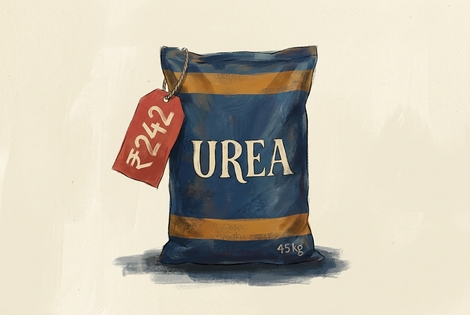
The next morning, in a fertiliser shop in a Vidarbha taluka, a 45-kg bag of that same urea was sold for ₹242. The same price as the morning before. The same price as the morning of 1 April 2018, when the government-mandated maximum retail price (MRP) was last revised.
Through the Russia-Ukraine spike of 2022, the Houthi attacks of 2024, the Gaza ceasefire of January 2025, and now Operation Epic Fury and the closure of the Gulf — the printed number on the bag has not moved.
India pays roughly ₹3,600 for a bag of urea at the port. The farmer pays ₹242 for the same bag at the shop. The ₹3,358 gap, multiplied across roughly 35 million tonnes of annual consumption, is the operating principle of Indian fertiliser policy in 2026.
It is also, increasingly, the principal load-bearing wall of Indian food security.
This essay is about that wall: what it is made of, what it costs, and what would crack it.
India pays roughly ₹3,600 to land a 45-kg bag of urea at port; the farmer pays ₹242 at the shop — the gap, absorbed by the central exchequer, is the operating principle of Indian fertiliser policy in 2026.
The promise
The Modi government’s defining choice through both the 2022 Ukraine shock and the 2026 Hormuz closure has been the same: absorb the price spike on the central exchequer, pass nothing to the farmer.
India has roughly 14 crore landholdings, and fertiliser is the second-largest cash outlay after seed. A 20 per cent rise in the bag price during a Kharif sowing window is the kind of variable that loses governments — and the Modi government, which fought the three farm laws into legislative retreat in late 2021, has been particularly clear-eyed about that.
Ministers have been explicit. Agriculture Minister Shivraj Singh Chouhan in Bhopal on 10 April 2026, two weeks after the strait closed, said: “A bag of urea will continue to be available at ₹266, and DAP at ₹1,350. The government is bearing the entire additional burden so that farmers are not affected.” (The ₹266 includes GST; the ex-MRP remains ₹242.)
Finance Minister Nirmala Sitharaman in Mumbai on 26 April: “Didn’t we do that during Covid? Farmers paid the same price as before. We never shifted the burden to them.”
While the promise has held, it has come with costs.
The retail prices farmers see have been effectively frozen for years: urea since 2018, DAP since 2024 (held there by a “one-time special package” the Cabinet has quietly extended “till further orders”), and muriate of potash — the standard potassium fertiliser — at a level that bears no relation to its imported cost.
The gaps are bridged by the Nutrient Based Subsidy (NBS) — a per-nutrient payment to manufacturers and importers that has been revised six times since FY23 in lockstep with global prices, most recently three days before IPL’s April DAP tender, when the Cabinet raised the Kharif 2026 phosphate subsidy to the highest level in its history. Each revision is the state moving its own goalposts to keep the farmer’s where they were.
The mathematics of absorption
The arithmetic of pass-through is unforgiving. Every $100 per tonne rise in the landed cost of urea, absorbed wholesale across the 35 million tonnes India consumes each year, adds roughly ₹29,000 crore to the subsidy bill.
The IPL urea tender of 22 April alone — booked at more than $400 a tonne above the February price — added roughly ₹9,000 crore to FY27 in a single purchase.
The DAP tender of 7 May added another few thousand crore on top. Two procurement decisions in two weeks committed the equivalent of a small Union ministry’s annual budget.

The arithmetic of pass-through: every $100 per tonne rise in landed urea cost, absorbed wholesale across 35 million tonnes of annual consumption, adds roughly ₹29,000 crore to India’s fertiliser subsidy bill.
The seven-year ledger tells the story plainly. In the year before the pandemic, the total fertiliser subsidy bill was roughly ₹81,000 crore. It crept up through the pandemic years and then exploded to ₹2.54 lakh crore in FY23 — the year the Russia–Ukraine war put global urea above $1,000 a tonne. It eased to around ₹1.9 lakh crore in FY24 and FY25 as prices normalised, and is currently tracking at a similar level for FY26 — before the full impact of the Hormuz closure shows up in the books.
Two features of that arc matter.
The first is the FY23 peak: ₹2.54 lakh crore — roughly 6.5 per cent of the Union budget that year, and more than the Centre spent on health and education combined. It was the price of holding the line through 2022. The Modi government paid it without flinching, and without revising urea MRP.

India’s fertiliser subsidy outgo from FY20 to FY27 — two shock years (the FY23 Russia–Ukraine peak and the projected FY27 Hormuz-driven overshoot) bracket a system that has never quite returned to its pre-pandemic baseline.
The second is FY27’s budget number: ₹1.71 lakh crore. That was prepared in the autumn of 2025, before Operation Epic Fury, before $935-a-tonne urea. Crisil’s Pushan Sharma, in late April said: “Natural gas shortages — exacerbated by the Strait of Hormuz closure — have curtailed domestic urea production by 25% in March 2026. Import prices have nearly doubled… This unavoidable fiscal strain — absorbing costs to shield farmers — will widen the deficit or force expenditure reallocations.”
A 20–25 per cent overshoot would put the bill of FY27 above ₹2 lakh crore. The World Bank’s April 2026 Commodity Markets Outlook is just as blunt; its chief economist, Indermit Gill, summarised the year’s commodity story in one line: “War is development in reverse.”
What the bill buys
The subsidy is not a single transfer but a stack of instruments, each tuned to a different vulnerability.
The largest line is urea subsidy, paid directly to manufacturers and importers on a unit-cost-plus basis. Domestic producers are reimbursed the gap between their concession price and the regulated MRP; importers, the gap between landed cost and MRP through a pool-pricing mechanism. This single line accounts for most of the total subsidy envelope.
The second is NBS for phosphates and potash — a fixed per-nutrient subsidy on 25 specified products, decontrolled in principle but capped in practice by departmental jawboning and the special DAP package.
The third is the special DAP package itself: an extra payment over and above NBS, introduced in July 2024 and made open-ended in January 2025. Without it, the rating agency ICRA estimates DAP importers would be losing money on every tonne they sell. With it, they break even — barely.
The fourth instrument is the freight subsidy, which equalises rail rates and primary movement costs so a bag in Dibrugarh costs the same as a bag in Dhar. While the amount is small in absolute terms, it is disproportionately important to the equity of distribution.
The fifth is the buffer stock and Special Banking Arrangement: a strategic reserve of urea and DAP held against shortfalls, plus an off-budget facility through public-sector banks that finances subsidy arrears at concessional rates so producers do not face working-capital crises when payouts lag. Both let the system absorb the March 2026 production shock without bare shelves in April.
The sum, for FY26: roughly ₹1.86–1.92 lakh crore. That is what it has cost so far to hold the ₹242 bag.
The longer arc
The instinct on reading this ledger is to ask whether the policy is sustainable. The answer depends on the horizon.
In the short run — FY26 and FY27 — yes. India runs a Union budget many times the size of the fertiliser subsidy bill. A fertiliser overshoot of a few tens of thousands of crore is real money, but comparable to a single quarter’s variance in GST collections, which the Centre routinely accommodates through supplementary demands.
FY23’s ₹2.54 lakh crore bill was absorbed without macro disruption, in part because corporate tax buoyancy that year ran ahead of estimate. While FY27 may be less fortunate, the headroom exists. The cushion will hold.
In the medium run — FY28 to FY30 — the question becomes one of composition. India’s domestic urea capacity is set to rise meaningfully once the long-delayed Talcher plant in Odisha commissions in late 2027. At that point, urea imports fall sharply, and what remains will come increasingly from captive sources: the existing Oman plant that the cooperatives IFFCO and KRIBHCO have run for two decades, and a new Russian joint venture being built at Togliatti on the same model.
The urea subsidy bill could fall by a fifth or more, simply because more of the supply will be at regulated domestic cost rather than imported spot.
The story for phosphates and potash is harder. India will keep importing the majority of its DAP, almost all its phosphoric acid, all of its potash. While the major phosphate suppliers in Saudi Arabia, Morocco and Jordan have been locked in through long-term contracts, the prices in those contracts still track global benchmarks. The phosphate and potash subsidy will rise or fall with the world market, not Indian policy.
Three structural pivots sit beyond that horizon. The first, and most ambitious, is green ammonia — ammonia made from renewable electricity rather than imported natural gas. A government tender of early 2025 has already begun procuring it for over a dozen fertiliser plants on long-term contracts, and a first commercial-scale plant on the east coast is due to start up in late 2026. A larger consortium of Indian conglomerates is building toward an order of magnitude more capacity by 2030.
If even half this pipeline delivers, India could displace most of its imported merchant ammonia — and a few billion dollars of foreign exchange — within a decade.
The second pivot is the Atlantic Africa axis. Where India has historically sourced rock phosphate and phosphoric acid from suppliers in Jordan and Saudi Arabia — all of whom ship through the Red Sea or the Persian Gulf — Indian firms have over the past five years been quietly building captive supply through West Africa.
New mines and processing capacity in Senegal, expanded contracts in Togo and Mauritania, and a major new acid complex on India’s east coast that processes African ore — together these are an attempt to route around the Aqaba-Hormuz corridor altogether.
The third pivot, and quietly the largest, is the Russia wedge. Russian fertiliser imports have grown roughly fourfold since 2021, and Russia is now the single largest source of imported nitrogenous fertiliser into India.
The new urea joint venture at Togliatti — modelled on the long-running Oman plant — will mean that India’s two largest single-source urea complexes sit on opposite sides of Eurasia, neither of them dependent on the Suez or Hormuz routes.
All three pivots aim at the same fiscal goal: shift the subsidy bill’s risk profile from event-driven spikes to slow drift. A future 2026-style Hormuz shock would add perhaps ₹15,000 crore to the bill, not ₹30,000–40,000 crore. The promise to the farmer would cost less to keep.

India’s three structural pivots beyond 2026 — a Russia wedge already underway, an Atlantic Africa axis being built out, and a green ammonia pipeline still in its first years.
What would crack the wall
The honest case for concern is not that the bill is unaffordable. It is that the promise itself is brittle in ways not yet stress-tested.
The first vulnerability is fiscal-political. A bad year — monsoon failure, a fresh chokepoint shock layered on Hormuz still being shut, a global gas spike — could push the bill toward FY23 levels again.
While that has been absorbed before, it has not been absorbed in a year where defence spending is also surging, where revenue receipts are softer than budget, and where the fiscal deficit glide path is politically committed.
The state can do one large shock-absorption per cycle. Two simultaneously — a fertiliser shock and a defence supplementary in the same year — would force the kind of reallocation that Crisil’s Sharma alluded to.

Why a single 21-mile-wide strait matters so much: roughly half of India’s urea imports and four-fifths of its ammonia and sulphur transit the Strait of Hormuz.
The second is producer-side. The DAP importer community has been on the special package for fourteen months. Working capital is stressed, and there have been documented cases through 2025 of importers walking away from tenders rather than book at NBS rates.
While the April-May 2026 tenders cleared, each did so at near-record costs and with thinner participation than in 2022-23. The system relies on private movement — IPL, KRIBHCO, IFFCO, Coromandel, Chambal — to actually deliver tonnes. If any one of them takes a balance-sheet hit large enough to make them pull back, the others cannot fill the gap quickly.
The third is the MRP itself. The ₹242 bag has held eight years and two global price cycles. The longer it holds, the more politically encoded it becomes. There is no live constituency for raising the price, even by inflation-indexed amounts. This means the absorption ratchet only goes one way: every year the gap widens, every year the bill is higher than it would have been under partial pass-through.
The Commission for Agricultural Costs and Prices and NITI Aayog have both argued for an inflation-indexed MRP — which would cut tens of thousands of crore from the subsidy bill annually without materially affecting farmer economics. The proposal has been on the table since 2024. It has not moved.
Where this leaves the bag
India will get through Kharif 2026. The data say so. Buffer stocks are pre-positioned at well above the normal seasonal share. Tendered imports of urea and DAP since the strait closed have been large enough to replace what the disruption took out. Domestic urea production, after a sharp dip in March when gas allocation was cut, recovered strongly in April as GAIL, the state gas utility, routed additional spot gas to fertiliser plants. Through all of this, the subsidy framework has been revised, the retail price has not, and the bag continues to sell at ₹242.
What is also clear is that the cost of that achievement — in FY27 subsidy outgo — will be the highest peacetime number in the history of the instrument. ₹2 lakh crore, possibly higher. That is what the wall holding costs.
The wall is, for now, intact. The question is not whether it holds through 2026 — it will — but whether the politics that built it can imagine, before the next chokepoint shock, the architecture of a wall that costs less to maintain.
The MRP can stay at ₹242 forever, in principle. The exchequer can absorb $1,000-a-tonne urea, in principle. But the cumulative cost of both — held indefinitely, through chokepoint after chokepoint — is the kind of slow commitment that quietly forecloses other things: a higher health budget, faster capex, a defence procurement cycle that does not require supplementaries.
The bag is a number on a piece of paper. The number has not moved since 2018. What has moved, and will continue to move, is what India pays — out of view, out of the farmer’s purchase price, but very much on the books — for the privilege of keeping that paper printed the same.


