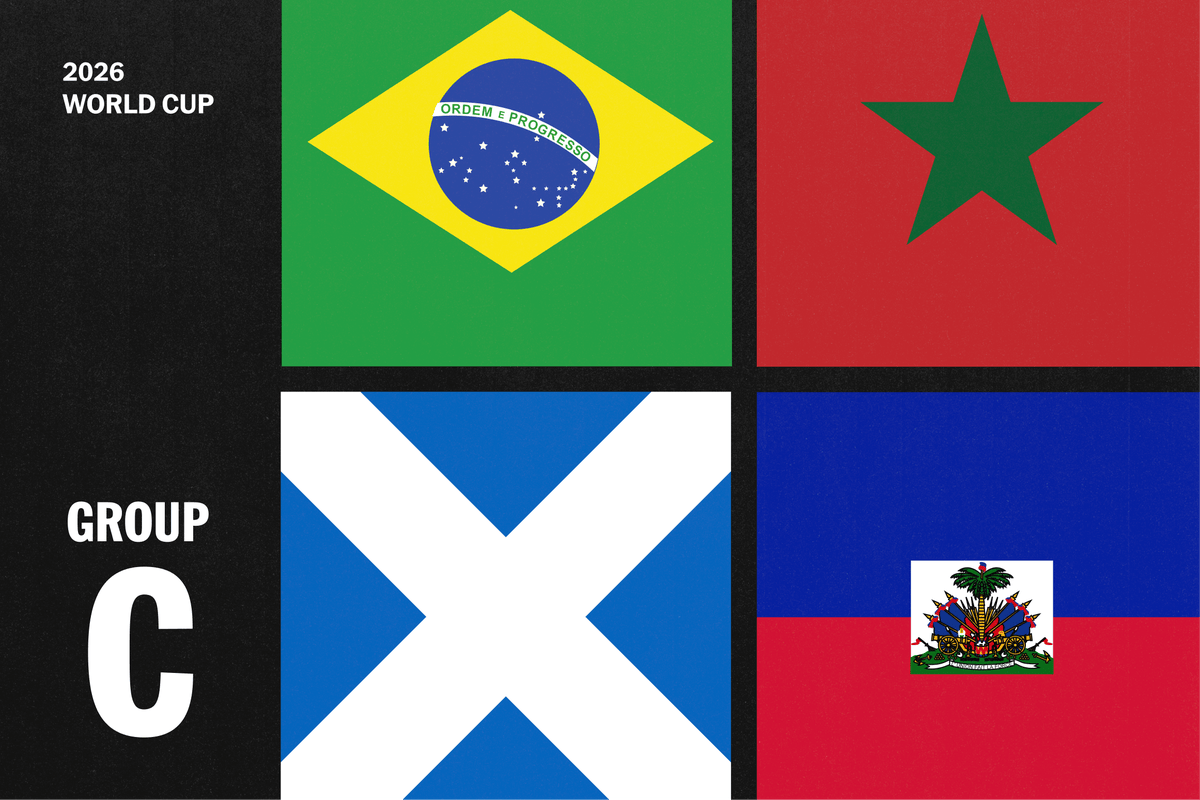
The World Cup draw is complete and Brazil, Morocco, Haiti and Scotland have been drawn together in Group C.
How did the teams qualify? How do the different countries play? And who are the key protagonists in the group?
Games in: Atlanta, Boston, East Rutherford, N.J., Miami, Philadelphia
The schedule: Games, venues, dates and kick-off times
Matchday 1
- Saturday, June 13: Brazil vs Morocco (6pm ET, 3pm PT, 10pm BST) — MetLife Stadium, New York City
- Saturday, June 13: Haiti vs Scotland (9pm ET, 6pm PT, 2am BST) — Gillette Stadium, Boston
Matchday 2
- Friday, June 19: Scotland vs Morocco (6pm ET, 3pm PT, 10pm BST) — Gillette Stadium, Boston
- Friday, June 19: Brazil vs Haiti (9pm ET, 6pm PT, 2am BST) — Lincoln Financial Field, Philadelphia
Matchday 3
- Wednesday, June 24: Scotland vs Brazil (6pm ET, 3pm PT, 10pm BST) – Hard Rock Stadium, Miami
- Wednesday, June 24: Morocco vs Haiti (3pm ET, 12pm PT, 8pm BST) – Mercedes-Benz Stadium, Atlanta
Brazil
(Marc Atkins/Getty Images)
How did they qualify?
Put it this way: Brazil are happier than most that FIFA expanded the World Cup from 32 teams to 48 for 2026. That raised the number of automatic qualification spots in South America to six and saved Brazilian blushes in the process: they finished fifth in the 10-team group and would be heading for an intercontinental play-off under the old system. With only eight wins from the 18 games, it is fair to say that they limped through.
What is their World Cup pedigree?
Brazil helped make the World Cup what it is today, imbuing the tournament with light, style and, yes, a sizeable dose of mystique during the middle part of the 20th century. They hosted the 1950 edition, won it in 1958 and 1962, then turned up in 1970 with a team that did not so much conquer the world as charm it into wilful submission. Two further successes — in 1994 and 2002 — put Brazil out in front in the list of multiple World Cup winners.
They are still there, but the past two decades have been tough. The flameout (a 7-1 semi-final loss to Germany) at their own party in 2014 was the nadir, but they were also knocked out at the quarter-final stage in 2006, 2010, 2018 and 2022. That might be acceptable for some countries, but not Brazil. Those failures have dented confidence levels and given rise to a kind of perma-inquest that shows little sign of wrapping up any time soon.
Who is the coach?
After Tite walked away at the end of the 2022 World Cup, the suits at the Brazilian federation set their sights high. They wanted a proven winner. They wanted Carlo Ancelotti, whose ability to navigate choppy waters — and manage big egos — had been so successful at Real Madrid. Ancelotti is now in the job and will lead their challenge next June and July. High-fives all round, right?
Not quite. Ancelotti only actually arrived in May this year after three years of flirting and faffing. In the interim, Brazil had three different coaches, all with wildly different approaches. Continuity? Never heard of it, sorry. Ancelotti has been dropped into a chaotic situation. He will need every last drop of his nous and geniality in the months ahead.

How do they play?
Good question. Ancelotti has only been in charge for eight games. We can gesture at a direction of travel but it is still too early to draw concrete conclusions about how Brazil will play at a World Cup which is six months away.
There have been a couple of notable changes from how they set up under Ancelotti’s predecessor, Dorival Junior. Casemiro has come back into the picture, lending the midfield more experience and defensive solidity. Up front, Vinicius Junior has been tested out in a more central position.
The shape looks likely to be a fluid 4-2-3-1 against weaker teams. That makes sense, given the abundance of attackers available. The question is whether — and how — Ancelotti will reinforce his midfield against the better sides.
Who is their key player?
Vinicius Jr. One of the major failings of the Dorival Jr era was his inability to get the best out of the Real Madrid forward. In fairness, it is a long-standing issue: Vinicius Jr has never produced on a consistent basis for Brazil. Even when he was in unstoppable form at club level, he would only flicker for his country.
Nobody seems quite sure why that is. What does seem clear is that Ancelotti has a better chance than most of solving the riddle. He knows Vinicius Jr well from their time together in Madrid and understands what makes him tick. If he can get the 25-year-old to something approaching his best and have him running at defenders in dangerous areas rather than just waiting for the ball on the wing, it will breathe life into the Brazil attack.
What else should we know about them?
A return to the United States, where they won the 1994 World Cup, will bring up plenty of memories, not all of them happy.
Brazil’s triumph at that tournament was, in part, a reaction to tragedy. Two months before their opening game, the team played a friendly against Paris Saint-Germain in France. Their honorary guest that night was Formula One driver Ayrton Senna, one of Brazil’s most beloved sons. Senna joined the players for dinner after the match, motivating them for the challenge that awaited them in America. “He made us all believe,” goalkeeper Claudio Taffarel later said.
Eleven days after that meal, Senna died in a crash at the San Marino Grand Prix.
The news plunged the whole of Brazil into mourning. It fell to the country’s footballers to provide distraction and respite. When they overcame Italy on penalties in the final at the Rose Bowl in Pasadena, they raised a banner in Senna’s honour.
Jack Lang
Morocco

(MB Media via Getty Images)
How did they qualify?
Morocco did not break a sweat in their 2026 World Cup qualification group. They won all eight of their games, thrashing Congo and Niger 6-0 and 5-0 respectively, scoring 22 goals and only conceding two*. A team on a 15-match winning streak, Morocco haven’t lost since a 2-0 round-of-16 exit against South Africa in the Africa Cup of Nations in January 2024.
What is their World Cup pedigree?
In 1986, Morocco became the first African country to reach the knockout rounds of a World Cup, winning a group that contained England, Poland and Portugal. After failing to qualify for five of the next eight tournaments and making three group-stage exits when they did get there, Morocco made more World Cup history in 2022. They topped a group containing Croatia, Belgium (who had finished second and third at Russia 2018) and Canada, then eliminated Spain and Portugal in the following rounds. The fairytale ended in the semi-finals against France, but Morocco were still the first African side to go that far at a World Cup.
Who is the coach?
The mastermind behind Morocco’s 2022 World Cup was Walid Regragui, who took over from Vahid Halilhodzic only three months before that tournament and has been the national team’s coach ever since.
Reaching the semi-finals in Qatar etched his name in the history books. Regragui has been able to galvanise Moroccan talent to form a genuine team rather than a number of individuals. He is able to communicate his messages clearly and is tactically adept, as he proved during that World Cup.
When he was still a player, Regragui dreamed of being a coach. Two Moroccan league titles, one in the African Champions League and a fourth-placed finish at the World Cup are evidence the now 50-year-old chose the right career path.

How do they play?
Morocco’s performance at Qatar 2022 was of a team organised without the ball and able to limit the opposition’s strengths.
However, Regragui’s side are more than capable of playing attacking football. Starting in their regular 4-3-3, Morocco mainly focus on attacking in wide areas, with full-backs Achraf Hakimi and Youssef Belammari pushing forward to support the wingers. Morocco’s plethora of talent in midfield and on the flanks provides Regragui with multiple options in those positions. The centre-forward role is contested by Youssef En-Nesyri and Ayoub El Kaabi, who are both a threat inside the penalty area.
Morocco can build from the back and attack the wide areas, or go long if needed. Similarly, they are comfortable pressing high up the pitch or defending in a deeper block.
Who is their key player?
It is hard to point out a single individual in a team that boasts Yassine Bounou (Al Hilal), Hakimi (Paris Saint-Germain), Noussair Mazraoui (Manchester United), Eliesse Ben Seghir (Bayer Leverkusen), Brahim Diaz (Real Madrid) and more.
Yet, Diaz’s switch of allegiance from Spain, where he was born, to his father’s homeland is certainly a coup considering the midfielder’s talent. Starting from a wide position or playing as an attacking midfielder, his dribbling stands out, as well as his ability to use both feet, which aids his passing and shooting.
Since making his debut in a 1-0 win against Angola in March last year, Diaz has eight goals and two assists in 14 matches.
What else should we know about them?
In African football, unpredictability is the constant theme, as shown by Morocco’s previous coach, Halilhodzic, being sacked three months before that 2022 World Cup.
Having an Africa Cup of Nations in between this World Cup draw and the tournament starting in June is a minefield in disguise — narratives can change, coaches can be sacked and players can get injured or simply fall out of favour depending on their performance in the continental competition.
The pressure is going to be on Morocco when AFCON kicks off just before Christmas, with them being the host nation. However, they have not performed well at the tournament in recent years, reaching its semi-finals only once since 1990 and making last-16 exits in two of the past three.
Ahmed Walid
Haiti

(Ben Nichols/Getty Images)
How did they qualify?
One of the surprises of Concacaf qualifying, Haiti finished top of Group C in its third and final round, ahead of traditional Central American powers Costa Rica, which has been at five of the past six World Cups, and Honduras, qualifiers in 2010 and 2014.
They beat Costa Rica 1-0 and then Nicaragua 2-0 in its final two group games to secure a spot in the 2026 tournament.
What is their World Cup pedigree?
This will be Haiti’s first visit to the men’s World Cup since 1974 and just their second ever. By qualifying, they became the first Caribbean nation to reach multiple World Cups. In that 16-team tournament in West Germany more than 50 years ago, Haiti was drawn with Poland, Argentina and Italy in the first group stage. They lost all three games, including a 7-0 defeat by the Poles, but at least scored twice through forward Emmanuel Sanon.
Who is the coach?
Sebastien Migne, a 52-year-old Frenchman, began his coaching career in Africa, and has spent much of it working in international football. A former midfielder who had a spell at London-based EFL side Leyton Orient in the 1990s, he was in charge of Congo, Kenya, Equatorial Guinea and South African club Marumo Gallants and was an assistant with Cameroon before taking the Haiti job in June 2024.

How do they play?
Against stronger teams, Haiti is happy to sit back in its own half in a defensive posture and make things difficult. They have players capable of breaking out in transition play to punish opponents. Haiti’s organized defensive structure gave the United States trouble in the group stage of this past summer’s Concacaf Gold Cup, where despite holding 66 percent possession, it took a 75th-minute goal from Patrick Agyemang to make the difference in a 2-1 win. Haiti has a goal threat as well. Duckens Nazon came off the bench to score a hat-trick past Costa Rica’s longtime Real Madrid and Paris Saint-Germain starting goalkeeper Keylor Navas in a September qualifier to earn a crucial away point.
Who is their key player?
Long-time Haiti goalkeeper Johny Placide has proved himself more than capable of keeping his country in games against bigger teams. The 37-year-old, who plays professionally in France for second-tier club Bastia, made a name for himself at the 2019 Concacaf Gold Cup, where Haiti allowed just two goals en route to topping their group with three wins out of three, then beat Canada in the quarterfinals before losing 1-0 to Mexico in a semifinal that went to extra time. Placide made four saves in that game before Raul Jimenez’s penalty beat him. More recently, he turned in shutouts in three of Haiti’s final four qualifiers.
What else should we know about them?
Migné has managed to get Haiti back to the World Cup despite never having set foot in the country. Their home, the Stade Sylvio Cator in the capital Port-au-Prince, was overtaken by gangs in February and March 2024. The Haitian federation released a statement saying the stadium was “occupied by armed gangs”, and the national team has not played there since. The country has been enveloped by violence and Migné’s men played their home matches during qualifying in Curacao, the tiny island nation that will join them at this World Cup.
Paul Tenorio
Scotland

(Robbie Jay Barratt/Getty Images)
How did they qualify?
Predictably, in the most dramatic fashion possible. A first-half disaster-class away in Greece meant they looked destined for the play-off spot but Denmark fluffed their lines, drawing at home against Belarus. It resulted in an epic decider in Glasgow. An overhead kick and two stoppage-time wonder strikes — one a 25-yard curler, the other from just inside their own half — meant Scotland emerged with a 4-2 victory to top the group.
What is their World Cup pedigree?
This century? None at all. The last time Scotland featured was in 1998, when they almost snatched a draw in the opening game against Brazil but ultimately fell short.
Scotland have made eight World Cups but have never progressed from the group stage and never won more than a single game. It was under Ally MacLeod in 1978 that hopes were at their highest and they did beat eventual finalists the Netherlands 3-2, but it proved futile and they went out in the group stage. Four years later they were eliminated at the same stage.
Reaching the knockout rounds has to be the aim this time, given their poor showings at the last two European Championships — two points from six games, scoring only three goals.
Who is the coach?
Steve Clarke, who has a strong claim to be the best manager in the nation’s history. Celtic great Jock Stein, Andy Roxburgh and Craig Brown led Scotland to major tournaments but Clarke is the first man to take the country to three. After ending a 28-year wait for a World Cup appearance, he has forged a belief and togetherness that had been missing from the Tartan Army for years.
A pragmatist who did well at West Bromwich Albion in England before excelling at Kilmarnock in Scotland, his no-nonsense demeanour belies a manager who has made the camp feel like a club environment the players look forward to being a part of.

How do they play?
This is the pivotal question that needs answering if Scotland are not going to just make up the numbers. Clarke settled on a back-five system that provided a stable base to build on and hid their weaknesses at centre-back and on the wings.
The struggle to control matches against teams of a similar level has been their issue, though. Clarke has switched to a back four and the addition of Bournemouth’s Ben Doak on the right wing has added much-needed pace. Scotland still struggle to break teams down, though, and can often lack direction in possession when it comes to big games. They remain a team who look best in a high-energy press and when they play forward quickly, but when they lack control they can look messy.
Who is their key player?
Scott McTominay. Former manager Alex McLeish convinced him to pledge allegiance to his father’s homeland in 2018 rather than wait for an England call-up. His decision has been emphatically vindicated.
McTominay has blossomed from a functional midfielder to a box-crashing attacker at Napoli, inspiring them to the Serie A title in 2024-25 but he owes a great deal of that transformation to Scotland. Clarke identified that his best attributes were his athleticism and finishing ability. His move into the final third of the pitch has elevated the entire team. After just one goal in his first 37 caps, he now has 13 in his past 30 and is in the nation’s top 10 all-time goalscorers.
What else should we know about them?
They could well have a quadragenarian in goal, who stands to be the second-oldest man to play at a World Cup. Hearts goalkeeper Craig Gordon turns 43 on December 31, meaning only Essam El Hadary’s appearance for Egypt in 2018 at the age of 45 years and 161 days will beat him. Angus Gunn had the Scotland jersey but his injury meant Gordon was called upon for the final two crunch qualifiers.
Having not played a single game all season, he stepped up once again. His career has been defined by repeatedly defying the odds, recovering from an arm break and anterior cruciate ligament surgery that saw him spend two years out of the game from 2012. His latest international resurrection comes after a year out with a double leg break. With 34 clean sheets in 83 caps, you would not bet against him keeping the shirt for a bit longer yet.
Jordan Campbell


