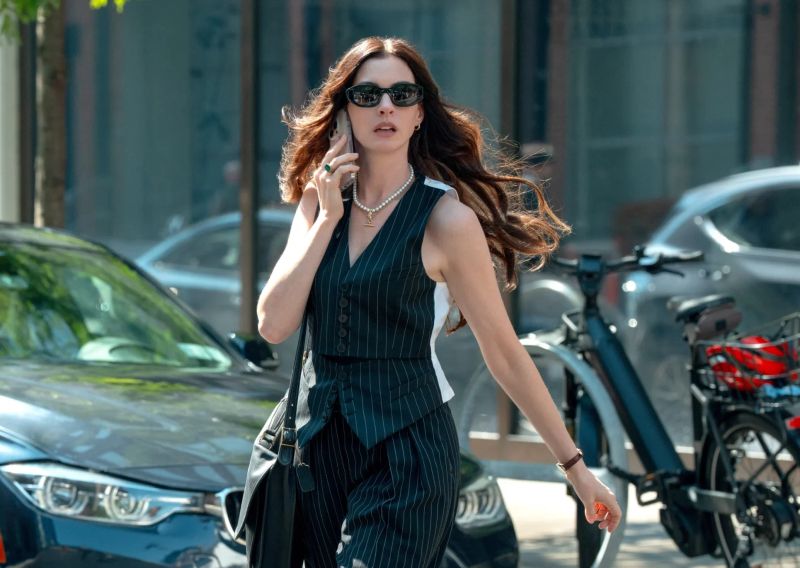
The movie offers exactly the kind of comforting spectacle that late-stage capitalism prefers: a little woke awareness to flatter progressive viewers, enough glamour to satisfy the aspirational crowd and zero threat to the profit model driving the industry’s worst excesses.
Twenty years after the original charmed audiences with its sharp satire of ambition and excess, The Devil Wears Prada 2 brings back Meryl Streep’s Miranda Priestly, Anne Hathaway’s Andy Sachs and Emily Blunt’s scene-stealing Emily Charlton for what seems, at first glance, a smartly updated reunion. Directed by David Frankel and written by Aline Brosh McKenna, the sequel begins with Andy winning an award for ‘real’ journalism, although what story earned her that honour, the film never bothers to tell. This arc exists only to pull Andy back into the orbit of “Runway” magazine, this time to help manage a sweatshop scandal. This irony is hard to miss: Vogue, the real-world inspiration for Runway, has long and freely featured fast fashion brands, many of which have faced allegations of using exploitative sweatshop labour practices.
The clothes are still spectacular, the one-liners land and the chemistry among the leads remains fun to watch. Yet beneath the surface glamour and timely-sounding crises, the film performs a careful act of ideological laundering. It acknowledges just enough real-world pain to seem relevant, while shielding the fashion industry from any meaningful reckoning. The film’s central tension revolves around Runway facing backlash over its ties to a brand using exploitative production. Andy is tasked with damage control: writing the apologetic feature, humanising the brand and helping Miranda steer the ship through stormy waters. But what Andy actually writes, and what Runaway itself thinks about fast fashion or exploitative labour or sweatshops, we never find out.
Meryl Streep, from left, Emily Blunt, Stanley Tucci, and Anne Hathaway attend “The Devil Wears Prada 2” world premiere at David Geffen Hall on Monday, April 20, 2026, in New York. Photo: AP.
On paper, the film recognises the horrors of the global garment industry, but stops short of confronting them. There is a widely cited claim that the planet already has enough clothing to dress six generations of humanity, frequently referenced by sustainability organisations. The fashion media, however, fails to acknowledge this fact. Vogue itself publishes explainers on fast fashion while simultaneously championing the brands driving it. One such article cheerfully suggests that this “fashion problem” can be solved through “slow fashion” and legislation, blatantly minimising a systemic crisis.
But even these are not truly the film’s focus. Its crises are resolved through a few tense meetings, moral speeches and several fashion walks and parties. The film quietly suggests that capitalism is a manageable PR problem, fixable with better storytelling and a handful of reformed characters. In a world of Instagram-worthy glitz, why worry about planned overproduction, microplastic pollution or the deliberate devaluing of clothing designed to ensure consumption never slows?
The film’s deeper evasion lies in the fact that it does not even own its crisis. It borrows one from journalism instead. It is true that newsrooms in 2026 are in distress, hundreds of reporters laid off from legacy media outlets across the world while independent voices are stifled by the demands of billionaires. But Runway is not a beleaguered investigative paper. It is a luxury fashion publication whose real-world equivalent, Condé Nast, continues to thrive through premium subscriptions, events and brand partnerships. Fashion conglomerates are hardly in fire-sale mode either. Luxury groups like LVMH and Kering have posted record profits in recent years, engaging in strategic acquisitions and succession planning rather than desperate sell-offs. While the US-Israel war on Iran and slowing sales in the West Asian markets have created some slump, the luxury fashion industry remains hopeful. Grafting journalism’s very real budget cuts and ownership battles onto a fashion magazine, is not only dishonest, but also evasive of accountability.

Anne Hathaway, from left, Emily Blunt, Stanley Tucci and Meryl Streep pose for photographers upon arrival at the ‘A Night With Runway: The Devil Wears Prada 2’ photo call on Wednesday, April 22, 2026, in London. Photo: AP.
The crisis the film should have depicted is closer to what the real world is facing right now. Billionaire Jeff Bezos served as the lead sponsor and honorary chair of the Met Gala this year, alongside his wife Lauren Sánchez, Anna Wintour and others. Amazon warehouse workers, unions and activists held protests outside the museum, calling out Amazon’s exploitative labour practices. They even staged a worker-led counter fashion show called “Labour is Art: A Ball Without Billionaires.” While the neo-rich billionaire class is trying hard to acquire cultural capital and demonstrate taste, the fashion world is only too happy to embrace their patronage, with nothing to say about the workers’ treatment. Incidentally, the actor playing Andy attended the event. Miranda chose to skip.

Heidi Klum arrives at The Metropolitan Museum of Art’s Costume Institute benefit gala celebrating the opening of the “Costume Art” exhibition on Monday, May 4, 2026, in New York. Photo: AP.
The film’s selective attitude toward class extends deeper. Even after 20 years of award-winning journalism, Andy’s water runs muddy in her New York apartment. Yet she somehow affords top brands to wear at work, explained with a single word: “thrifted.” The panic gripping America’s middle class today, over dwindling savings, mass layoffs and looming AI threat, is reduced to mere plot scaffolding to push Andy back into Runway’s affluent inner circle, with its Milan trips, exclusive parties and endless wardrobe changes. Working and middle class people appear mostly as background figures or punchlines: harried assistants, laid-off journalists or anonymous passersby who line the streets while the leads showcase clothes they can never afford. Even the fashion models do not get any screen time.
There is a scene of Miranda Priestly flying economy class, wedged in the middle seat next to a man eating a burger. Although it is played for laughs, it feels more like contempt disguised as comedy. Miranda is modelled on Anna Wintour. whose real-world net worth hovers around $50 million. The idea that someone like her would fly economy is absurd to anyone who has worked a job. Budget cuts do not affect those at the top, they cut from the bottom.
The billionaires in the sequel are neither devils nor do they wear Prada. They are bumbling simpletons, fallen into this world by a twist of fate. They hold budget meetings in the office cafeteria and show up in polyester. The film whitewashes their nature entirely by framing corporate raids and wealth consolidation as comedic inconveniences, resolvable with the help of ‘good’ billionaires. The original film mocked corporate excess through Miranda’s glamorous tyranny, but the sequel doubles down on billionaire simplicity while easily letting them off the hook. Justin Theroux’s character, Benji Barnes, modelled on Jeff Bezos and Elon Musk, is portrayed as goofy and awkward rather than as a predator consolidating cultural power. The film almost makes him sympathetic and easily replaceable, solving its crisis with a fantasy: good billionaires will rescue journalism and creativity.
The first film’s Miranda was a figure who kept capitalism’s tyrannical hierarchy running while also revealing the personal cost of power, especially for women. In the sequel, the character is softened into a slightly humbled elite, accepting feedback on inclusivity from her assistant (admittedly, quite funny), while banking on the charm of both the character and the actor.
In the end, The Devil Wears Prada 2 offers exactly the kind of comforting spectacle that late-stage capitalism prefers: A little woke awareness to flatter progressive viewers, enough glamour to satisfy the aspirational crowd and zero threat to the profit model driving the industry’s worst excesses. It is a stylish distraction, the cinematic equivalent of doomscrolling on Instagram after the Met Gala, a system admiring itself in the mirror while the polyester garments pile up in the global south and the sweatshops in Bangladesh and Vietnam continue running.
For all its surface charm, the sequel chooses nostalgia for elite entitlement over any honest confrontation with the material realities of the world it claims to inhabit.
Kavita Kabeer is a writer and a satirist, currently helming the shows ‘Cracknomics’ and ‘Digital Arrest’ for The Wire.
This article went live on May sixth, two thousand twenty six, at nine minutes past six in the evening.
The Wire is now on WhatsApp. Follow our channel for sharp analysis and opinions on the latest developments.


