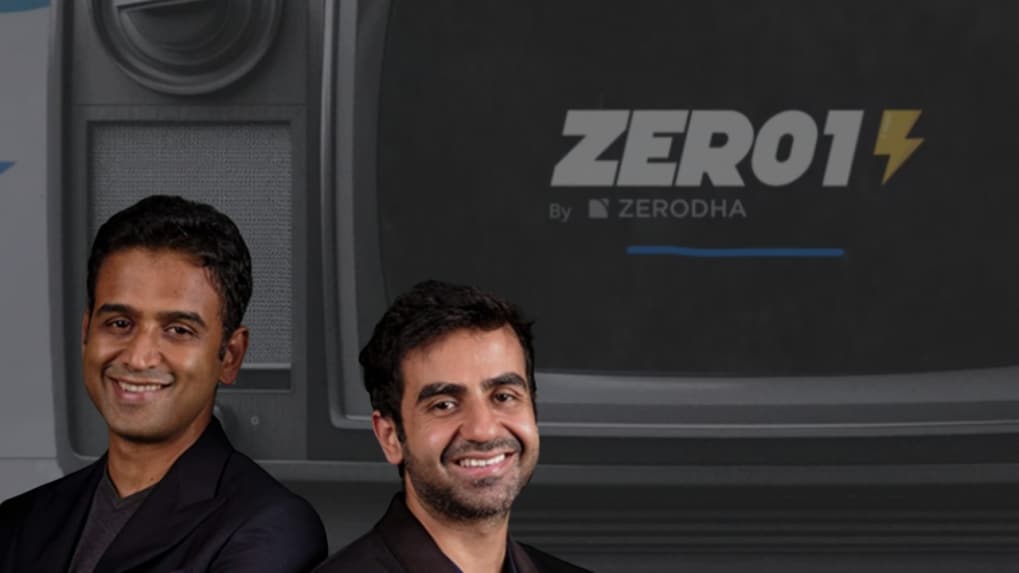
By shutting down Zero1, Zerodha may have done more than wind down a creator network. It may have exposed the fault lines of the creator incubator model itself.
Zerodha has shut down Zero1, its creator-led content network built with influencers, prompting a broader debate over whether creator incubators, particularly in regulated sectors like finance, can sustain themselves without clearer monetisation, tighter compliance controls, or stronger attribution.
Launched as a media network focused on simplifying finance, health and investing through data-led storytelling, Zero1 backed creators with research, studios and editing support while allowing them to retain ownership of their channels and content. The initiative, run through a joint venture between Zerodha and LearnApp, amassed nearly 800,000 YouTube subscribers, over 600 videos and more than 100 million cumulative views before being wound down.
For some observers, the closure points to pressure on ROI.
Mohit Ghate, Co-founder of Wit & Chai, framed it as a structural issue with certain incubator models.
“Some industries require influencers all the time to build TOMR, while others require them to create spikes of attention before consumption must spike. Incubator models work well for the former more than the latter. Even then, a word of caution to anyone setting up a creator incubator: pick carefully and shuffle often. Influencers, much like movie stars or sports personalities eventually start being termed as ‘sell out’. They tread a delicate balance of views vs engagement. As branded content gets pushed down because of Instagram’s algorithm, the engagement reduces as well. This, in turn, creates further pressure on ROI calculations. A Unilever, with their vast product range and consumer range can keep shuffling between influencers creating a win-win situation. Zerodha? Not so much.”
On rising scrutiny around finance creators, Ghate added: “Currently the regulations aren’t a hinderance, they are a deterrent to the bad actors. The larger problem I see is that because of the affiliation with Zerodha, a lot of these creators are now looked at as the authority on finance. With the backing gone, will some of these influencers use this authority to sell sub-prime products? We’ll need to wait and watch.”
Shudeep Majumdar, CEO and co-founder of Zefmo Media called Zero1 “an outlier” from the start. “Zero1 was always a bit of an outlier. Writing cheques for creator production without asking for performance numbers or equity – that is essentially philanthropy with a media network label on it. It was only ever going to run as long as Zerodha felt like running it. What the experiment did prove is that producing really good, unsponsored finance content in India is genuinely expensive, and there is no easy way to make the numbers work through the usual creator economy playbook. But it did not fix the economics underneath. So the wind-down itself is not shocking – at least not to me.
The takeaway for the rest of me is pretty clear – brand-funded creator networks tend to work when the brand gets something back – whether it is distribution, IP, audience, a course funnel, or something else. Trust-building is a hard thing to keep defending inside a company year after year, even for a business as profitable as Zerodha. Therefore, I would expect the next versions of this model to look less like open-ended grants and more like structured partnerships with actual outcomes attached – this is an imperative.”
An anonymous industry source argued the story is as much about compliance architecture as creator economics. “Zerodha has not stepped back from creator content. By their own account, they are expanding their owned channels under LearnApp and plan to run those in-house with fuller editorial control. What ended is specifically the network model, the loosely built partnership structure with independent creators, which also came with a non-compete clause preventing those creators from working with competing brokers.
That structural detail matters because it helps explain the regulatory exposure more clearly. An open network where partner creators retain editorial independence, but are contractually associated with a regulated entity like Zerodha, creates a compliance surface that is genuinely difficult to manage at scale.
The broader lesson is not that incubators cannot work, but that incubator models in regulated categories require more deliberate compliance architecture than most were originally designed with.”
Another anonymous source pointed more squarely to the ROI problem. “In the creator incubator models, the ROI is generally difficult because the amount of investment you make until unless you are asking creators to also promote your product on a regular basis, it’s very difficult to justify the ROI. So that is something that I feel because in this case, Zerodha wasn’t asking creators to promote their product.
They were just asking them to just give a call out to Zero1 network. So in that case, computing the ROI becomes even more difficult. It becomes a very long term activity.”
That tension, between long-term trust-building and short-term accountability, is emerging as a recurring fault line.
Pranav Panpalia, Co-Founder of Opraah, argued the model itself is not broken, but expectations may have been mis-set. “I don’t think this is a one off, but I also wouldn’t call it a failure of the incubator model as a whole. The reality is that creator incubators are still evolving in India. The biggest challenge is proving ROI in a format that is inherently long-term.”
He added that while some budgets may be tilting toward performance-led spends, abandoning creator-led IP entirely would be shortsighted.
“What we’re seeing instead is a rebalance.”
Rohit Agarwal, Founder and Director of Alpha Zegus took a harder line. “What Zerodha attempted with Zero1 was ambitious. Building a creator-led content ecosystem without a clear attribution or monetisation loop is extremely hard, especially in a regulated category like finance.
The shutdown highlights a larger truth for the creator economy. Content alone is not a sustainable business model unless it ties back to measurable outcomes.”
But not everyone sees economics as the main story.
Neel Gogia, Co-founder & CEO, IPLIX Media pushed back against the ROI framing entirely. “It’s primarily a regulation-based decision and not an ROI-based decision. I feel Zerodha knew from day one the way they were working with creators. It was primarily an awareness channel. They were not looking for any direct conversions anyway.”
He pointed to the lack of direct calls to action, creative autonomy given to creators, and limited content oversight as evidence the model was not built around immediate returns.
“If someone is here for the short run, they take very aggressive decisions, take a lot of control, but that was not the case. So it’s a regulation-based decision.”
That divergence in views is what makes the shutdown consequential.
Was Zero1 undone by soft economics, hard regulation, or the tension between both?
The answer may be somewhere in the overlap.
For an ecosystem betting heavily on creator-led IP, the bigger question now is whether the next generation of incubators will look less like patronage and more like tightly governed media businesses. And whether, in regulated categories, creator freedom can coexist with compliance at scale.
First Published on


