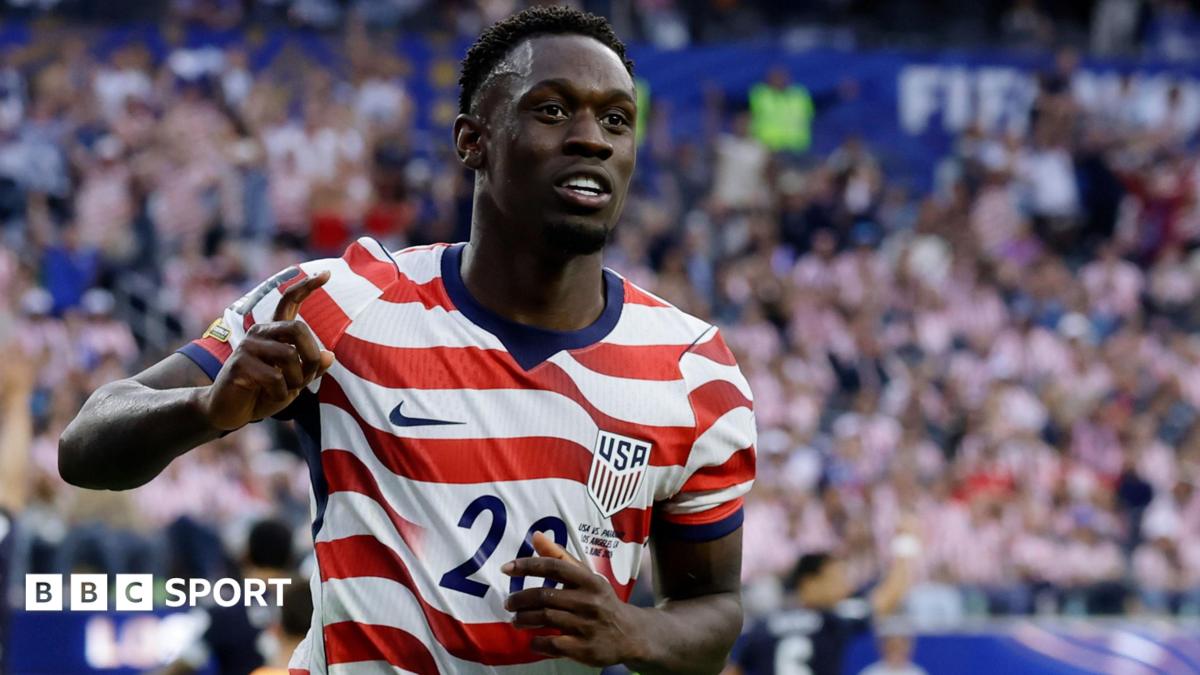
Until three years ago, there was no guarantee Balogun would end up playing for the United States.
Having appeared for the US and England at Under-18 level, he was at the heart of Lee Carsley’s England Under-21 plans – scoring seven goals in 13 appearances as they geared up for the 2023 Under-21 European Championship.
But his performances on loan at Reims from Arsenal during a prolific 2022-23 campaign – which earned him a £35m move to Monaco – had US officials circling.
There was also a huge swell of public support for him to commit to the US at a time the route map to England’s senior side appeared far more complicated.
Having withdrawn from an England Under-21s camp, a secret rendezvous to meet US Soccer officials was instead plastered all over social media and he was courted with NBA tickets and trips to Florida.
There was also reportedly an invite to the New York Yankees to watch training, and several senior US internationals were dispatched to take him out to dinner to convince him to make the switch.
“When I committed, and throughout the whole cycle, and the whole journey to me being at this point, I’ve always said the fans gave me so much motivation and showed me so much support,” Balogun said on Friday.
“For me, the most important thing has always been to be able to repay that. I just want to continue to show the fans I made the right decision.”
As much as Team US want to keep politics off the pitch and focus on their game, it’s hard to ignore the fact Balogun joining the team would’ve been impossible under President Trump’s proposed order.
If the Trump administration were to win the Supreme Court case, it would create uncertainty not just for Balogun but plenty of others, says Ilya Somin, George Mason University law professor and the chair in constitutional studies at the Cato Institute.
The administration has said they will not actually move to retroactively deprive birthright, but the logic of their argument – that those people are not actually citizens – will hang over them.
“Trump’s promises and guarantees often are not worth very much, but even if he were to stick to that resolution, a future administration might not,” said Somin.
Still, Somin believes the high court, which has a 6-3 conservative majority, will not rule in President Trump’s favour given their scepticism during oral arguments in April.
When the administration argued the ease of modern travel necessitated reinterpreting the constitution, Chief Justice John Roberts quipped: “It’s a new world. It’s the same constitution.”
It may be coincidence that the World Cup, the birthright Supreme Court decision and the country’s 250th anniversary are happening at the same time. But with international turmoil and domestic division on a range of polarising issues, the confluence of events is holding up a mirror to the American people.
A majority of Americans believe all babies born in the country should automatically be granted citizenship, according to a Reuters poll from April.
But there is a split along party lines. The poll found only 9% of Democrats agree with ending birthright citizenship compared to 62% of Republicans.
Balogun is hardly the only player on Team USA with a blended identity.
Marcos said fans were used to that, and the team is uniquely built to represent the nation’s melting pot.
“I think that’s what makes the team really unique in terms of the football landscape,” he said. “But it’s also what makes it special and it makes it very American.”
In 10 of the previous 12 editions of the World Cup, six goals would have been enough to win the Golden Boot.
On that basis, and only one game in, Balogun is already a third of the way to one of the most prized individual accolades in world football.
He may not be a household name in the country yet, but he’s well on his way to becoming a new talisman for US soccer fans to pin their hopes on.
Additional reporting by Pratiksha Ghildial.


