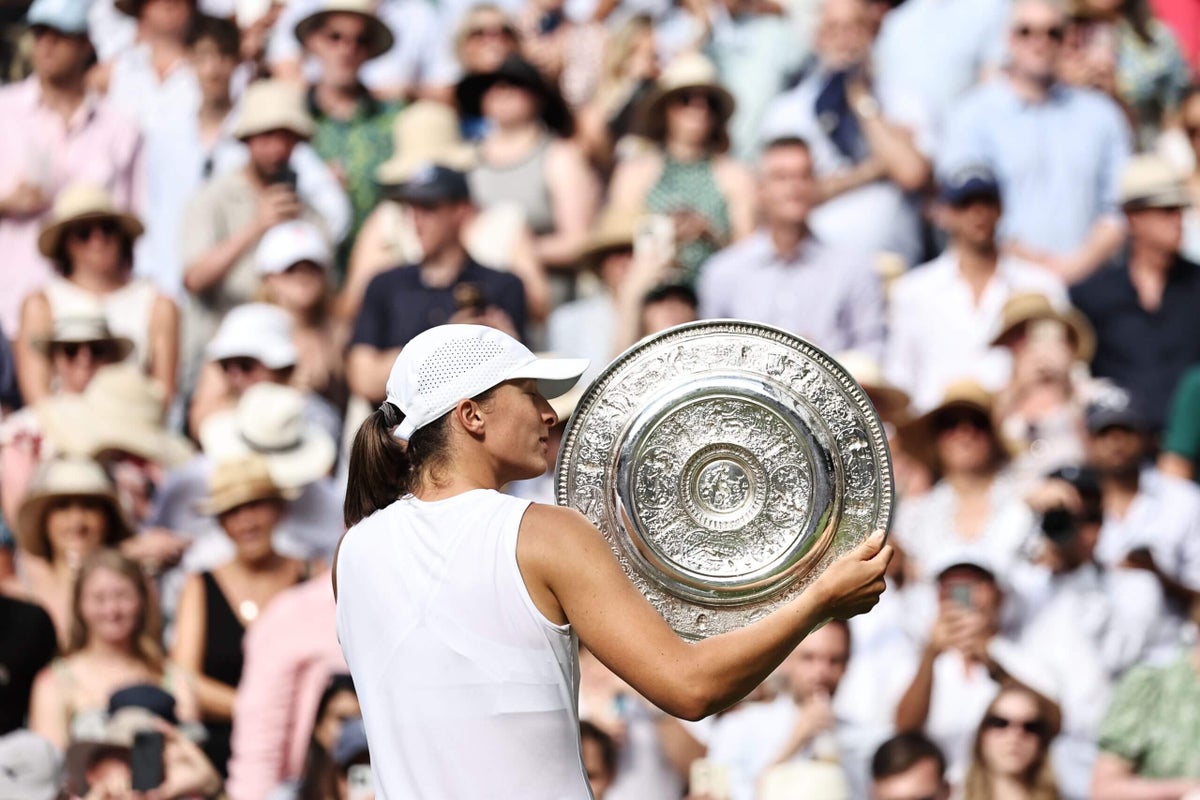
Wimbledon has increased its prize money by 20 percent for 2026, but its pool remains short of the revenue percentage tennis stars are seeking from the Grand Slams in an ongoing debate over remuneration.
The £64.2 million ($85.8 million) prize money is 15.1 percent of Wimbledon’s 2025 tournament revenue, which was £423.6 million ($566 million). A campaign led by top-10 ATP and WTA players — which led to a media protest at the French Open last month and has prompted discussions around boycotting majors in the future — is seeking 22 percent of revenues, in line with what tour events pay.
Last year’s prize pool of £53.5 million ($72.7 million) was 13 percent of Wimbledon’s 2024 revenue of £406.5 million ($553 million).
Singles champions will receive £3.6 million ($4.8 million), up £600,000 from 2025, while first-round losers will receive £80,000 ($107,000), up £14,000 from 2025.
This year’s French Open prize money was also around 15 percent of projected tournament revenues, which the player group, including Aryna Sabalenka, Coco Gauff, Jannik Sinner and Carlos Alcaraz, greeted with “collective disappointment.” A source briefed on the group’s conversations with the Grand Slams said they were hoping for around 16 percent at Wimbledon this year, as a step toward that 22 percent figure.
Wimbledon operates differently to the other three events. It has a profit-share agreement with the Lawn Tennis Association (LTA), which oversees British tennis, in which it distributes 90 percent of annual tournament profits to the association. Last year’s profit was £52.7m ($70.4m). Like the other three majors, Wimbledon invests its money in tournament infrastructure and grassroots tennis as well as player prize money.
“Using revenue to determine prize money, it makes no sense,” Deborah Jevans, chair of the All England Lawn Tennis Club, said at a pre-tournament briefing Thursday.
“We have said that to Larry Scott (the executive representing the players, including in a meeting with All England Club representatives during the French Open). Revenue does not take into account the investment that we give. And as I’ve spoken about, we’re not for profit, we’re very different to a 1000 (the rung below the Grand Slams) event. Everything goes back in the sport. I am frustrated that that message hasn’t got across.
“But we have constant dialogue with Larry in this regard and we’re hoping that that message will get across for the players to understand the investment back into the game that is so very important and that allows us to be sustainable and will be in the future. That is a dialogue we welcome and why we have encouraged them to form with us a player council.
“Then we can have that dialogue. And that dialogue will include, when you think about player compensation, pension, maternity cover, all of those things, we would welcome the opportunity to sit down and talk with them about that. And that offer is on the table.”
Scott, a former ATP Tour player and ex-WTA chief executive, met with AELTC and United States Tennis Association (USTA) officials during the French Open.
A source briefed on the player group’s plans and on Scott’s meetings, who spoke on the condition of anonymity because they weren’t authorized to speak publicly, said that the talks had been direct and productive, with the Grand Slam tournaments appearing to understand the group’s three principal priorities: prize money as a proportion of revenue, contributions to player welfare and consultation of players on changes.
Scott also met with FFT officials, including French Open tournament director Amélie Mauresmo, with a source briefed on the discussions, who was also not authorized to speak publicly, saying that the players were encouraged by the FFT’s pledging to offer concrete proposals about increased prize money, player welfare and representation within the next month.
Wimbledon will also use video review technology for subjective calls across its six main courts — Centre Court, No. 1 Court, No. 2 Court, No. 3 Court, Court 12 and Court 18. This will be for the duration of the tournament on the two main courts and until singles matches are finished on the other four.
It will also introduce visual indicators on scoreboards for out calls, in concert with the use of electronic line calling. The Australian Open used a red-light system on net posts for this in January, but Wimbledon will use scoreboards to show when “out” or “fault” calls are made.
Last year’s Wimbledon was the first in tournament history without line judges, and there was a notable controversy when human error led to ELC being “deactivated” on Russia’s Anastasia Pavlyuchenkova’s side of the court in her fourth-round match against Britain’s Sonay Kartal. A shot from Kartal landed long on game point for Pavlyuchenkova, but with no call it was replayed and Pavlyuchenkova was ultimately broken. Outgoing AELTC chief executive Sally Bolton said Thursday at the media briefing that a review was undertaken to understand how the mistake was made.
This year’s tournament starts June 29, with Iga Świątek and Jannik Sinner defending their singles titles.


