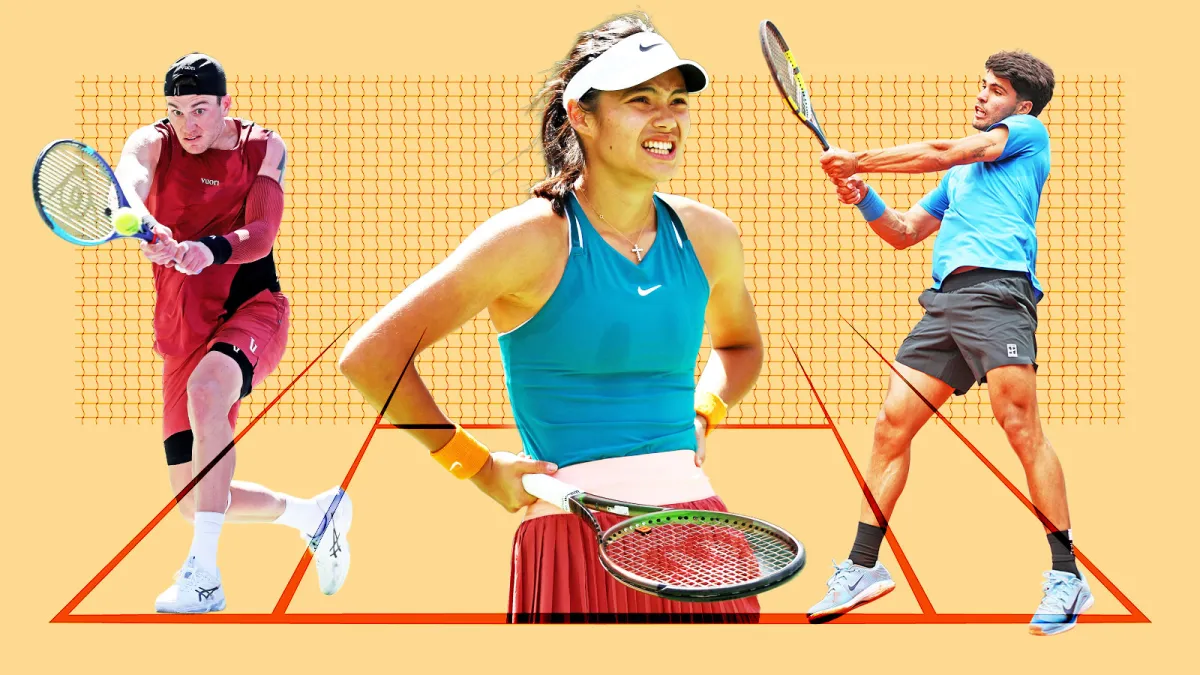
Survival of the fittest has become an apt metaphor for life on the tennis circuit in recent months. Carlos Alcaraz is sporting a cast on his right wrist and is a serious doubt to defend his title at Roland Garros next month. Amanda Anisimova, a grand-slam finalist twice last year, is battling the same problem. Novak Djokovic has not played in more than a month due to a shoulder issue, while Jack Draper’s long-awaited return after a six-month layoff due to bone bruising in his left arm was abruptly halted last week by an aggravated tendon in his right knee.
Injuries are, of course, an inevitable part of sport, with the margins between peak performance and overexertion so fine that mistakes are unavoidable. But their rate at the top level is steadily increasing, despite all the advancements in sports science. A study published in 2024 by the University of Barcelona found that match retirements had increased by at least 25 per cent and 50 per cent on the ATP and WTA Tours respectively since 1999. According to the Professional Tennis Players’ Association, the average length of a match has increased from 98 minutes in 1999 to 120 minutes now, while the average distance covered on court per match has increased by more than 50 per cent since 2015. The nature of the injuries, the reasons behind them, and the constant balancing act to mitigate them is a nuanced and ultimately imperfect science.
“There’s a lot that goes into it and, for me, it’s almost like a crime scene,” Dominic King, the head of athlete development at Halton Tennis Centre, near Aylesbury, says. “Here is the crime, who are the suspects, and we’ve got to be big enough to turn the lens on ourselves — and think: is it something I might be doing from an S&C [strength and conditioning] standpoint? — and be part of the solution. Is it the schedule? Is it the balls? Is it the rackets? Is it the number of night matches? Is it the lack of recovery time? Is it a massive increase in intensity in men’s and women’s play, and are we training appropriately for that?”
The culprits work — in many respects — as a syndicate. Howard Green is the head of development at Bolton Arena International Tennis Academy, and previously worked on the WTA Tour as the physical trainer to Ana Ivanovic, the former world No1. A Royal Marine who decided that “dodging tennis balls was easier than dodging bullets” after tours of Iraq and Afghanistan, he breaks down the four main factors that are causing injuries with fitting military precision: repeated mechanical loading, incomplete recovery, huge spikes in load, and environmental stress.
“In terms of the sport itself, it’s so much more dynamic,” Green says. “There are hundreds of what we call high-intensity movements, heavy accelerations and decelerations, big demands on rotation, really specific stress through the shoulder, the back and the lower body. To make tennis more interesting, the courts are becoming a little bit slower and the balls are a little bit heavier, making rallies longer, and the players themselves are becoming better athletes. That carries pros and cons. They’ve got a higher ability to produce force, but they are also having to absorb that force, and the number of accels and decels goes up. It’s like you see in rugby: guys are getting bigger and more explosive and running into each other at greater speeds.”
Gaël Monfils, 39, has seen that evolution firsthand. “The tour has become very physical,” he says. “Through the year, everybody gets well prepared physically, everyone serves big, everyone hits big. I never like to use this word, but everyone is more ‘professional’ in a way, even in Futures to Challenger [events].” Those demands have already filtered down to the junior ranks, where prodigies emerge by their early teens. “I was unlucky enough to get injured when I was around 13,” Matteo Berrettini, whose career has been curtailed by injury since reaching the 2021 Wimbledon final, says. “I was always careful about my preparation in the gym, my hours on court, but, because I was younger, I was growing a lot. I didn’t have any muscles, and it was tough to handle all the physical work we had to do to improve.”
The second factor is the lack of recovery time and accumulated stress between matches. The top women’s players are mandated to play at least ten WTA 1000 and six WTA 500 events, along with the four grand-slam events, in a season. The number of night matches, defined as starting after 7pm, has risen dramatically to one in five at grand-slams, affording players less — and worse quality — rest time. “The players’ co-ordination and reaction time fatigue: that’s where these niggles and injuries can come from. If you’ve got a fatigued shoulder, it’s far more difficult to reproduce the same serve speeds, but they’ll still attempt to because the return quality is good. [Grigor] Dimitrov ripping his pec last year is a good example [he led the eventual champion, Jannik Sinner, by two sets in the fourth round at Wimbledon before having to retire]. If you look at the stats, how big he was serving, his body just couldn’t cope with it as the tournament went on.”

The best players can afford to miss certain tournaments. Aryna Sabalenka has already skipped the Dubai Tennis Championships and the Stuttgart Open this year, citing minor injuries, having said in January that she expected to miss events due to the “insane” schedule. “When I got hurt, I always took a really long time,” Monfils says. “I tried to avoid surgery. I’ve had none. When it was six months [out], I could easily go for eight. By the end, it pays off because it’s helped me to play a bit longer.” But those outside the elite cannot afford that luxury.
Dr Mark Kovacs, perhaps the preeminent expert, who works with Djokovic, highlights another interesting development in string technology. “Most of the chronic issues are in the lower body or the back, but you have seen an increase in upper arm issues over the last decade,” he says. “The rackets now allow for, let’s call it a less traditional technique. It can still be very successful, but people use their arms a bit more sometimes with extreme grips, extreme racket positions. There is potentially also some bad coaching going on when it comes to mechanics.”
The third factor is sudden spikes in load. Players can track their performance to the nth degree in practice, but the stress of real competition is far greater. Unlike in football, where GPS vests worn under shirts have been commonplace for years, Alcaraz was forced to remove his Whoop-band fitness tracker, which was hidden beneath his wristband, at the Australian Open. “Tennis is a little behind other sports, where GPS provides really accurate [data that] can better inform their training,” Green says.
While all players now recognise the importance of post-match recovery and modalities such as massages, hydrotherapy and compression devices, there is still fierce debate about how best to prepare players for those spikes. Green prefers his players to lift heavy weights, rather than replicate tennis-like movements in the gym. “The best teams value high-intensity strength work. They’re not trying to tick along,” he says. Kovacs previously worked in the NBA and noticed some teams were significantly reducing the rigour of their practice sessions to preserve their energy for matches. “The myth was this load-management concept,” he says. “If you practice less, you’re not developing resiliency, not developing your body to handle the competitive environment well enough. The concern in tennis is some will go that route as well.”

The fourth factor — but by no means the least impactful — is the environmental stress on players’ bodies. Beyond living out of hotels and the jet lag, the extended Masters 1000 events, while sometimes affording longer recovery times, can be more mentally taxing. The abrupt changes in playing surfaces significantly add strain, too, with players quickly going from longer rallies, higher balls and sliding on clay to lower bounces, deeper lunges and harder serves on grass. Draper seemed in positive spirits about his physical shape, despite an early exit at the Miami Open last month, but his first match on clay resulted in a knee injury. “When you add these things together, you accumulate a load much faster than the body can adapt to,” Green says.
For King, whose aim is to guide children from “tots to the tour”, it is no longer just about training them for the sport itself. “I do genuinely think about, if they’re 12 years old, at 32, 42, 52 years old, I want them to be OK physically,” he says. “Tennis is incredibly demanding and there will be wear and tear, but I don’t want them to have a great career and not be able to move after it.”


