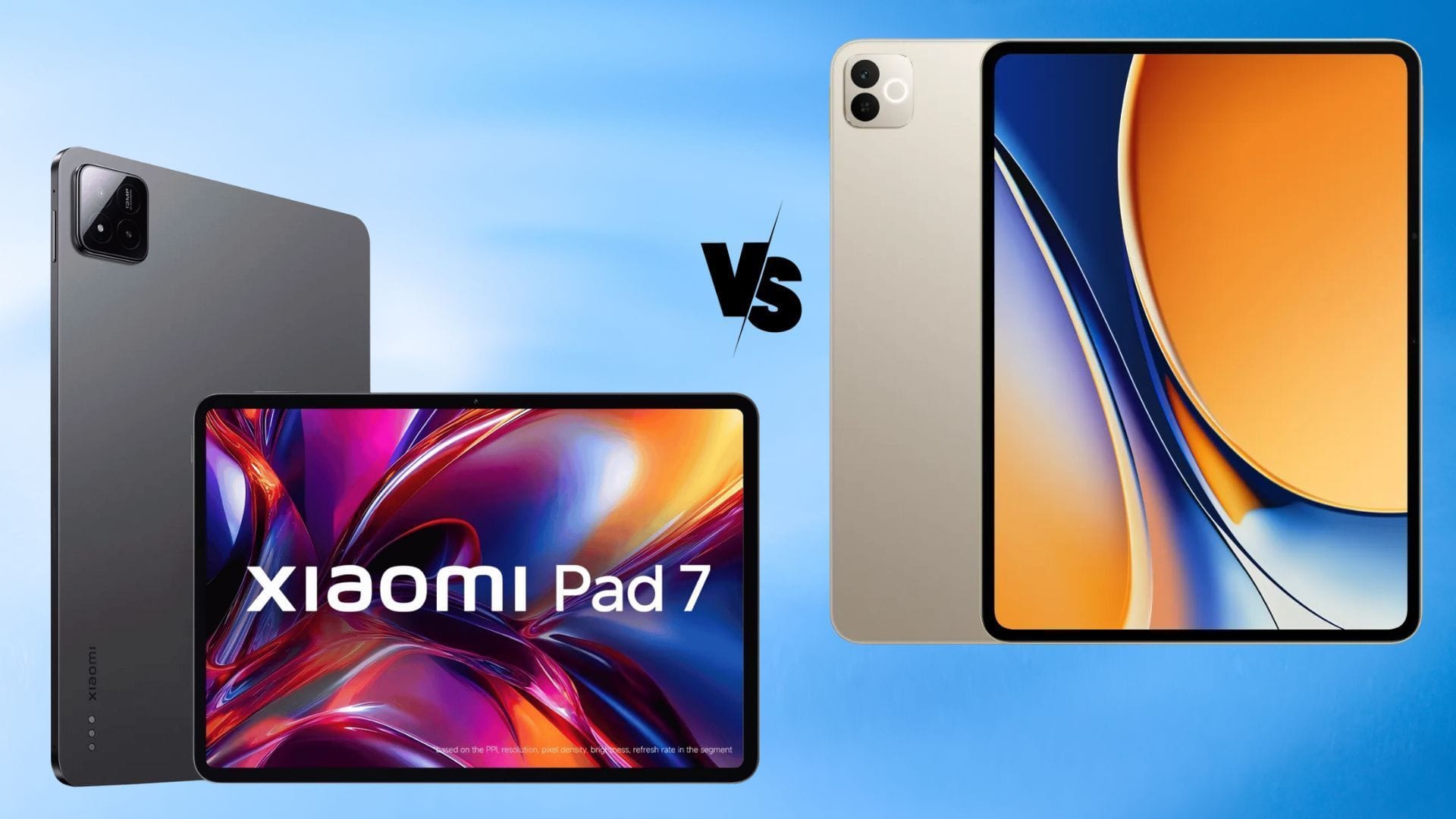

The Xiaomi Pad 7 and Realme Pad 3 are strong mid-range tablets offering premium features at prices that won’t break the bank. Both devices offer the perfect blend of performance, portability, and value. Due to the similar pricing, it’s natural that you may be confused between the two options.
As such, this article provides a thorough comparison to help you purchase the right tablet based on your needs.
Xiaomi Pad 7 vs Realme Pad 3: What are the differences?
The Xiaomi Pad 7 and Realme Pad 3 are solid offerings in the mid-range segment. Both devices sport large screens and sufficient power for daily multitasking, creative workloads, productivity, and gaming.
In terms of pricing, the Pad 7 starts at around ₹24,999 for the base variant and can go up to ₹27,999 for the top-end model. Note that it only comes in WiFi variants and does not support 5G connectivity like the latter. Realme’s Pad 3 starts at ₹26,999 for the base variant and can go as high as ₹31,999 for the high-end variant.
Here are the detailed specifications of the two tablets:
Also read: Xiaomi Pad 7 vs Redmi Pad 2 Pro: Which is the better mid-range tablet?
Performance
The Xiaomi Pad 7 is powered by the Snapdragon 7+ Gen 3, delivering smooth performance for multitasking and gaming. It’s ideal for games like Genshin Impact, PUBG, and more, showing incredibly smooth framerates. It comes with up to 12GB LPDDR5X RAM, offering higher speeds.
The Realme Pad 3’s Dimensity 7300-Max handles daily tasks and light editing well, but may not be as good as the former in GPU-intensive workloads. Even then, it handles gaming quite well, showing smooth performance in demanding titles. It comes with a max of 8GB RAM, which provides decent speeds for daily tasks.
All in all, Xiaomi’s Pad 7 is the better performer for demanding workloads and gaming applications.
Display
The Xiaomi Pad 7 boasts an 11.2-inch display with a 3.2K resolution, offering incredibly smooth visuals with its 144Hz refresh rate. Its 3:2 aspect ratio offers a balanced view for content, reading, and gaming. The screen is also usable in bright environments thanks to its 800 nits brightness in HBM.
On the other hand, the Realme Pad 3 comes with a slightly larger 11.61-inch display with a 2.8K resolution, enabling it to produce pictures with higher quality and smooth visuals with its 120Hz refresh rate. The tablet comes with a 7:5 Book-View aspect ratio, making it excellent for reading e-books and multitasking. It features a brightness of up to 550 nits in HBM, making it bright enough for outdoor use.
Overall, go for the Pad 7 for smoothness and premium visuals, and choose the Pad 3 for immersive reading and content viewing.
Camera
Being tablets, neither devices are camera-centric. The Xiaomi Pad 7 comes with a 13MP rear camera and an 8MP front camera, which is ideal for casual photography, document scans, and more. Its camera also shoots at up to 4K video at 30 FPS, making it suitable for casual videography as well.
The Realme Pad 3 features 8MP cameras on the front and back, which are sufficient for video calls and doc scans. It can shoot at up to 1080p video at 30 FPS, and the overall quality is comparatively inferior to that of the Pad 7.
Battery life
The Realme Pad 3 dominates with its 12200mAh battery, lasting an entire day’s use. According to reviews, it lasts over 16.7 hours of video playback, which is very impressive.
On the other hand, the Xiaomi Pad 7’s 8850mAh battery also offers full-day power with light tasks. With mixed use, you can expect upwards of 10 hours of battery life.
Final Verdict
While both devices offer excellent specs for their price, the final choice would come down to your priorities. If gaming and multitasking are your priorities, choose the Xiaomi Pad 7 for superior performance, display quality, and portability. However, note that it only comes with support for WiFi, and does not offer SIM card support.
If you require all-day power, a larger display, and carrier support, the Realme Pad 3 would be the ideal tablet for you.
Check out other articles by Sportskeeda:
Edited by Abu Amjad Khan


