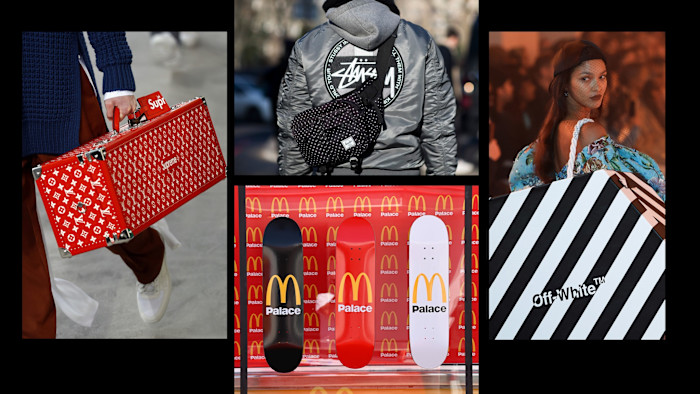
In 2017, Louis Vuitton and Supreme launched a blockbuster collaboration, with global pop-ups attracting the kind of queues that Supreme fans were accustomed to. It was a high point in Supreme’s ascendancy from streetwear pioneers to the centre of the fashion industry. Within months, pieces from the collection were reportedly reselling for more than $150,000.
This was the start of streetwear’s imperial phase, which also included Virgil Abloh’s “The Ten” collaboration with Nike. A year later, Abloh would be confirmed as Louis Vuitton’s artistic director of menswear and Supreme would receive a billion dollar valuation when the Carlyle Group acquired 50 per cent. Within a few months, everything had changed. “Brands and designers in all corners of the streetwear world were suddenly in more demand than ever before,” says Tyler Watamanuk, author of Bigger Than Fashion: How Streetwear Conquered Culture.
In 2019, PwC’s strategy arm examined the state of the streetwear industry alongside Hypebeast, estimating that it was worth $185bn in sales globally and represented about 10 per cent of the entire apparel and footwear market. The same survey identified Supreme as the key brand, followed by Off-White, Stüssy, Palace and well-established sports brands such as Adidas and Nike. What had started a long way away from the centre of the fashion industry was now a major player.
Streetwear is an amorphous and ill-defined cultural movement, which gained prominence in the 1990s and encompassed skateboarding, surfing, hip-hop and sneaker culture. Leading lights such as Supreme in New York and Palace in London began life as skate brands, while early pioneer Stüssy originated in the Californian surf scene. The aesthetics focused on cool, casual clothes including T-shirts, hoodies and sneakers.

In the 2010s, streetwear exploded. Queues formed, big-name collaborations became a regular occurrence and its aesthetic codes — mainly logo-heavy hoodies and T-shirts — were embraced by high fashion. “It’s never been particularly design-forward,” says Jian DeLeon, men’s fashion director of Nordstrom and former editorial director of Highsnobiety, an online magazine that came to prominence during streetwear’s rise. “It’s about repurposing existing designs, it’s about the associations a T-shirt or hoodie has when the logo is on it.”
As well as the countercultural roots and design aesthetics of streetwear brands, there were other similarities. Collaborations became a prominent part of each collection, as did the focus on weekly drops, in which certain items would be released at a precise time. At Supreme, this was a Thursday morning, when the website would be inundated and queues would snake out of the brand’s stores. This technique was a key driver of streetwear’s growing popularity. “Brands mastered the art of the ‘drop’, leveraging scarcity to create insider status,” explains Sam Shaw, strategy director at London-based consumer insights agency Canvas8. It also led to a thriving secondary market.


While brands such as Stüssy and Supreme were founded in the ’80s and ’90s respectively, it was in the 2010s that things really changed. “That explosion of interest was fuelled by the emergence of visual social media platforms like Instagram and Tumblr,” says Watamanuk. For DeLeon, a new generation of celebrities were helping to change how people dressed, shouting out high fashion alongside streetwear brands.
The late 2010s were the pinnacle of streetwear’s cultural cache. Collaborations with legacy fashion brands — Supreme worked with Louis Vuitton and Rimowa while Palace collaborated with Ralph Lauren and, in 2022, Gucci — showed the fashion establishment embracing the movement. Louis Vuitton later released its own skateboarding sneaker and Jil Sander named Supreme alumnus Luke Meier as co-creative director.
Over time, however, streetwear’s cultural dominance began to falter. “Brands flooded the market with too many releases and collaborations, reducing the scarcity and exclusivity that made them special,” says Katy Lubin, VP of brand and communications at global fashion shopping platform Lyst. “The resale market became part of the problem. When everyone’s buying to flip rather than wear, and resellers are dominating drops, the community aspect dies.”
While this was happening, streetwear’s customer base was moving on. “There’s an argument that the streetwear customer has matured and developed a more personal sense of style, moving beyond head-to-toe brand loyalty,” says Lubin. “That shopper wants individuality over hype.” This represents a changing of the fashion landscape, with no single dominant aesthetic replacing streetwear. “The market hasn’t just changed; it has fractured,” says Shaw. “We aren’t seeing a single replacement for streetwear, but rather a splitting of the market.” There was a return to preppy dressing, the emergence of quiet luxury and rumblings of a “post-sneaker society”.


The closer relationship between high fashion and streetwear also caused problems within the culture. “Streetwear started as something worn by subculture and community, and then it became its own subculture and community,” says DeLeon. “Being a part of the culture just means wearing the brand. You’re not necessarily subscribing to the activities — skateboarding, DJing, graffiti writing, downtown culture — that formed those brands.”
Another example of streetwear’s changing status came as its leading lights were acquired by private equity funds and bigger corporations. Three years after Supreme’s billion-dollar valuation in 2017, the company was sold to VF Corporation, owner of Vans and The North Face, for $2.1bn. The distance between the traditional fashion world and the upstart of streetwear was smaller than ever. “Streetwear started as a form of rebellion and then sort of became the status quo,” says DeLeon.
In 2024, Supreme was sold again at a significant loss, as EssilorLuxottica acquired the brand for $1.5bn. Similarly, New Guards Group — which backed labels including Heron Preston, Ambush and Off-White — has sold off the majority of its streetwear assets. Both Supreme and the New Guards Group stable are examples of the pressures faced by these outsider labels as they integrated into larger corporate structures.
It’s easy to see Supreme’s fall in value as a sign that the fashion industry has moved on. Streetwear, once the rebellious outsider, has now been consumed into general culture. The reality is more complicated, and enthusiasm remains.
“I think it suggested that Supreme, which still operates on a foundation of controlled — if perceived — scarcity, did not fit into VF’s core business model of extensive distribution,” says Watamanuk of the recent EssilorLuxottica acquisition. He points to the brand’s recent financial performance, which shows revenue rising between 2023 and 2024, and anecdotal evidence from speaking to fans of the brand at its Bowery store in New York. “You could tell they didn’t care about industry chatter,” he says. “It didn’t dim their reverence for the brand one bit.”
In Japan, Human Made — the label founded by legendary streetwear figure and Kenzo artistic director Nigo and backed by star musician Pharrell Williams — recently listed on the Tokyo Stock Exchange. It was the streetwear industry’s first IPO and immediately led to a 13 per cent increase in Human Made’s share price on the first day of trading.


There are other signs of life. Palace has carved out its own vernacular, heavily rooted in UK culture. The brand recently launched a collaboration with Nike featuring football legends Wayne Rooney and Leah Williamson. London-based Corteiz, a relative newcomer, is also reinterpreting streetwear’s original playbook, with logo-heavy collections, impromptu drops and guerrilla marketing, and has built a devoted, youthful audience.
Lubin echoes this, pointing to Lyst’s shopping data. “We’ve seen spikes in demand for brands embodying streetwear’s cultural roots, building audiences in local communities rather than through global hype cycles.” Streetwear’s alignment with the fashion establishment may have alienated some of its base, but new brands such as Corteiz, and fellow UK labels Always Do What You Should Do and Drama Call, are returning to the very things that made it popular in the first place.
While there may no longer be the queues snaking out of Supreme stores once a week, streetwear’s legacy is everywhere. “I don’t think there’s necessarily been a shift away from streetwear, it’s just become part of the establishment,” says DeLeon, pointing to Bobby Kim, who founded The Hundreds and is now VP of creative, consumer products at Disney, and store KITH’s recent successes. You can also see its impact through brands like Noah and J Crew, both key parts of the recent prep revival and both overseen by Brendon Babenzien, a former creative director of Supreme.
More than that, though, Supreme’s legacy can be seen in the general casualisation of men’s clothing and the prevalence of sneakers in almost every walk of life. “Streetwear’s influence is so interwoven within the traditional fashion system at this point that it just doesn’t register at the same volume it did a decade ago,” says Watamanuk. “What we know as the icons of streetwear — the graphic T-shirts, the hoodies, the sneakers, the logos — are now just an immovable part of the system.”
Follow us on Instagram and sign up for Fashion Matters, your weekly newsletter about the fashion industry


