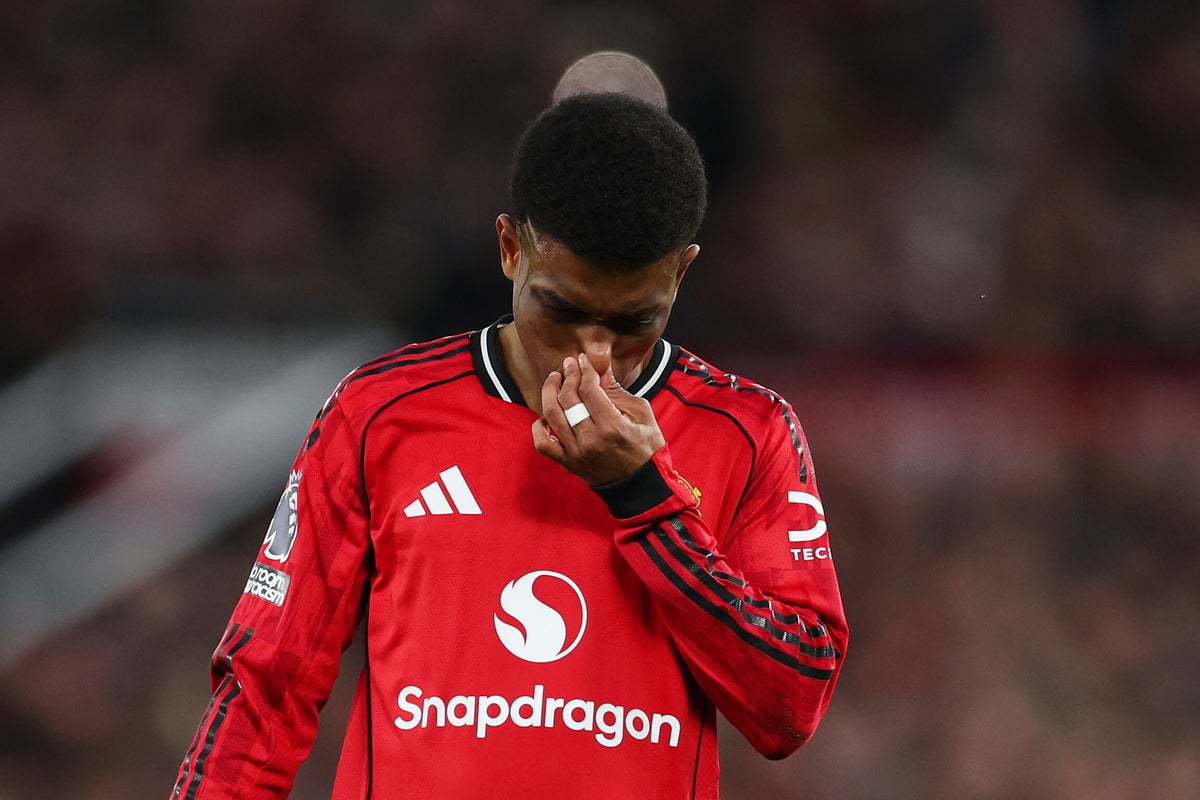
The last time Amad scored for Manchester United was the opening goal in a 4-4 draw with Bournemouth on December 15.
A day later, he left for the Africa Cup of Nations with Ivory Coast. By the time he returned, a lot had changed at Old Trafford. Ruben Amorim was gone. In his place was Michael Carrick — and with him, a shift from a 3-4-2-1 formation to a more traditional 4-2-3-1.
Under Amorim, Amad had been evolving into a deeper right-sided player — part wing-back, part creator, balancing defensive work with attacking output. But Carrick has pushed him higher up the pitch. On paper, it looked like a move which would unlock more. It hasn’t — at least, not yet.
Amad has started nine of Carrick’s 12 games in charge but is still waiting for his first goal or assist under the new head coach. His numbers this term were not great before the change: two goals and two assists. For a player who scored eight and assisted six in the Premier League last season, it is a noticeable drop-off.
He is one of the few players whose output has not improved since Carrick replaced Amorim.
Last weekend against Chelsea, Carrick opted to start Bryan Mbeumo out on the right-hand side, with Benjamin Sesko up front. It will be interesting to see if Amad remains on the bench for the visit of Brentford on Monday night.
Amad’s most recent goal for United came in the Ruben Amorim era (Stu Forster/Getty Images)
The ability to rotate the forwards will be needed next season if United get over the line in the race to qualify for the Champions League. But Amad needs more output to cement his place, especially with another managerial transition potentially coming, or Carrick and his staff getting the job on a long-term basis.
That said, the player is not down about his form and has been the same lively character around Carrington in recent weeks. Carrick’s staff value his work rate as he readjusts after a year in a different role in a system still taking shape.
It is also only 12 games under Carrick and 794 minutes on the pitch for Amad. It’s a small sample size, and everything still feels somewhat of a work in progress with the head coach, even if results point to a team which has made improvements.
Amad’s defensive contributions have been important in recent games, and he has 15 interceptions this season, up from 11 last term. But the data definitely shows that his attacking threat is down despite being pushed further forward.
The graphic below shows his attacking metrics this season in the Premier League under the two managers he has worked with. In every single criteria, his output was better under Amorim.

There are obvious caveats for this.
In the wing-back role, Amad was getting on the ball further back, which would allow him to gather pace before he reached threatening areas. This made him difficult to defend against and often opened up more opportunities to find passes. Also, having more attacking players in front of him helped with his chance creation.
An example of this is his pass to set up Mbeumo for one of his two assists this season in the 2-1 win against Liverpool back in October. In fact, both assists from Amad this season have come for Mbeumo. The other was a cross for the first goal in a 2-2 draw with Tottenham in November. Mbeumo and Amad still play together, so that link-up should still exist, but they are no longer operating on the same flank.
It also means defenders can crowd Amad more when he gets on the ball in threatening areas and may be more inclined to leave space with the United right-back behind him.
Carrick’s way of playing gives more freedom to his forwards. This is a positive when you have players such as Matheus Cunha, Bruno Fernandes, Mbeumo and Amad, but there are trade-offs. It means there’s more competition within the team for the ball in certain areas. Fernandes, now further forward himself than he was under Amorim, roams across the last line to get on the ball, put crosses in and orchestrate play.
Amad is expected to come inside more. The graphic below shows that in the wing-back role under Amorim, he was tighter to the touchline when on the ball in a more defined role. Under Carrick, his touches are not as concentrated in certain areas and he is expected to be more fluid.

That adjustment is visible in the numbers. He is receiving the ball less in his own half and more in congested areas higher up the pitch, where space is tighter and decisions must be made more quickly. This, as the United coaching staff are aware, needs adapting to again.
Despite playing more minutes already this season (with five games remaining) than last — 1,999 compared to 1,903 — his presence in the penalty area has dropped. He has 119 touches in the box, down from 152. Fewer touches there, inevitably, means fewer opportunities to score or create.
Versatility is a great trait for a squad, but it doesn’t always help the individual. Amad has featured in four different positions this season and being fluid under this manager and the previous one is another reason why he may not have really settled into Carrick’s setup as he looks to define his role. It has been harder to establish a rhythm.

United staff are not overly worried by his drop-off in numbers, as they’re aware that the arrival of Cunha and Mbeumo was always going to have an impact on the sharing out of attacking threat.
There are broader attacking concerns, too. Mbeumo has not registered a goal contribution since setting up Sesko in a clinical counter-attack against Everton on February 23.
Sesko himself has not scored since the 3-1 win over Aston Villa on March 15, albeit that is just three games due to scheduling gaps, while Cunha’s winner against Chelsea was just his second goal since the start of February.
Casemiro, who will depart the club this summer, has eight goals in the Premier League, which is level with Cunha and Fernandes and just one behind Sesko and Mbeumo.
With output across the forward line dropping outside of Fernandes’ assists in recent weeks, there is a need for someone to step forward. It would be great timing for Amad to be that player.


