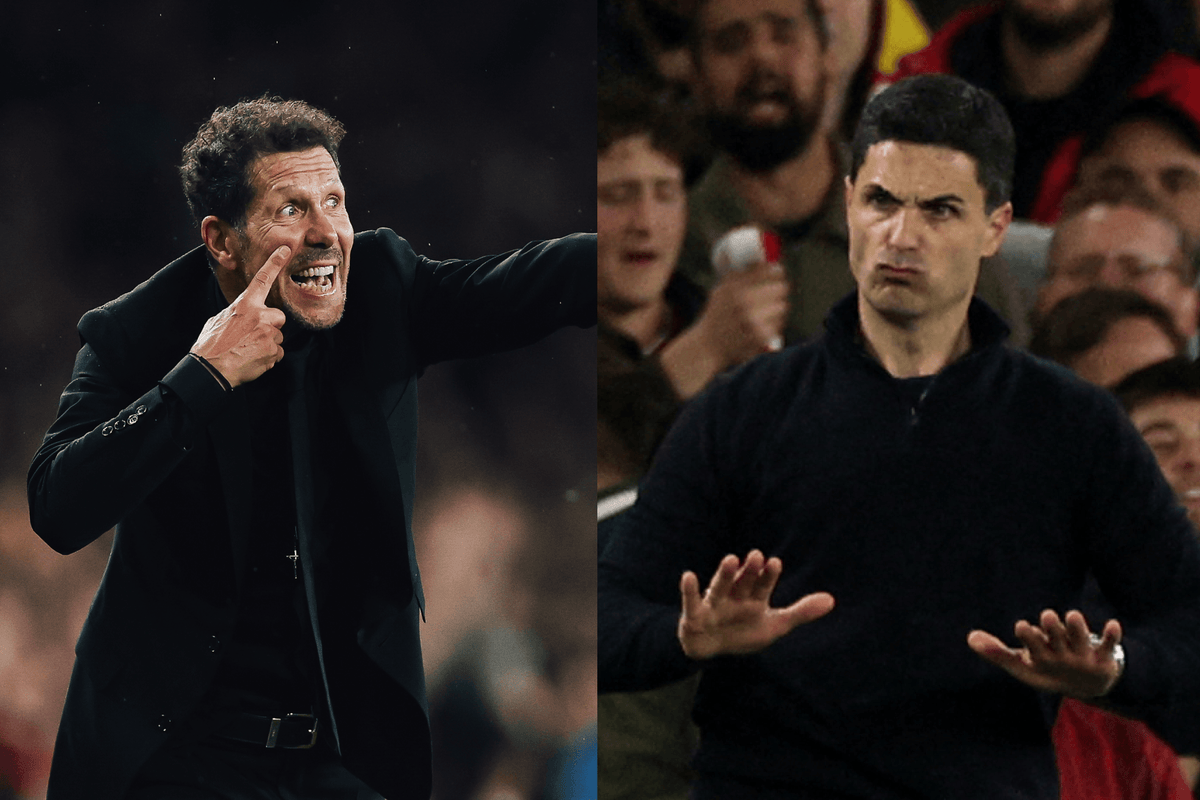
Bukayo Saka was trying to mount an attack early on in the first half, only to find himself being tracked back by a man in a suit.
Diego Simeone, the Atletico Madrid head coach, had matched the Arsenal winger’s run over the first few yards but then had to give up the chase and leave it to his left-back, Matteo Ruggeri, to make the tackle.
Although Simeone stopped short of intercepting Saka, that moment encapsulated the drama in the dugouts during Arsenal’s Champions League semi-final win over the Spanish club on Tuesday.
Simeone is one of the most flamboyant managers in European football, who sometimes has you wondering whether he would be better off just lacing up his boots and coming out of retirement. He kicks every ball and feels every tackle.
His Arsenal counterpart, Mikel Arteta, minus a bit of the extravagant flair, is similar. But at the Emirates Stadium, he was overshadowed — at least from a flailing-arms-and-barking-orders standpoint — by Simeone.
Amazon Prime Video had more than 40 cameras at the Emirates Stadium, and one of them was constantly trained on the dugouts, regularly switching between the two touchline protagonists.
“You are trying to portray the emotion of the occasion,” Prime Video’s director of live sports production in Europe, Andrew Hornett, who oversaw the broadcaster’s coverage, tells The Athletic. “That emotion can be in the crowd, the players involved, and of course it can be the manager.
“The manager is the representation of their club, and they are so nicely in a box that is controllable — and you can see them.”
The Athletic, courtesy of Prime Video, was given access to a TV monitor at the Emirates that only showed the antics — and there were plenty — in the respective dugouts.
Diego Simeone gestures during the semi-final (Adrian Dennis/AFP via Getty Images)
Whether it was both managers being shown yellow cards, Arteta seemingly leading Arsenal’s press from the sideline late on, or Simeone kicking his right foot at exactly the same time Julian Alvarez had a shot in the first half, the technical areas were compulsive viewing.
For Hornett, who spoke to The Athletic two hours before kick-off, there is always a story to be told from the dugout.
“Sport, and football in particular, is about emotion, and one of our driving forces is to get closer to the action to tap into the emotion,” he says.
“And the emotion can be any number of things; anger, frustration, disappointment, history, (Jose) Mourinho running up the touchline, provocation…”
It took fewer than six seconds for Arteta to jump out of his seat to deliver instructions, first whistling to get his players’ attention before waving his arms. The camera then cut to Simeone, who, hands in pockets, stood still.
That, however, was about as calm as he looked for the rest of the evening as his team were knocked out of the Champions League.

The monitors trained on the dugouts during the game (The Athletic/Amazon Prime Video)
“Most of the time, you are going to be coming to them (the managers) as replays,” Hornett says of his team’s approach. “You are recording everything, but very quickly, you are going to play in that one little bit of movement.
“It’s not a true reflection of everything they are doing all the time, but sometimes, let’s say if the ball is out of play, you will go to them live.”
Whatever you may think of him, watching Simeone is box office. He is either on the move, throwing his arms about, rocking back and forth, or upset about something — usually it is a combination of all four.
Whether it is frantically adjusting his shirt and trousers, or waving four fingers and shouting, ‘Cuatro’ at the fourth official after his team won a foul and he perhaps wanted a yellow card shown, you can’t take your eyes off him.

Diego Simeone and Mikel Arteta before last night’s game (Adrian Dennis/AFP via Getty Images)
Even former Arsenal defender Nelson Vivas, now Simeone’s assistant, was in the firing line after approaching him during the first half, only to immediately return to his seat while being stared down by his compatriot, who clearly did not want his counsel.
Arteta, meanwhile, had his fair share of moments, even if he tried to remain calm and keep his emotions in check. Celebrations for Saka’s goal, for instance, were restricted to a quick punch of the air and a short embrace with assistant coaches Albert Stuivenberg and Gabriel Heinze.
But there were also squiggles on a notepad before half-time, a desperate clutch of the head as Viktor Gyokeres missed a good chance to make it 2-0, and another remonstration with the fourth official late on as he was blocked from making a substitution.
Another rare moment of calm, possibly angst, for Simeone came during the half-time break. After leading his team out of the tunnel before the restart, he took a seat, dropped his head into his hands for a few seconds, and then got back up, ready to play another 45 minutes from his technical area and its surrounding area.

Diego Simeone with head in hands as seen on one of Amazon’s monitors (The Athletic/Amazon Prime Video)
If he was on the edge for much of the first half, willing his team on, you could make the case that he was becoming beaten and bruised throughout the second half. His team had improved, yet they could still not find a way through Arsenal’s defence. Atletico’s penalty appeals were waved away, even though Simeone protested by tugging his suit jacket to indicate a shirt pull.
As the match ticked towards its conclusion, with Simeone cutting a dishevelled figure and Arsenal closing on a first Champions League final appearance since 2006, Arteta became much more jittery.
In the final 10 minutes, Arteta left his technical area — again — and whipped up the crowd into a frenzy to help get his side over the line. They responded in equal measure. And to the backdrop of a raucous Emirates, the Arsenal manager walked back into his dotted box and adjusted his trousers. He was also chased down by the fourth official and eventually booked after momentarily standing in the way of an Atletico throw-in.
“There’s any number of emotions that are captured in an enormously intense situation, and you are not going to get much more intense than the second leg of a Champions League semi-final,” Hornett adds.
Moments before the final whistle was blown, Andrea Berta, Arsenal’s sporting director who used to work at Atletico, emerged from the tunnel and waved his arms at the referee, imploring him to blow the whistle.
This caught Simeone’s eye, and he took umbrage at the man he had worked with for more than a decade and decided to shove him before the confrontation was broken up. There is certainly no love lost between the pair.
Diego Simeone appeared to push his former colleague Andrea Berta towards the tunnel as the former Atletico Madrid Sporting Director urged the referee to blow the final whistle for Arsenal 👀 pic.twitter.com/8YTpwdepcH
— Football on TNT Sports (@footballontnt) May 6, 2026
For a brief moment, you even had Kepa Arrizabalaga, Arsenal’s backup goalkeeper, calling for calm on all sides as the temperature threatened to boil over. He was then booked along with Atletico Madrid captain Koke.
As the full-time whistle was blown, Saka, the hero of the night with his decisive goal, slipped past Simeone again, just as he did in the opening exchanges of the match, and joined his team-mates on the pitch to celebrate.
Arteta immediately turned to his coaching team, gave them all a hug, and then went in search of Simeone.
This was Arsenal’s night, and deservedly so, but as is so often the case when Simeone is in town, the dugouts are hive of emotion and activity — and, in a nod to a row that sparked a confrontation between Ben White and the Atletico manager in the reverse fixture, the Argentine made sure to walk over Arsenal’s crest on his way back down the tunnel.


