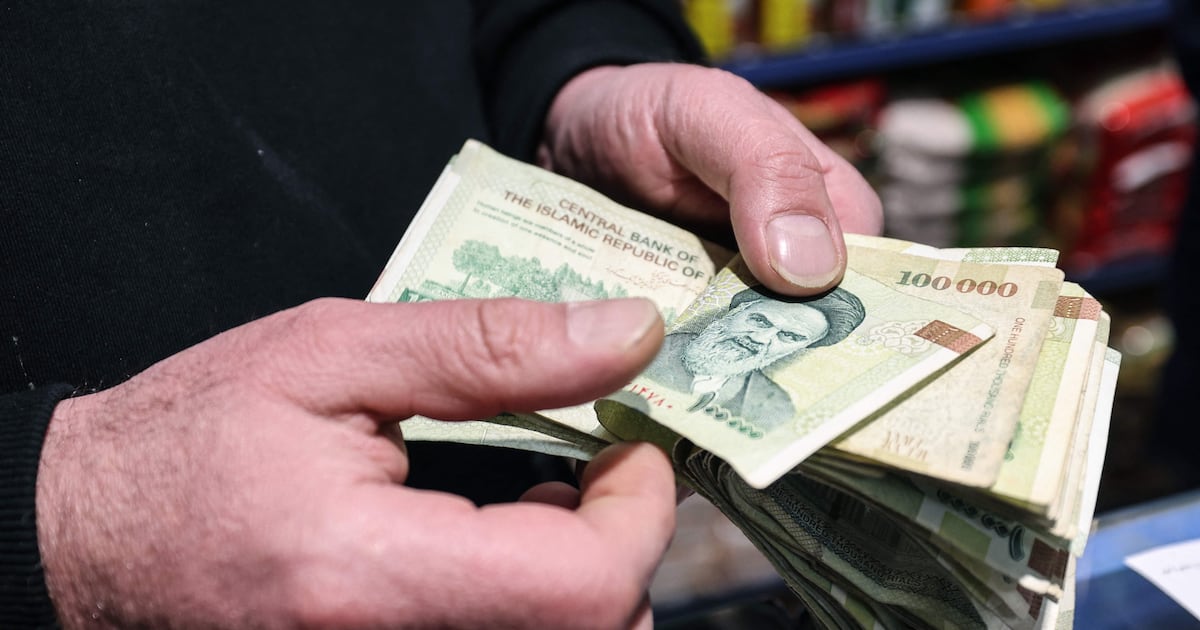
The widening Iran war is casting a spotlight on the country’s cryptocurrency system that analysts estimate handled $7.8 billion in activity last year, with the Islamic Revolutionary Guard Corps believed to be a central player.
Washington has been imposing sanctions on Iran for decades, and the Trump administration’s “maximum pressure” campaign on Tehran led to a local collapse in December, with the Iranian rial hitting a new low against the US dollar in January.
“There is effectively no functioning economy,” Alan Eyre – the only US career diplomat who was a core member of the American nuclear negotiating team from the start of talks in 2010 until the 2015 Joint Comprehensive Plan of Action – told The National.
“It was already in terrible shape before the bombing began and now everything has come to a halt. The economy is essentially paralysed.”
With Iran’s economy essentially broken and with a significantly weaker currency, crypto has become an integral part of Iran’s financial system. Research from the International Monetary Fund has said crypto assets have gained a more mainstream presence in recent years to hedge against weaker currencies.
Many ordinary Iranians turned to cryptocurrencies as a financial safety net during times of economic instability, protests and steep declines in the value of the rial.
“Iranian users can’t really access mainstream crypto exchanges because there are restrictions on Iranian users accessing them because of sanctions. And so Iran has a very vibrant crypto community,” said Kaitlin Martin, senior intelligence analyst at Chainalysis.
But while ordinary Iranian civilians rely on crypto, so, too, does the regime.
Surge in crypto outflows
One of the dozens of exchanges Ms Martin tracks is Nobitex, the largest Iranian crypto asset exchange and a critical component of Iran’s crypto environment.
Iranians use Nobotex to hedge against inflation and because of the ease in transferring money. The exchange is also used by the state and the IRGC.
According to blockchain analysis company Elliptic, Nobitex either sent or received $7.2 billion in crypto transactions last year and has more than 11 million users.
Researchers at Elliptic said outflows from Nobitex surged immediately after the co-ordinated US-Israeli strikes on Iran, with total crypto outflows jumping 700 per cent in the hours after the attacks.
Those findings are similar to those of Chainalysis, which said that about $10.3 million in crypto asset outflows were recorded between Saturday and Tuesday.
“We know that Iranian state actors and actors associated with the IRGC have leveraged domestic Iranian exchanges, and so some of those outflows could represent Iranian state actors moving money from the Iranian exchange,” Ms Martin said.
Crypto wallet addresses are pseudonyms, which makes it difficult to distinguish whether those behind the transactions are law-abiding civilians or part of the regime, Chainalysis said.
We know that Iranian state actors and actors associated with the IRGC have leveraged domestic Iranian exchanges, and so some of those outflows could represent Iranian state actors moving money from the Iranian exchange
Kaitlin Martin,
Chainalysis
Ms Martin said large transfers that range in the hundreds of thousands to millions of dollars could suggest activity by the Iranian regime.
“I’ve seen them move to other unlabelled wallets, or I’ve seen cash-outs at overseas mainstream exchanges, and those are kind of the transfers that I’m looking at to ask the question, who in Iran is moving these large amounts of money?” she said.
The IRGC operates as a vast economic network controlling large segments of Iran’s economy, combining legitimate business activities with illicit operations ranging from industrial projects to weapons procurement, said Tom Tugendhat, a Conservative member of the British parliament and former UK security minister.
“The IRGC uses crypto because, unsurprisingly, it’s sanctioned from most European ones as well. And so it uses it as a way to get around that,” he said in the House of Commons.
Some crypto platforms may tolerate transactions involving sanctioned people because the activity helps to maintain market liquidity and price discovery.
Sanctions evasion
Mr Tugendhat said digital assets represent only part of Iran’s broader sanctions-evasion strategy. Much of the country’s wealth continues to be stored in traditional assets such as gold.
“Most of the store of value of Iran goes into gold,” he said. “It’s the only way they can get anything. And you’ve got to remember, the IRGC is massive criminal enterprise that also runs about 40 to 50 per cent of the Iranian economy. So there are some things that are illegal, like weapon systems out of Venezuela. There are other things … [that] would be legal.”
In January, the US Treasury imposed sanctions on Iranian businessman Babak Zanjani, accusing him of supporting projects tied to the IRGC.
Treasury officials alleged that two cryptocurrency exchanges, Zedcex and Zedxion, both registered in the UK, functioned as part of a broader network used to move funds linked to the IRGC through the global financial system with near-total anonymity.


