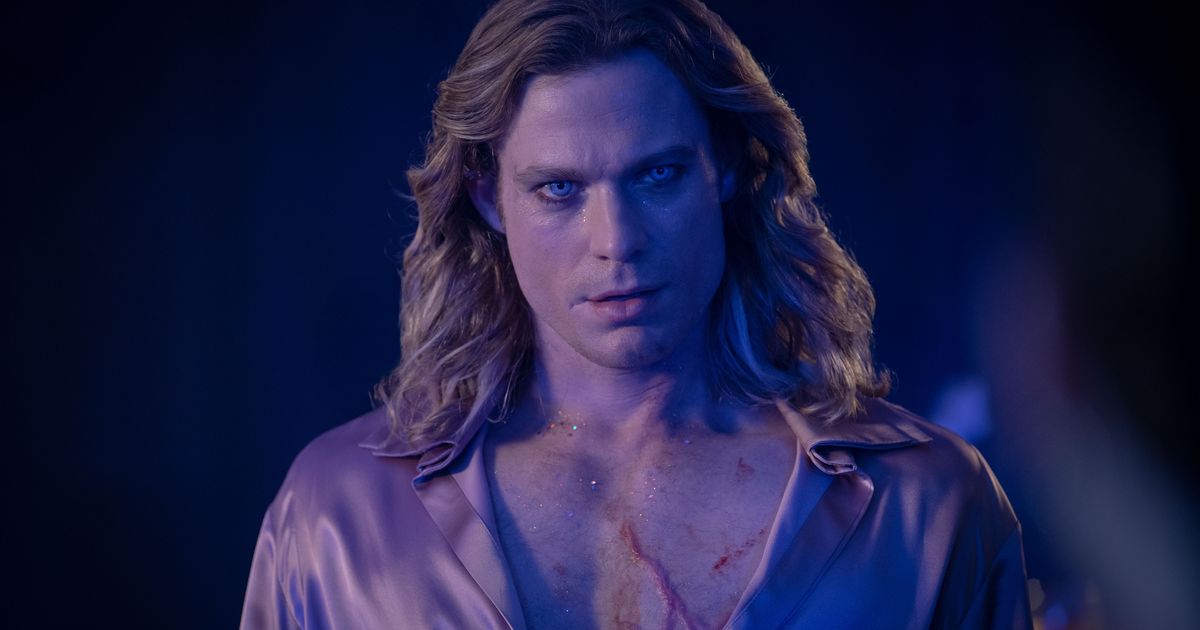
Spoilers follow for “Detroit,” the season premiere of The Vampire Lestat (formerly known as Interview With the Vampire), which premiered on June 7 on AMC.
Every time we’ve seen Sam Reid’s Lestat de Lioncourt on Interview With the Vampire, the French vampire has been filtered through another character’s perceptions. The first two seasons of the AMC series belonged to his ex-lover and vampire progeny, Louis de Pointe du Lac (Jacob Anderson), as he narrated the story of his afterlife: We meet Lestat as he butchers the priest to whom human Louis was confessing his sins, then seduces Louis into vampirism, gives Louis a vampire daughter, Claudia (Delainey Hayles), and by turns adores and terrorizes his fledgling family. Louis’s image of Lestat is an arch, impetuous, and violent figure who embodies all the allure and danger of immortality, but now, season three of IWTV, renamed The Vampire Lestat, resets the story on Lestat’s terms. And Reid is careful to emphasize that this is not a new Lestat we’re meeting: “I don’t think I’m playing versions of Lestat,” he says. “He’s all of these things.”
Premiere “Detroit” introduces the series’ new setup: Lestat is fronting a rock band and touring the country, but during a particularly exuberant moment onstage, he tears down the walls he built to protect himself from the traumas of the last 250 years. Out flood centuries of memories, including Lestat’s childhood in rural France with a cruel father and manipulative mother, Gabriella (Jennifer Ehle); his first romance, with violinist Nicolas de Lenfent (Joseph Potter); and the anguish of his own turning into a vampire. As the season and tour progresses, Reid plays Lestat with increasingly unhinged verve, especially as he derides Louis’s book-length interview with journalist Daniel Molloy (Eric Bogosian) and dives headfirst into debauchery to process his pain over Louis’s account of their relationship.
Reid recorded nearly two dozen songs for the season and learned new instruments to believably perform his front-man duties; he even performed in character as Lestat, alongside series composer Daniel Hart and a full band, at a concert after the New York premiere on June 2. “He has a theatrical persona. It’s the same thing he’s doing in the Théâtre des Vampires as he’s doing on the rock stage,” Reid explains. “It’s his way of dealing with, Okay, I’m a supernatural being, and I want to be out in the open about it. This is how I’m going to present it.” Lestat’s onstage persona is braggadocious and competitive, but in singing about his insecurities and regrets, he’s also presenting himself at his most vulnerable. “He’s looking for real validation,” Reid adds. “He wants to be accepted and loved for his capabilities and himself. And that’s the same way he is with Louis — well, it’s mostly just Louis, the one who he wants to love him truly.”
When you got cast in this role, were you aware of the possibility that you’d eventually be singing and performing?
Auditioning and screen-testing was quite a long process — you’d do a tape, and then you wouldn’t find out for a couple of weeks — and throughout that, I reread all the books again. When I did get cast, Rolin Jones was like, “Learn classical piano, learn violin,” because there’s all this stuff happening in season one. I was a bit like, “This is a lot to take on.” [Laughs.] I’m already trying to learn French, and I’m trying to learn the piano pieces that I had to do, and it was COVID lockdown in Australia. It was quite hard. I remember having a long conversation with Rolin that I’ve conflated with first getting the acrylic nails. I must have been having a phone conversation walking back from the nail salon in New Orleans, because I was really disturbed by how incapacitated I was by the nails in that moment. I remember Rolin saying, “I think you should learn conducting. I think Lestat’s gonna be a conductor,” and I thought, Hmmm, he should be a rock star. I always tried to put elements of that in Lestat — these teasers that we were going to get there. He’s playing piano with Jelly Roll Morton in New Orleans and he’s thrashing his head around.
There was a bit of a push and pull, particularly in the first year and maybe in the first couple of weeks of season two, where Rolin was holding onto the idea that Lestat is a true artist and elitist or snobby in his taste, so he was going to be more directed toward classical music. But I felt it’s quite important that he does take on this rock-star persona. Daniel Hart was very insistent as well. It wasn’t until the middle of season two when this rock-star idea formed strongly in Rolin’s mind.
You’re playing Lestat as a rock star, but you’re also playing a character who’s finally in control of the story rather than a creation of Louis’s memories. How did you approach those demands for the character?
One thing we never really get in previous seasons is the moments where Lestat processes his actions and the quiet. He’ll say something, and then he might regret it, or he might feel that it’s stupid, or he might not have the full, cavalier confidence Louis has painted him with. He does have a lot of self-doubt, and he is capable of seeing his own absurdity and reaching for it, owning it, and then questioning it. With this season, it’s Lestat who’s dealing with his own actions and his own choices. He’s very influenced by how other characters operate and what they do, and he’s often a bouncing board for them. It was wonderful to have people like Jennifer Ehle, just this incredible force of nature, come in, and see how Lestat is when somebody else is ripping the rug out from underneath his feet.
Was there one aspect of Lestat’s arc in season three that was most challenging for you?
There’s so many things happening at the same time, which is appropriate for a character that’s lived over 200 years and is an amalgamation of everybody else’s perception of him. That is his issue: He’s never had time in his life to be able to form his own sense of self-identity. His persona is a performance and has been since he left Auvergne and got to Paris and became an actor. Then he’s ripped off the stage and it becomes this whole other thing. Even through his childhood, his mother is projecting what she wants him to be. He’s desperately trying to seek approval and love and acceptance. It’s quite exhausting living in Lestat’s world, for an audience and for the actor, because he’s trying to stay ahead of the audience and ahead of the listener. And it is coming from a point of reflection, how he’s choosing to narrate this story. He wants you to step into his mind-set. He says, “Well, this is how I felt at the time. I didn’t fully understand it at the time, but this is how I was moving.”
There’s a very long interview scene in episode three, which is very complex. It took me a long time to map out how we were going to do this, playing multiple things at the same time, as well as maintaining that at the core of him is a very empathetic, emotional being that does have a huge amount of awareness and regret and capacity for self-reflection. At the same time, he’s this larger-than-life diva who pushes everybody away from him. It’s actually very joyful to have such a complex arc and character presented to you, and you can just dive into it and get lost.
Daniel told me recording the music for this season has been a nearly two-year process.
The last song we recorded recently. After we finished shooting, I went straight back and recorded for another ten days. I sang all the songs live during filming, and the show will have a mix of the recording and the live performances. Daniel, and particularly Matthew Santos, the vocal coach, spent a lot of time making me feel comfortable that I could trust my voice. We got to the point where, when I sing the songs, I have found the Lestat voice. It is a very specific way of singing and operating, but I needed some foundation for me, Sam, to feel like I could trust my voice in that capacity, to be able to do some of the stuff Daniel wanted. There’s so many songs that haven’t been released yet, but a lot of them are in the highest part of my range, and it took me a while to find that.
Which instruments have you learned to play for the show?
Acoustic guitar, violin, electric guitar, piano. I did a lot of lessons in the drums and in some woodwind and brass instruments, but that sequence ended up changing to something else, which I was grateful for. I’m playing the instruments, but I’m not able to do it all. Early on, we worked out when you’ll need to see me play so I can learn just that part of the song rather than learning the whole song. Violin took a very long time to be able to do convincingly. I don’t know if it would sound any good, but I definitely learned how to play these songs so that you can cut to me and it looks like I’m doing it properly.
Daniel said that, as he was writing the songs, you were the most important person to consult with because you know this version of Lestat best, more so than Rolin or anyone else. What kind of conversations did you and Daniel have about what you might specifically want to get across through the songs?
That’s kind that he said that; I don’t know if I agree. For me, it was very new to approach a character by receiving songs before I received a script. It was obviously a new voice. How Daniel writes the lyrics for Lestat is different to how Rolin or Hannah Moscovitch would write dialogue for Lestat. I was trying to navigate the shift in the character. Daniel’s very fearless, like Rolin, so sometimes Lestat will say something and I’ll think, Oh, that’s a little extreme, or it feels like it’s grappling with an idea that seems undeveloped for me, but he’s already five stages ahead and worked out where Lestat’s speaking like that in the actual show. For me, it was about incorporating Daniel’s songs into Rolin’s and Hannah’s scenes and dialogue and trying to marry the two. The more voices that I have screaming in my ear — whether it be Anne Rice, Rolin Jones, Hannah Moscovitch, or Daniel Hart — the more I have in my head to help me stay in this mercurial zone, the better.
These characters have lived so long, it’s a great disservice to play them without really feeling like they have changed over time. They’re beings of their time, whichever time that they’re in that space. Armand has that great line to Louis about, “I need a vampire to bring me into the New Age.” I always wanted Lestat to feel he’s been to an international school — you don’t really know where he’s from. I have a timeline in my head for him: When we start the show, he should sound more English, and then as we progress throughout the series, he becomes more of an American character, which is his true sense — he absorbs American culture because he is an American character written by an American author and American and Canadian playwrights. He’s actually a very good sigil of contemporary culture because there’s a huge nihilism in him.
What do you hope viewers take away from this season and its presentation of Lestat?
What I do hope that people take away — because this is something that’s really, really fundamental to the character, and is from Anne Rice, and I think Rolin and Hannah have done a beautiful job executing it — is that he’s a very aspirational character. He’s somebody who managed to stand up in the face of adversity over and over and over again. He’s got incredible resilience. He’s getting knocked down and humiliated and going through one traumatic event after another through the centuries, yet still manages to stand up and say, “Actually, I’m pretty fucking great.” He doesn’t always believe it, but he’s always reaching for it. He does always need a level of self-validation, which isn’t that aspirational, but no one’s perfect.
Sometimes I think about Anne Rice saying that he was her id and this character that she wanted to be. I don’t know if I want to be Lestat in my daily life, but he’s a force. In episode three, “The Loneliness” is this song where he’s saying, “You are this terrifying being that can’t escape being trapped in this never-ending cycle of abuse and fear and generating chaos wherever you go. But don’t let it get to you. Don’t burn alone. Don’t worship that grave. Don’t drive toward your end; go toward your potential.” I think it’s very inspiring.
Daniel told me you performed a ballad, “Brutal Love,” that brought crew members to tears during filming.
It’s funny because they cried in the room, but will they cry when they watch it onscreen? We don’t know.
See All
In Anne Rice’s Interview With the Vampire, Armand tries to persuade Louis to be his companion: “It is through you that I can save myself from the despair which I’ve described to you as our death. It is through you that I must make my link with this nineteenth century and come to understand it in a way that will revitalize me, which I so desperately need … I must make contact with the age. And I can do this through you.”


