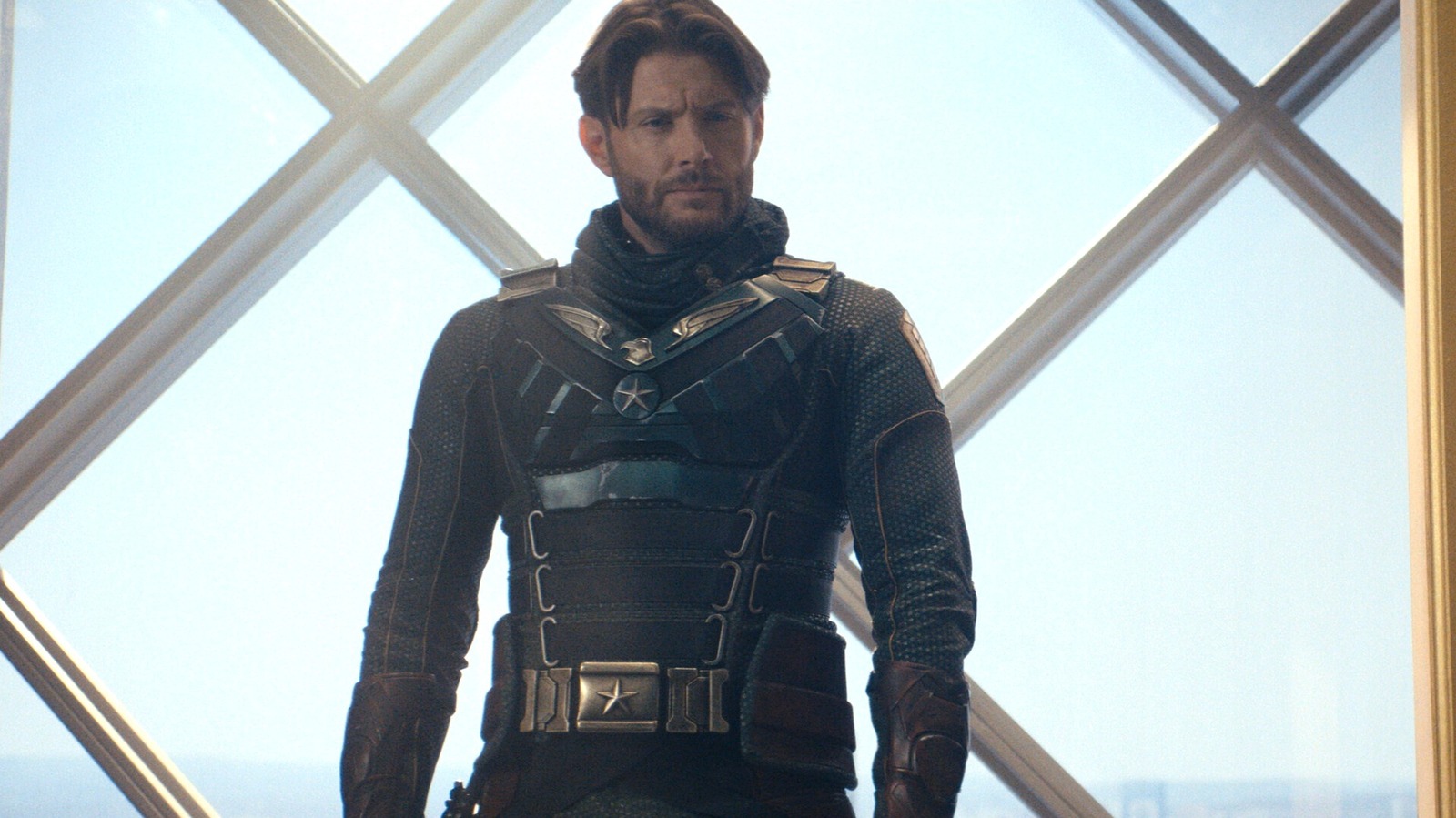
This post contains spoilers for Season 5, Episode 6 of “The Boys.”
Soldier Boy (Jensen Ackles) has returned to the fifth and final season of “The Boys” for a good reason. Previously set up as a foil to his son Homelander (Antony Starr), Soldier Boy shares an uncomfortably complicated dynamic with his son in the latest season. A noticeable shift takes place in Episode 5, in which Soldier Boy kills Mr. Marathon (Ackles’ “Supernatural” co-star Jared Padalecki) and co. to protect Homelander from harm. Soldier Boy still holds disdain towards his son for not upholding hyper-masculine ideals, but he is no longer a threat to Homelander like before.
Episode 6 cements this when Soldier Boy hands over the last surviving vial of V-One to Homelander to help him achieve immortality. This shocking change of heart stems from the twist reveal that Soldier Boy was in love with Stormfront (Aya Cash) at one point. Reasoning that Stormfront would’ve wanted Homelander to achieve “godhood,” Soldier Boy singlehandedly ruins the titular group’s only shot at taking him down. As the Supe Virus doesn’t work on those with V-One in their bloodstream, defeating Homelander feels impossible now, especially with only two more episodes to go. Unless … someone with the unique ability to manipulate blood, like Marie Moreau from “Gen V,” pops up to help save the day.
“The Boys” has been teasing Soldier Boy’s Stormfront connection since the season’s fourth episode. This sets the stage for the upcoming prequel series, “Vought Rising,” which features both Stormfront and Soldier Boy. The details about this unlikely love story aren’t spelled out, leaving ample space for “Vought Rising” to explore what made these characters tick in the 1950s. But what does this twist mean for Soldier Boy as a character?
Soldier Boy’s change of heart in The Boys isn’t as unpredictable as it seems

Sister Sage (Susan Heyward) has been playing 4D chess since she was introduced. As revealed earlier, Sage’s true goal is to incite all-out war between Supes and humans, which will inevitably lead to Homelander’s demise. Soldier Boy is an integral part of this plan, which is why she deliberately sows discord between father and son. Unfortunately, Homelander doesn’t kill Soldier Boy at Fort Harmony, and the latter pays Homelander back by protecting him from Mr. Marathon’s schemes.
Sage’s final pawn was Stormfront, which is why she strategically placed an incriminating tape to prove that Stormfront and Homelander had intimate relations while she was on life support. Soldier Boy reacts with disgust — Sage had banked on such a visceral reaction, which should’ve proven to be the final nail in the coffin of their twisted dynamic. Unfortunately, Sage’s predictions are proven wrong once Homelander claims that he loved Stormfront and that losing her was a massive emotional blow for him. This unexpected common ground informs Soldier Boy’s decision to hand Homelander the V-One, proving yet again that our Captain America knock-off has no regard for real-world consequences.
While Sage is flabbergasted, Soldier Boy’s behavior should hardly come as a shock. He was consistently abusive while being a part of Payback, has shown little remorse for civilian casualties, and was even willing to kill a child (Cameron Crovetti’s Ryan) in Season 3. His fondness for a white supremacist like Stormfront does feel extreme even by his standards, but Soldier Boy has never been one to take a stand against moral depravity. He’s a self-serving hedonist who puts his emotions first at the cost of moral righteousness. We can expect “Vought Rising” to explore these nuances.
Soldier Boy’s return in Season 5 was never about killing Homelander

Details surrounding “Vought Rising” are sparse, but we know that it’ll be centered on “a twisted murder mystery” and Vought’s official formation in the 1950s. The show will most likely explore how Soldier Boy helped bolster Vought’s reputation with post-war propaganda that solidified superhero mythmaking with an unhealthy dose of American exceptionalism. It makes sense to assume that he met Stormfront (who went by the name Liberty) around this time, as the duo founded Herogasm sometime in 1952. If you peer into Soldier Boy’s maligned past, you’ll know that he brutalized civil rights activists during the 1963 Birmingham protests and went on to participate in several Vought-sponsored atrocities down the line.
It’ll be interesting to explore Soldier Boy’s past in “Vought Rising,” but what kind of role is he playing in the final season of “The Boys?” Although he has always been a promising candidate for stopping Homelander, Soldier Boy is more of a psychological mirror to his son in Season 5. While it’s valid to argue that Homelander is the greater of two evils, Soldier Boy’s brand of evil also operates on similar tenets of apathy. Soldier Boy might not be a petulant, validation-craving Supe, but he is fueled by his own set of insecurities that feed into his cruelty.
At this juncture, Soldier Boy’s methodical selfishness feels more dangerous than Homelander’s erratic megalomania. He is well aware of the repercussions of a V-One fueled Homelander, but willfully prioritizes a warped sense of loyalty over the state of the world. Soldier Boy doesn’t care if innocents live or die as long as he can indulge in his vices without consequences. What can be more dangerous than that?
“The Boys” is streaming on Prime Video.


