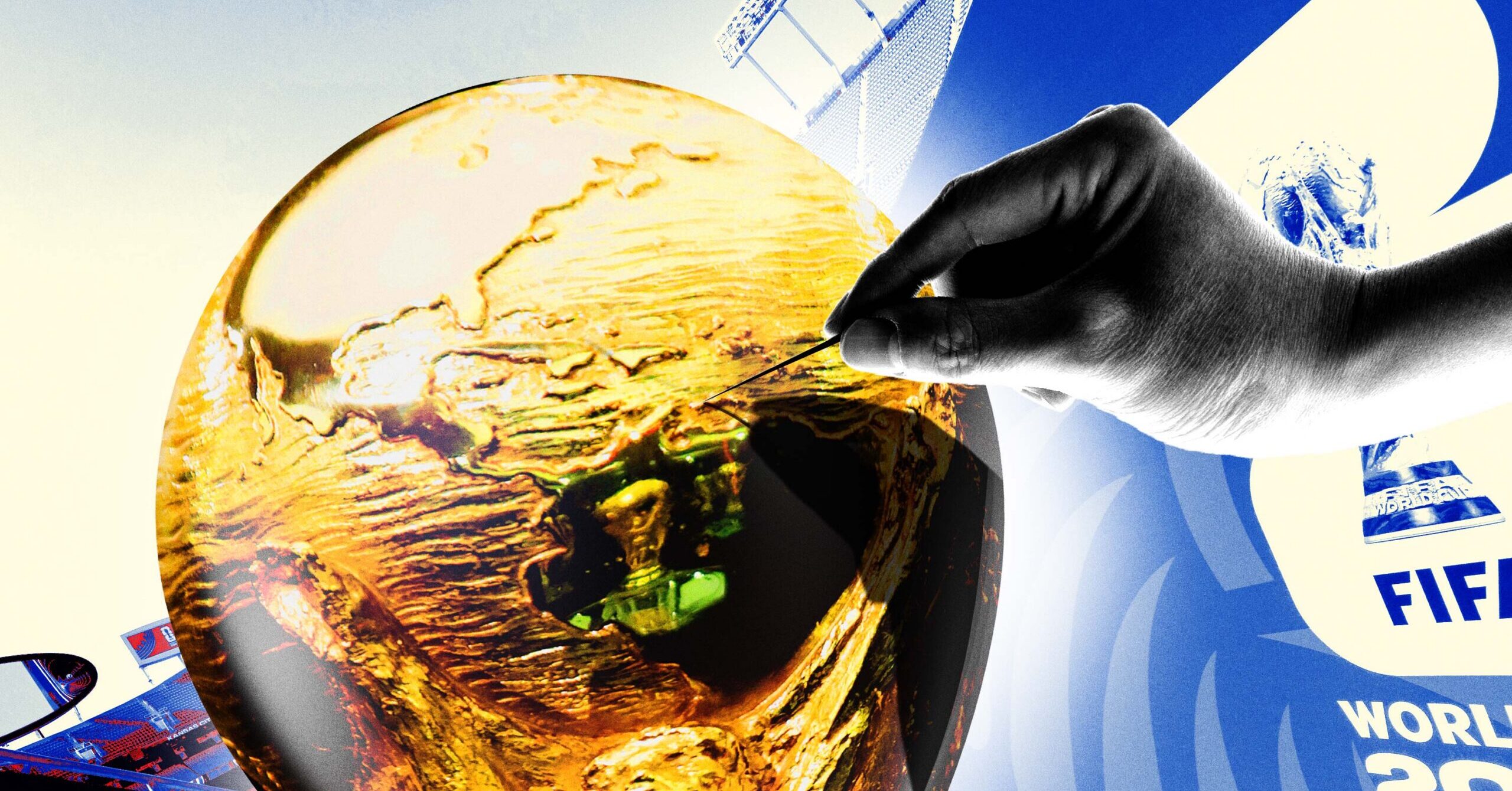
One way to understand the modern World Cup is to think of it as an experiment in capitalism. How much will customers put up with if the product is good? Every four years, FIFA rolls out a new iteration of the biggest sporting event on the planet. Every four years, the organization gets more transparently corrupt, keener to lease itself out to sportswashing authoritarians—Putin, the Qatari royal family, and Donald Trump in the past eight years alone—and more callous to the human rights abuses that seem to follow wherever it goes. (Strangely, you might think, for an entity so devoted to the cause of human Every four years, FIFA’s leaders wait to see whether their behavior will stop a meaningful number of fans from paying ever-escalating prices to enjoy the World Cup experience. Each time, FIFA’s customers demonstrate that they’re willing to overlook almost anything for a month of good soccer. Each time, FIFA notes the outcome in its laboratory notebook and sets the bar a little lower for the next four years. And so the experiment continues.
This year, though, it finally seems as if the result might be different. Of course, what seems true before a World Cup has a way of getting blown to dust by about the second day of matches. But the 2026 tournament, cohosted by the United States, Mexico, and Canada—though don’t mention the cohosting part to Donald Trump—kicks off this week in Mexico City, and in all the years I’ve been covering the event, I’ve never seen a World Cup generate this little advance excitement or this much advance disgust. I’ve also never seen a World Cup whose muted buzz could be so clearly attributed to fans’ exhaustion with the cartoon villainy of the people in charge.
It’s June, the sun is shining, and Harry Kane is about to trot palely across various American stadiums in shorts. But instead of a celebration, the World Cup has become an occasion for dread, fury, and indifference. (In fairness, these are three appropriate responses to the sight of Harry Kane in shorts.) Soccer fans have spent the past four years watching several things happen at once:
- Trump using the tournament for self-glorification while working to reshape American society into something violently hostile to the values of openness, tolerance, and human dignity that FIFA claims the tournament stands for;
- FIFA’s smugly groveling president, Gianni Infantino, abasing himself before Trump to a degree so humiliating it’s basically its own form of body horror, even as Trump insults, threatens, or attacks many of the nations sending teams to the tournament;
- Both FIFA and Trump treating fans and tournament personnel with a degree of contempt that verges on outright hatred;
- All this congealing into a unified spectacle of bullshit that aligns the World Cup with the growing fascist-oligarchist movement to undermine freedom on earth, and that manages to do so without even encouraging fans to hydrate.
We’ve seen Infantino award Trump the inaugural FIFA Peace Prize, practically writhing in submission, like a masochistic iguana, as he did so. “There is also a beautiful medal for you,” Infantino gushed, “that you can wear everywhere you want to (And yes, that’s the same famously peace-loving Donald Trump who has fantasized about annexing both Greenland and Canada, who is openly preparing to invade Cuba, and who threatened to destroy the entire Iranian civilization after his bungled war with Iran left him looking weak and incompetent.)
We’ve seen FIFA roll out a dynamic pricing scheme whose message seems to be, “Welcome to the people’s tournament! We have calculated to the cent exactly how much you need to feed your family for the next three months. That is what it will cost you to see Austria play Jordan.”
We’ve seen the Trump administration vindictively deny visas to members of the Iranian team’s We’ve seen it refuse entry to a tournament referee from Somalia, who was stopped by Customs and Border Patrol officers at the Miami airport. (Somali immigrants, of course, are one of the most frequent targets of the president’s racist attacks; June marks the sixth consecutive month in which the Trump administration has admitted only white refugees.) We’ve seen it harass a member of the Iraqi national team, who was held nearly seven hours for questioning at O’Hare after flying to the U.S. for the tournament. We’ve seen ICE sowing misery in American cities for months, and we’ve heard DHS secretary Markwayne “Yes, That Is the Word on My Birth Certificate” Mullin promise that ICE will be “out there every day” during the World Cup.
How do you stage a tournament while attacking the very basis of its existence, morally and also physically? Welcome to our celebration of openness and international friendship, which we hate! All visitors are welcome here, except the ones we arbitrarily throw into prison, which probably won’t be you, but maybe! Please write your credit card number on this form. How can you stage an event when you can’t even be bothered to conceal that this is your attitude toward it?
It’s all unspeakably grim, and grimly familiar. What’s new this year is that for once, fans seem disinclined to put up with it. Hotel bookings are far below anticipated levels, with 80 percent of hotels in the 11 host cities reporting bookings below initial expectations, according to a report in May issued by the American Hotel and Lodging Association. Games—including the U.S. men’s national team’s opening match—aren’t selling out. As of Tuesday, the cheapest seat available for the USMNT’s June 12 game against Paraguay was $845. “I wouldn’t pay it either, to be honest with you,” Trump said about the ticket prices.
Sagging demand, overpriced tickets, empty seats: These are the defining features of an aging classic rock juggernaut facing the end of its stadium tour era. (In this metaphor, I guess “Free Bird” is Cristiano Ronaldo.) Still, the sports media is running the usual lists of player rankings and teams to watch, often with tacked-on gambling bait—sorry, I mean data-driven insights—from Polymarket or Kalshi. But this time they’re sharing space with headlines like “Why Does No One Care About the World Cup This Year?” and “Empty Rooms and FIFA Cancelations—US Hotels Fear World Cup Washout” and “The World Cup of Ugh.” And beyond that—well, this is anecdotal, but many people I’ve talked to seem to be having the same experience: It just kind of feels like no one is fired up about the tournament. The vibes are not so much off as they are absent. There’s a weariness suffusing American life at this moment, a deep, deadening skepticism provoked by anything that reads as official or semi-official—the war in Iran, Trump’s beautiful ballroom, the White House MMA —and it seems to have spread over questions like “did Harry Maguire deserve to make the England roster” and “will Mbappé erase the memory of the 2022 final.” The greatest sporting event on the planet feels like just one more goddamn thing we have to get through.
Or at least it does today. As I said earlier, the tournament has a way of making pre-tournament discourse evaporate. And rightly or wrongly—there’s a case to be made on each side—three good matches in the first week could erase the indifference of the past three years. The feeling around the tournament may be dark at the moment. It may be the color of a mood ring sealed inside a bottle of cobra venom buried under a garbage dump in a radiation-poisoned But if the U.S. team wins its group, or if Erling Haaland scores on a staggering highlight-reel overhead kick, the feeling could change dramatically.
After all, soccer fans have already put up with so much. We didn’t abandon the tournament in 2010, when poor South Africans were forced from their homes and shoved into a camp of corrugated iron shacks to keep them out of the tourists’ view. We didn’t abandon it in 2014, when Brazil used its military to clear villages and pacify favelas that were seen as obstacles to the tournament. We didn’t abandon it in 2018, when Putin smiled under the lights inside stadiums built by forced labor from North Korea, while forces aligned with his regime savored the results of their horrific purge of gay men in Chechnya. And we didn’t abandon it before the bloody, beautiful, and hopelessly misbegotten 2022 World Cup, which was conceived in corruption, which ended with the single most thrilling sporting event I have ever seen, and which took place in arenas that hundreds, possibly thousands, of migrant workers died to build.
We stayed with the tournament because soccer is not called the beautiful game for no reason. The performance of athletes has never been determined primarily by the political context of the games in which they’re playing, and the games have frequently been amazing. Everything good about sports—the astonishing skill, the moments of knee-buckling drama, the goals that make you hold on to your face and run around the room like a wind-up toy, the live chance that a group of Japanese tourists will meet a group of Senegalese tourists in a sports bar called P.J. O’Malley’s and become friends for life—it’s all here, amid all the nihilism and venality and horror. All of it.
For my part, I’ve always believed that the good of the World Cup is enough to justify watching, as hard as FIFA works to convince me I’m mistaken. Maybe it’s more accurate to say I’ve always wanted to believe that we soccer fans can have our own World Cup, one that has nothing to do with FIFA and that only superficially overlaps with the tournament FIFA is selling. That is, FIFA may be shoving bland, cynical spectacles of sportswashing down our throats; FIFA may see the World Cup as a service industry whose service is overlaying Trump’s decaying head atop the globe’s ultimate circus. But the moments of joy that soccer generates can still, and mostly do, come from an entirely different place, and the astonishing feeling of connection that comes from sharing the same peak experience with so many people at once is a force neither the authoritarians nor their lackeys can control.
A billion people are watching the same terrified 22-year-old step up to take a penalty kick. A billion people are going to lose their minds at the same time regardless of what happens. Being part of that experience changes your consciousness. It can’t happen otherwise. As corny as this sounds, it really does bring people together. It gives us something shared, something that feels magical and that simply doesn’t care very much about borders or tariffs or empires or sources of xenophobic distrust. It reminds us of precisely the thing the authoritarians want us to forget, I tell myself. It’s working against their agendas the whole time they’re trying to harness it.
I still feel this way, but God, it’s harder than it used to be. The human cost is so high, and getting higher all the time. If I don’t believe the World Cup should ever have been awarded to Russia, Qatar, or Trump’s United States—and I don’t!—then when I justify my decision to watch it anyway, am I doing anything but taking complicity’s scenic route? I hope so. I think so. But I can’t be sure.
Probably the best hope for the 2026 World Cup as a viewing experience is that Trump looks cooked in ways that hadn’t previously seemed possible. He’s old, rambling, and increasingly frail. He can’t stay awake for a game in a sport he actually understands. His poll numbers reveal him to be crushingly unpopular. Other Republican politicians are defying him for the first time in years; for the Republican-controlled House to pass a war powers resolution rebuking his aggression in Iran would have seemed unbelievable even a few months ago, but it happened last week. Even his most recent lies about voter fraud, regarding Spencer Pratt’s loss in the Los Angeles mayoral race, don’t seem to be moving many needles. Americans increasingly see the president as a elderly little boy pouting in front of the PlayStation and claiming his controller is broken, which isn’t exactly the image of godlike authority he clearly wants to project.
If Trump is too weakened, distracted, and sleepy to make it through a Knicks game without looking pitiful, it’s unlikely he’ll be able to dominate the World Cup—even from a distance, even via posting—in the way he once seemed bound to. If he can’t, it should be a lot easier to watch the games without constantly thinking about what they’re propping up and what they represent, which might, paradoxically, make it possible for them to represent something good.
The greatest cause for optimism around this World Cup, however, may be the likelihood that the pessimists are right. What if people don’t tune in? What if global interest actually plummets? While I’ll be surprised if that happens, what could be a more beautiful outcome for the beautiful game than the Trump-Infantino alliance falling flat on its face?
After all, the path to genuine FIFA reform isn’t likely to run through skyrocketing ratings. The best chance for the World Cup to improve is for Infantino’s regime to fail in the ways that doom all corporate C-suites: not to achieve growth, not to achieve profits, to weaken the power of the brand. When FIFA sinks to a level of grotesquery that World Cup viewers won’t tolerate—when the experiment finally returns an unsuccessful result—real change may be possible. One disastrously unsuccessful tournament this year might lead to less exploitative World Cups in years to come. That seems like an experiment worth making, too.

Brian Phillips
Brian Phillips is the New York Times bestselling author of ‘Impossible Owls’ and the host of the podcasts ‘Truthless’ and ‘22 Goals.’ A former staff writer for Grantland and senior writer for MTV News, he has written for The New Yorker and The New York Times Magazine, among others.


