When you buy through links on our articles, Future and its syndication partners may earn a commission.
Credit: Future / Getty
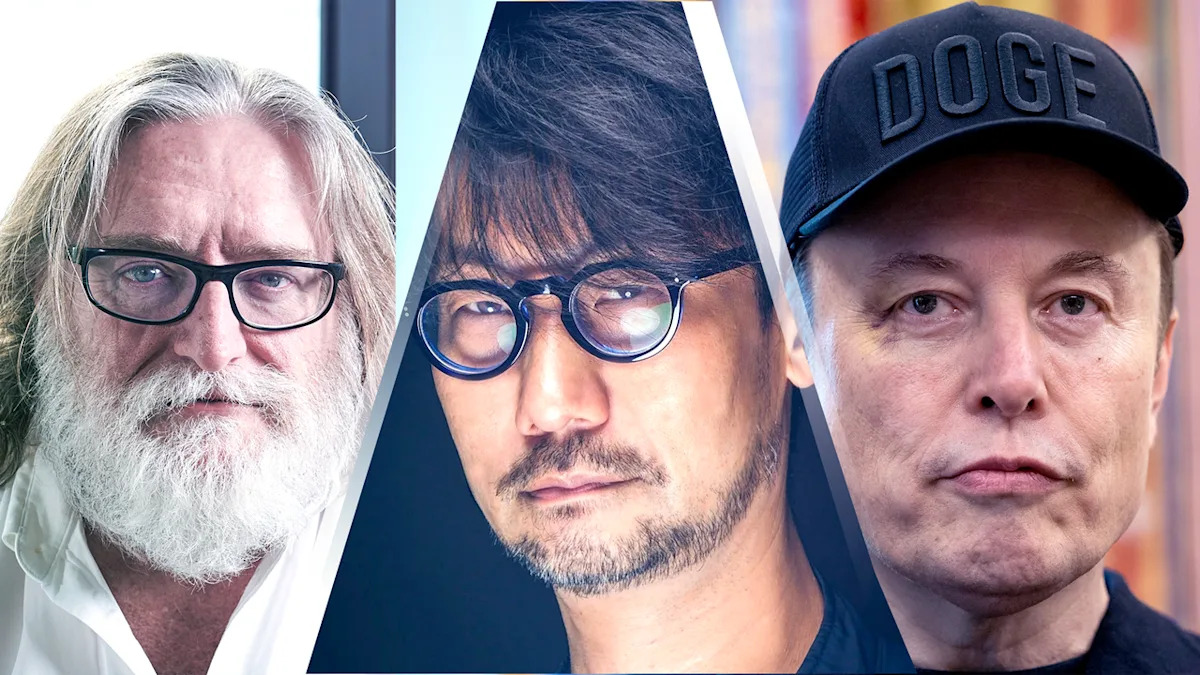
In 2018 Hideo Kojima visited Valve headquarters to talk about Death Stranding. Based on emails now public thanks to the ongoing Musk v. Altman lawsuit, Kojima and Gabe Newell seem to have hit it off, if they weren’t already buddy-buddy: after the meeting Newell promised to introduce Kojima to people at the then still-not-well-known OpenAI, and also to Elon Musk.
Musk, of course, owns SpaceX, and Kojima has well-known ambitions to go to space.
“Hideo Kojima (Metal Gear series, a real visionary in our field) was here at Valve talking about his new game, and he mentioned the importance he places on future work in AI,” Newell wrote to Musk in late October, 2018. “I said I’d be happy to introduce him to the people at OpenAI and spoke enthusiastically about the work that team has done with us (I’m not sure how involved you are with them nowadays).”
Newell continues: “The second thing is he was talking about how much he wants to go into space, and I offered to introduce him to you. He’d love to get a SpaceX tour.”
Musk was receptive: “Sure, it would be great to meet Hideo Kojima and he’s welcome to see the rocket factory,” he wrote. “No problem to send him my email.”
By 2020, Kojima’s desire to visit space still hadn’t been fulfilled. In an interview with Geoff Keighley, Kojima said that he wanted to visit SpaceX with Newell, to which Elon Musk replied on X (then still Twitter): “Welcome anytime.”
It needs to be kept in mind that Kojima’s desire to go to space is more intense than, say, a five-year-old child’s. In his book The Creative Gene (via Vice), Kojima describes his passion thusly:
“If I could have just one wish in my life—if I could cast a magic spell and make anything come true—without hesitation, it would be this: ‘I wish to go to space before I die.’ It doesn’t have to be anything as extravagant as a trip to the moon or Mars. I would be satisfied with only a brief orbit, just beyond Earth’s atmosphere, where I can gently brush against outer space. I would give up anything to make that wish come true: my current place as a game designer, which I’ve built up for forty-five years; I’m even prepared to throw away my family or my own life. That is how powerfully I—or rather we—yearn for the cosmos.”
In other words: Someone really needs to send this guy to space.
As for Kojima’s wishes to chat with OpenAI, Musk displays an early ambivalence towards the organisation that seems to presage the current Musk v. Altman lawsuit.
“Regarding OpenAI, my involvement is very limited at this point. I still provide some financial support and get verbal and email updates every few weeks from Sam Altman, but don’t spend time there. I lost confidence that OpenAI could muster the resources to serve as an effective counterweight to Google / Deepmind and decided to attempt that through Tesla instead. We have cash flow on the order of billions of dollars per year to build hardware that hopefully has at least a dark horse chance to keep Google honest. Probably worth talking about at some point.”
Given how much Steam earns Valve in revenue, I have to imagine that even in 2018 he wasn’t overly impressed by Musk’s “billions of dollars per year” line. Newell does, though, touch on Musk’s Neuralink concerns. No idle interest, it turned out, because a year later Newell founded his own neuroscience company in the form of Starfish Neuroscience.
“For a long time I thought neuromodulation (e.g. rTMS) was weird, mainly because I had an unsophisticated understanding of a bunch of aspects of the brain,” Newell wrote. “I’ve more or less done a 180, and think there is a significant near-term consumer market. Is this something I should bring up with the Neuralink team? If so, anyone in particular I should chat with there?”
Musk points him to several contacts before offering a progress report: “We’ve made some pretty insane technical progress. This is highly confidential, but we’re now able to implant ~6000 electrodes in a monkey brain with decent signal / noise. Moreover, the electronics are compact enough to be flush with the skull and the only thing visible is the USB-C opening and slight surround. Very trippy. Just like Neuromancer.”
You can read the full email exchange, surfaced by OpenAI defense firm Morrison & Foerster, here.


