Hey everyone …
• This week’s Served podcast wraps up Roland Garros and looks forward to Wimbledon.
• Here is my 50 parting thoughts column recapping Roland Garros 2026.
• In this week’s edition of a friend’s book you must order: Andrew Brandt’s Smarter About Sports.
Onward …
Thank you for mentioning the partner violence aspect of [Alexander] Zverev’s story, which some outlets would prefer to ignore. I imagine a fair number of tennis fans tuned out today, and much as I love the Served podcast I’ll be passing on the final recap episode because I’m just bummed this guy won.
Prof C.
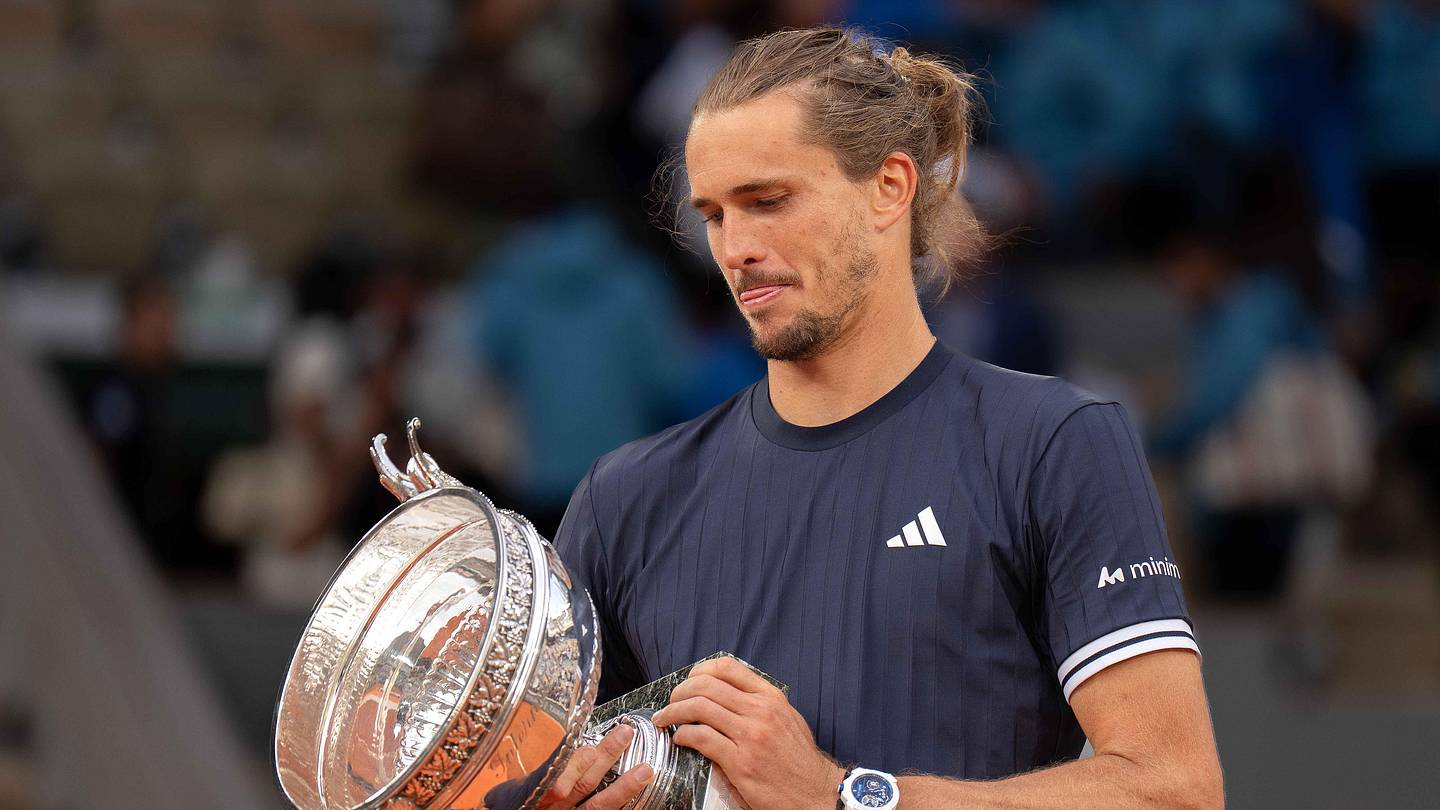
• Let’s address the pachyderm in the room. The past allegations of partner violence made against Alexander Zverev by two former girlfriends, Olga Sharypova and Brenda Patea, and the residual murkiness, have added emotional complexity to Roland Garros 2026. Predictably, it has generated a lot of discussion since.
As I see it, the driving force here is the residual ambiguity of it all, and the unsatisfying “resolution,” if you can even call it that, to his abuse case. This would be easier if Zverev had been convicted or exonerated. But, instead, his case was settled out of court, and we now sit in this liminal space, a no-man’s-land, in tennis terms. Here was the German court’s spokesperson in 2024: “The decision is not a verdict and it is not a decision about guilt or innocence. One decisive factor for the court decision was that the witness has expressed her wish to end the trial. The defendant agreed to the termination of the case.”
Even the statement from Zverev’s lawyers was craftily worded. “The discontinuation does not constitute a finding of guilt or an admission of guilt. The legal presumption of innocence remains unaffected.”
This wasn’t just an instance of dueling accounts—he said, she said. It was he said, she (plural) said, and came with documentation, photos and contemporaneous accounts. That the alleged violence happened adjacent to tennis events—the U.S. Open, Laver Cup—added discomfort. Same for the ATP’s fecklessness, as—at least for me—did circumstantial bits of evidence. (This one always got me: After Zverev’s reputation—and potentially career—was derailed by allegations of a crime of violence, he hit an umpire’s chair with his racket after losing a doubles match at the Mexican Open in 2022.)
At the same time, if you believe in legal presumptions of innocence until proven guilty, it must be noted that there was no finding of guilt here. We can save our critique of the German legal system for another day—how does a criminal bodily harm case end up with no finding of guilt or innocence, but a six-figure payment to the state and philanthropy? We can challenge Zverev’s assertions that the claims were “proven false.” They weren’t. And yet, Zverev was not convicted.
As such, opinions are split. To some, the weight of the surrounding circumstances is disqualifying. Others are squarely in the innocent-until-proven-guilty camp. Until/unless the allegations and charges result in convictions, Zverev is untainted, and in some cases, seen as even more sympathetic for having endured a (their words) “witch hunt.” (I experienced this firsthand the other day. I mentioned Zverev’s situation in my column off the French Open final and was harangued by some fans wondering why I would reference the allegations on the day of his biggest triumph. Hours later, I didn’t mention the Zverev allegations in the Roland Garros 50 thoughts column and was harangued by some fans claiming this was whitewashing.)
And the whole thing comes with this film of—legal term, here—ick. Sports betting writer Isaac Rose-Berman summed it up this way in a post on X: “This situation is objectively horrible for tennis, and there is no easy way to deal with it; taking action isn’t feasible but not taking action means lots of people will be, justifiably, furious.”
As for media coverage, there’s no rule of thumb for how to cover this, no conversion chart with “alleged offense” on one axis and “times you should mention” on the other. Just as some fans simply turn off the coverage when Zverev plays, some journalists do too. Ben Rothenberg, most notably, landed here. He’s not alone. Mary Carillo once declined a Laver Cup presenting role, citing Zverev. Just as other fans consider this settled or old news, some media outlets cite the lack of conviction and see no reason to mention the case at all.
Most of us fall somewhere between those poles. I don’t think we need to allude to the allegations at every changeover. But much as we—not least Zverev—wish it weren’t the case, a stain and stench remain. And, ethically, I don’t see how you can write a story of Zverev’s major breakthrough and take inventory of his career without referencing this. So I did.
I’m curious about your 50 Thoughts column. I love reading them after every slam, part of my tennis tradition. But I’m curious which didn’t make the cut. Surely, you didn’t only have 50!
Name withheld by request
• Sure. I write as I go and then obviously fill in the winners on the last weekend. But here are a few I either didn’t use or wish I had …
1) The rise of the female coaches. Conchita Martínez was in the cockpit when Mirra Andreeva piloted herself to a title. But there were two other players in the Final eight, Anna Kalinskaya and Marta Kostyuk, with a female coach. And I’m told the girls’ champion, Alisa Oktiabreva—who was a delight; surely the first tennis player to shout out her violin teacher—has a female coach in her camp as well.
2) Trivia answers to questions posed in the parting thoughts! Stan Wawrinka can pull off the career Grand Slam at Wimbledon. Gaël Monfils’s kid brother Daryl is Moïse Kouamé’s agent.
3) A tennis secret: The number of nonactive players who defer retiring so they can take advantage of tennis’s benefits, be it accruing pension years, staying on the health and dental plan, or taking paid maternity leave.
4) How quintessentially tennis is it that Serena Williams held her first press conference since returning during the Roland Garros men’s final? In what universe is this in the service of the good of the sport? Whether it’s the Williams camp’s demands, the lack of communication between tournaments or a general slip-through-the-cracks inattention to detail, this was a tidy example of tennis’s structural and governance disorder and how it hurts the overall product.
5) Remember Alizé Lim, a French player who now does some (excellent) commentary work? My moles tell me she missed Roland Garros because she was in the south of France filming The White Lotus.
Jon, as someone who knows Rafa and was in the film, I’m curious what you thought of the documentary. I loved it!
NS, Brooklyn
• I have conflicts galore here that I should disclose. I have a forthcoming tennis project with Netflix and a forthcoming media project with Rafael Nadal. Also, we all can—and do and should—have opinions about art we consume. But I want to make clear that I am not a film reviewer. I’d encourage you to read what the trained experts have to say. Here’s one from Naomi Fry of The New Yorker, a writer I quite like. She’s clearly an outsider (imagine a tennis fan describing Roger Federer as punchable!) and makes some interesting points.
I liked the film a lot. It’s excellent in many ways, and I highly recommend it to fans and nonfans for a variety of reasons. It’s beautifully shot and stitched together—high praise to the director and the editor. The history is comprehensive. The film casts a critical eye on complicated Uncle Toni without taking the easy way out and making him a villain per se. The score. The way Mallorca is portrayed as a character. The implied connection between Nadal’s physical vulnerability to the whims of injury and his need/desire to take control of everything he can control. The little moments, like singing Lady Gaga on the training table. There’s a lot of really deft touches here, large and small.
My quibble: The theme of injury and recovery comports with facts. Nadal’s career, indisputably, was one of starts and stops based on health, but that’s not especially visual or propulsive. The action and drama of sports, the binary of wins and losses, someone negotiating life’s curveballs (death, breakups, financial ruin or addiction) and responding to bad choices and their consequences—those are plot points audiences can relate to. Training tables, rehab sessions, MRI scans, and interviews with doctors and physios? Not so much—especially when the injuries are varied, and the types are few that we normies can relate to. (Wait, his foot is numbed but he’s still running?) It’s harder to wrap a film around that spindle.
But again, those are quibbles, not complaints. This is a worthy, honest, honorable project. It’s worth your investment of time and attention. Watch it here. (Then, he says shamelessly, keep your Netflix page on the tennis offerings and watch Chris and Martina: The Final Set starting June 26.)
Has Jannik Sinner cracked your top 10 of all time—men’s division—yet?
James B.
• This question came the day before Sinner was eliminated from Roland Garros, but I like it. I was talking to a former player about this. Sinner is a great advertisement for the ATP tour. He has won “only” four majors, and “only” one of the past five. Yet there is a sense that he is not merely great but generationally, even historically, great. Why? Because he wins week in, week out, on all surfaces throughout the year. I don’t think he’s quite in the all-time top 10 yet, but he’s higher than his major count would suggest. And he still has a decade to go.
HAVE A GOOD WEEK, EVERYONE!
More Tennis from Sports Illustrated
 Add us as a preferred source on Google
Follow


