Submissions have been lightly edited for brevity and clarity.
Hey everyone,
• Here’s this week’s Served podcast.
• This week’s buy-my-friend’s-book appeal: The Plunge by Chris Ballard.
Onward …
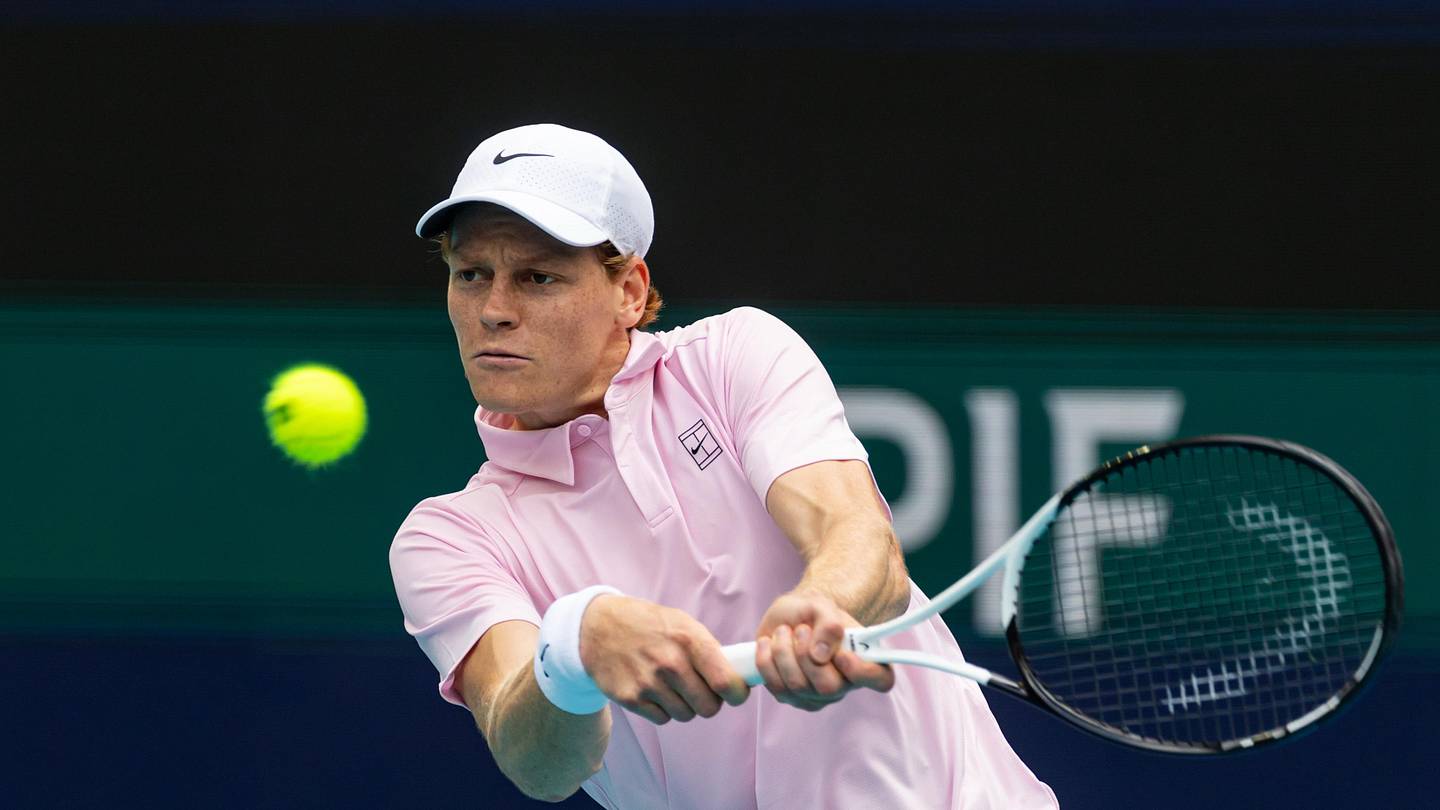
Love your podcast. Thanks! I’d like your thoughts on this: Is anyone else tired of hearing Jannik [Sinner] described as a machine or robot, as if he doesn’t have a creative game that’s beautiful and spectacular to watch, like Carlos [Alcaraz]’s game? Personality doesn’t translate directly into play, IMO. Jannik is also passionate about tennis, and Carlos plays a tactical game too. Labels are simplistic for such all-rounded excellence.
Name misplace
• We—fans, media and marketing types—like these cut-and-paste labels. It’s all so much easier to digest (and sell) when everyone is reduced to a caricature and one-phrase logline. Sinner has been reduced to the clinical, efficient, bloodless tennis engineer. Why? Because it seems his game isn’t hit-or-miss, but rather steady, and his on-court emoting is minimal. He is not interested in signature gestures, intemperate comments or social media mayhem. And, as the reader notes, it’s all set off against his rival, Alcaraz, who relishes the role of entertainer, has a different risk/reward threshold and is more open about his personal life.
To the reader’s point, these easy shorthands are wild oversimplifications. They don’t account for nuance. They don’t account for taste—for plenty of fans, Sinner’s ritual excellence, stand-and-deliver baselining, easy power and fluid movement is just as entertaining as classic shotmaking. It also doesn’t account for change. Like all of us, players evolve as athletes and human beings. The characteristics that define Sinner in 2026 may be totally different in a few years. Novak Djokovic was the goofy imitations guy, lacking in physical durability, until he became someone and something far different. Rock-and-roll Andre Agassi became a wind chime. Ice queens melt. Shy players find their voice. Will their sloppy labels catch up?
Love to get your thoughts on what in my mind is an underappreciated aspect of tennis (and probably golf) relative to other sports: the robustness of the ruleset. Obviously there have been changes over the years regarding tiebreaks, bathroom breaks, line calling, etc … but tennis has had very few rule changes that “cut deep” in my opinion. The technology has changed, the conditioning has changed, the professionalization has changed, but at its core, tennis is still played on the same dimensions of court, with the same scoring (more or less), and with the same mechanics governing what a point consists of. This core ruleset works equally well across a century of history, for both men and women, professionals and amateurs, a multitude of surfaces, and … with one small tweak, even to wheelchair tennis. There’s no a priori reason for this to be the case as far as I know but it seems true nonetheless. Compare that to other sports where it sometimes feels like rules are just endlessly being …
@harridaechoes
• Great question and topic. I would break this into a few subtopics.
A) The tennis scoring system is genius. There is no clock to run out, and there’s always the possibility of a comeback. It’s the beauty of the Simpson’s paradox. (You can win more points and more games and still lose.)
B) The dimensions of the court are what they are. Sure, given the evolving role of the serve, you might want to reduce the size of the box. But unless we are going to retrofit every tennis court in the world, changing court dimensions is not a realistic option.
C) The relative lack of rule changes could be seen as a sign of durability. It could also be a sign of intransigence, dysfunction or a lack of centralized power. Given the changes to technology, training, the quality of athletes and fans’ attention spans, is it a virtue or a vice that tennis has made so few changes that, as you correctly frame it, “cut deep”?
I waver. I like tennis’s pride in tradition. I like its skepticism of gimmicks. (Tangent: Anyone else see Steve Kerr advocating for a removal of the three-point line in basketball?) I also wonder whether the sport is adequately addressing injuries and maximizing fan enjoyment and player performance, given its resistance to meaningful change.
Referring to renowned athletes by first name is questionable enough, but when Venus never gets a surname here suggests a level of insider-ish writers chumminess that violates longheld journalism standards. Please purge this increasingly regrettable habit.
@mtierneysports
• Thanks. This is a fair point, but I would gently push back.
A) It’s less about personal chumminess than a general sports cosmos familiarity, born of the player’s accomplishment and longevity. Tiger, Shaq, LeBron, Kobe and Shohei. For that matter, Rafa, Novak. Roger and Serena. Some athletes have done enough that one name will do.
B) It’s compounded here—and was, almost, from the jump—by a sister in the same line of work. “Williams receives a wild card” would be a lousy headline, as it would leave the audience wondering which one. For the simple sake of differentiating, the Williams sisters were often referred to by their first names, and neither seemed to mind.
C) The unusualness of the name plays a role here, too. If I were to write, “Jelena won her lone major on clay,” it would ring awkwardly. (Who is Jelena?) “Michael is the fastest player in the draw.” (Who? Chang? Russell?) These single names are easier to defend when they are unique.
Hi Jon,
One suggestion: List the size of your subjects. For instance, “The 18-year-old righthander is 6-1, and 170 pounds.” Writers like yourself know the size of their subjects, but often don’t include it. For those who really follow sports, such information is helpful in assessing the athlete’s potential. Meant in good faith,
Dyke Hendrickson former Boston Herald
• I appreciate that, and don’t disagree. Given tennis’s international audience, it should probably be done in metric as well. One point—which doesn’t discount yours—is that size can be misleading. Sometimes, smaller players don’t lack power (see: Francisco Cerúndolo or, for that matter, Alcaraz). Sometimes tall players are slender or move gracefully. One of the beauties of tennis: Bodily dimensions don’t preclude certain skills.
Shots
• ŌURA, maker of the world’s leading smart ring, and the USTA announced a five-year partnership naming Oura an official sponsor and wearable fitness device partner of the U.S. Open, USTA and USTA coaching.
• The International Tennis Hall of Fame and Cerity Partners announced a multi-year title sponsorship of the Hall of Fame Open, the combined ATP Challenger and WTA 125 tournament.
More Tennis from Sports Illustrated
 Add us as a preferred source on Google
Follow


