69
The ongoing clash between Tollywood producers and exhibitors is being treated like a localized dispute over rent and revenue shares. But zoom out, and a much more dangerous picture emerges. The Telugu film industry is suffering from a massive structural collapse. The business model has evolved rapidly over the last four years, but the industry’s biggest players are still operating on outdated, pre-pandemic egos.
Here is a deep-dive analysis into the four pillars of this crisis and how they are suffocating the industry.
The 75% Black Hole: Out-of-Control Remunerations
The root of the crisis is terrible budget management. On paper, a Telugu blockbuster boasts a budget of ₹200 crore to ₹300 crore. In reality, up to 75% of that money never makes it to the screen. It is swallowed by the fixed, upfront remunerations of the lead actor, director, and top technicians.
This leaves a meager 25% for actual filmmaking—VFX, production design, writing, and promotions. To recover this top-heavy investment, producers are forced to hike ticket prices to exorbitant levels and sell digital rights prematurely. The producer takes 100% of the financial risk, while the stars take home guaranteed paychecks, regardless of the film’s box office fate.
The “Pan-India” Paralysis and the Missing Stars
The desire to replicate the success of Baahubali or RRR has created a “Pan-India” delusion. Instead of focusing on strong, regional storytelling, every major project is forcefully scaled up to appeal to a national audience. This ruins the core emotional connection with the native Telugu audience.
Worse, this massive canvas requires years of production. The data is alarming:
- Mahesh Babu: Guntur Kaaram released in January 2024. His SS Rajamouli project will take years, meaning a massive gap for his fans and the exhibitors who rely on his crowds.
- Allu Arjun: Pushpa 2 arrives in late 2024, nearly three years after the first part.
- Ram Charan & Jr NTR: Both global stars are locked into massive projects that stretch timelines to the breaking point.
When the biggest stars only deliver a movie every two to three years, the audience simply loses the habit of celebrating cinema in theaters. The hype dies, and the theaters stay empty for months.
The Collapse of the “Middle Class” Cinema
A healthy film industry survives on its middle class—the Tier-2 and mid-range heroes who keep the cash registers ringing between big tentpole releases. But Tollywood’s middle tier is currently missing in action.
Actors like Sai Dharam Tej, Akhil Akkineni, and Nikhil haven’t had a release in ages. Even reliable, frequent performers like Nani and Vijay Deverakonda have slowed their pace. Right now, only a handful of talents like Sree Vishnu or director Anil Ravipudi are consistently delivering yearly projects. Without a steady stream of mid-range, content-driven films, theater owners cannot survive the long winters between Pan-India blockbusters.
The Theatrical Death Spiral: Ticket Hikes and OTT Rush
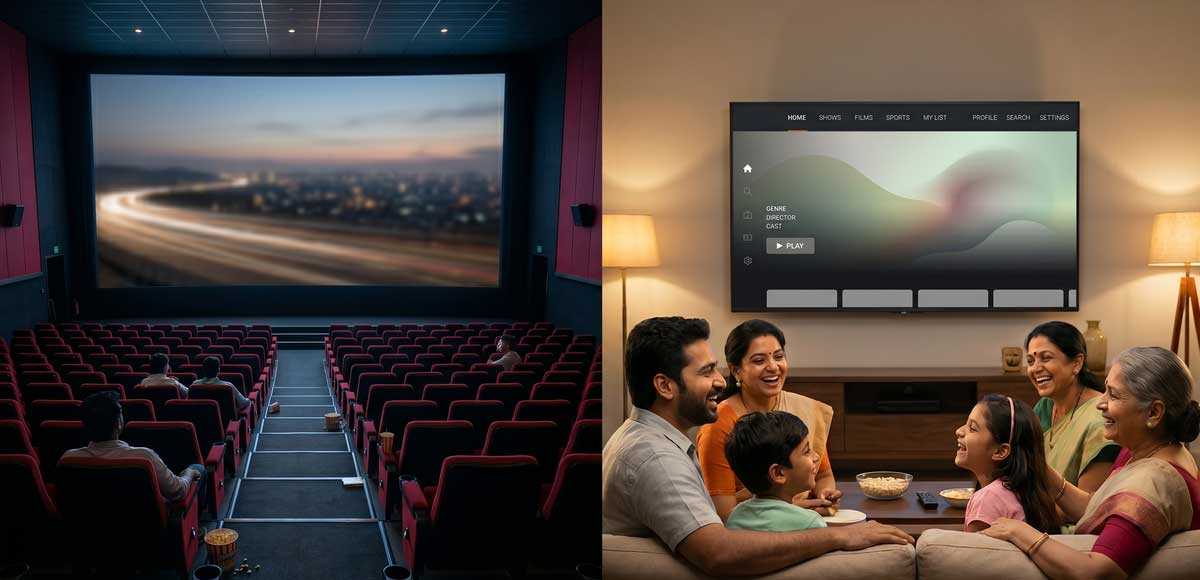
Audiences have not stopped loving movies; they have just done the math. A middle-class family going to a multiplex now faces a massive bill for tickets, parking, and snacks. When producers arbitrarily hike ticket prices to cover their inflated budgets, the audience revolts by staying home.
This is worsened by the four-week OTT window. If a movie receives mixed or average talk on Friday morning, families know it will be available on their living room TVs in just a month. The urgency to watch it in a theater is completely gone.
The Road to Recovery
To fix this, Tollywood needs a hard reset.
- Shift to Profit Sharing: Stars and top directors must abandon massive fixed fees. By taking a nominal upfront salary and a percentage of the profits, they share the risk. This slashes the initial budget and frees up money for actual screen quality.
- Enforce an 8-Week OTT Window: The audience needs to know that waiting for streaming means a long wait. An eight-week minimum gap will immediately boost second and third-week theatrical runs for good films.
- Speed Up Production: Stars need to return to the discipline of releasing at least one film a year. Not every movie needs to be a ₹300 crore Pan-India visual effects spectacle.
- Cap Ticket Prices: Keep cinema affordable. A full theater at normal prices generates far more long-term goodwill and repeat viewing than a half-empty theater charging premium rates.
The survival of Telugu cinema depends on one harsh truth: the industry must stop chasing artificial hype and start respecting the audience’s time and money.


