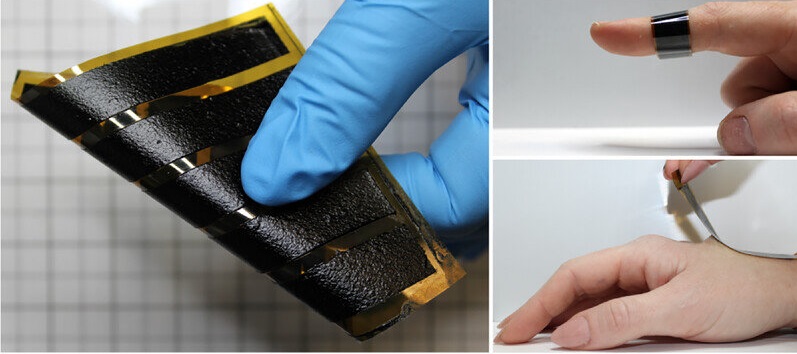
Researchers have developed innovative heart monitoring sensors that conform seamlessly to the skin, offering greater comfort and usability during movement. Designed to record electrocardiogram (ECG) data, these sensors match the performance of existing technologies while using scalable, cost-effective manufacturing processes. Their flexible design allows patients to wear them for extended periods without discomfort.
Overcoming Limitations of Conventional Sensors
Traditionally, ECG monitoring requires electrodes that rely on adhesives and conductive gels. However, these materials often irritate the skin and lose effectiveness as the gel dries. Moreover, patients must wear these devices for hours or even days, making comfort a critical factor. Recognizing these challenges, researchers aimed to create a solution that eliminates gels and minimizes skin irritation while maintaining signal accuracy.
Engineering a Skin-Friendly Electrode
To achieve this, the team used a polymer called POMaC, known for its flexibility and skin-like mechanical properties. However, since POMaC lacks electrical conductivity, researchers enhanced it by incorporating a conductive polymer and a surfactant. They processed this mixture in liquid form, enabling easy application through screen printing or molding.
Once heated and cured, the material transforms into an elastic, conductive solid. As a result, the final electrode adheres gently to the skin, captures accurate ECG signals, and supports the weight of connecting wires. Importantly, users can remove it easily without discomfort.
Demonstrating Performance and Versatility
As reported by medicalxpress, during proof-of-concept testing, the electrodes performed on par with commercially available ECG devices. Researchers evaluated them using both standard clinical monitors and an experimental wireless patch. In both cases, the sensors delivered reliable results, highlighting their versatility and practical potential.
Expanding Future Applications
Beyond ECG monitoring, researchers are exploring additional biomonitoring uses for this material. Furthermore, they are working to protect intellectual property and collaborate with industry partners. Because the electrodes rely on conventional materials and scalable techniques, they hold strong promise for improving health monitoring technologies in a practical and cost-effective way.


