Yet beneath the optimism lies a harder reality. These companies are still navigating long gestation cycles, uncertain revenues, regulatory gaps and the enormous technical risks that define the space business. India’s private space race has finally lifted off, but sustaining altitude will require far more than investor enthusiasm.
The Skyroot moment and what it signifies
Skyroot’s latest $60 million funding round led by Singapore’s sovereign wealth fund GIC and Silicon Valley-based Sherpalo Ventures, with participation from BlackRock, is more than a financing milestone. It is a statement that India’s private launch ecosystem has entered the global investment radar. The company’s valuation of $1.1 billion makes it the country’s first spacetech unicorn and among the very few pre-revenue space startups globally to cross that threshold.
Also Read | Skyroot Vikram-1 rocket is raring to soar high
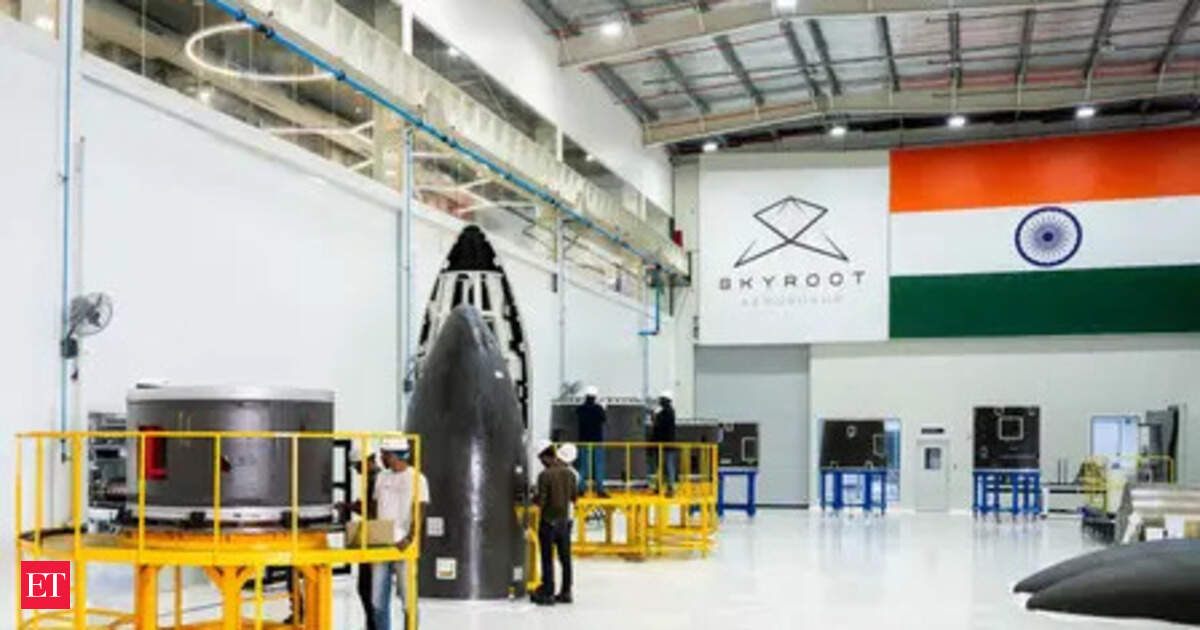
Founded in 2018 by former ISRO scientists Pawan Kumar Chandana and Naga Bharath Daka, Skyroot became the first private company in India to launch a rocket into space in 2022 with the Vikram-S mission. It is now preparing for the maiden orbital launch of Vikram-1, a far more consequential test because orbital launch capability is the true gateway to commercial space transportation. The timing is notable. For decades, India’s space programme was synonymous with ISRO, whose achievements in cost-efficient missions built the country’s reputation in space science and satellite launches. But the opening up of the sector in 2020, alongside the creation of the regulator IN-SPACe, fundamentally altered the ecosystem by allowing private players access to ISRO facilities and launch infrastructure. Skyroot was among the earliest beneficiaries of this shift.
Its unicorn status now serves as proof that deeptech businesses in India can attract large pools of global capital even before generating commercial revenue. In a startup ecosystem historically dominated by consumer internet companies, that is a major psychological and structural shift.
Also Read | Skyroot hits unicorn status, but India’s private space race needs clearer skies
Agnikul and the rise of a competitive launch ecosystem
If Skyroot represents validation, Agnikul represents momentum. The IIT Madras-incubated startup is in discussions to raise $50-75 million at a valuation of around $500 million, as reported by ET today based on information from sources. That valuation is roughly unchanged from its previous fundraising round in November 2025, suggesting investors remain interested but cautious about pricing amid the sector’s execution risks.
Agnikul has differentiated itself through technological experimentation. It developed India’s first electric motor-driven semi-cryogenic rocket engine and has drawn attention globally for its use of single-piece 3D printed engines. Its Agnibaan launch vehicle is aimed at the rapidly growing market for small satellite launches, where customers increasingly seek flexible and lower-cost deployment options.
The broader significance of Agnikul’s fundraising discussions lies in what they reveal about investor appetite. Venture capital firms are beginning to view India’s spacetech ecosystem as part of the global commercial space economy rather than a domestic niche. The market opportunity is substantial. Satellite constellations, earth observation systems, defence applications, climate monitoring and data analytics are all driving demand for smaller and more frequent launches.
India’s comparative advantage lies in its engineering talent and relatively lower operating costs. Startups such as Skyroot and Agnikul are attempting to replicate, in Indian conditions, a model that companies like SpaceX pioneered in the United States: privately built launch systems capable of dramatically reducing the cost of access to space.
Why global investors are paying attention
The influx of capital into India’s spacetech sector reflects several converging trends. The geopolitical significance of space has sharply increased. Governments across the world now view launch capability and satellite infrastructure as strategic assets tied to defence, communications and technological sovereignty. The economics of the global space industry is changing. The miniaturisation of satellites and the growth of private satellite constellations have created demand for dedicated small launch vehicles. India’s startups are trying to position themselves as low-cost and reliable providers in this emerging segment.
India itself has become more attractive as a deeptech destination. Unlike earlier waves of startup funding focused on ecommerce or fintech, investors are increasingly seeking exposure to hard technology sectors including semiconductors, artificial intelligence, defence manufacturing and aerospace. Skyroot’s funding round led by globally recognised investors like GIC, Sherpalo and BlackRock signals that international capital sees long-term strategic value in the sector.
The numbers underline the shift. According to Tracxn, private funding into India’s spacetech sector more than doubled in 2025 to $196 million across 55 deals. This year, startups have already crossed the $100 million mark in fundraising activity. That pace would have been unimaginable even five years ago.
The challenge of patient capital
Despite the excitement, India’s private space sector faces structural financial challenges. Space businesses are unlike software startups. They require years of research, testing and regulatory approvals before generating meaningful revenue. Launch failures can destroy not only rockets but investor confidence.
That is why patient capital is critical. Yet many Indian investors remain wary of long-gestation deeptech ventures. As a venture capitalist told ET, companies such as Agnikul are increasingly approaching US-based funds because they are more willing to back businesses that may take years before commercial payoff. Skyroot’s own funding round reportedly took close to six months to close. This financing challenge could become even sharper as startups move from technology demonstration to operational scale. Building launch vehicles is expensive. Scaling manufacturing, conducting repeated test launches and developing reusable technologies demand capital far beyond what early-stage venture funding can typically support.
There is also the issue of valuation discipline. Skyroot’s unicorn status has generated optimism, but investors will eventually seek evidence of recurring commercial demand and sustainable revenues. The global spacetech industry itself has seen periods of exuberance followed by sharp corrections, particularly in satellite and launch ventures that struggled to convert technological success into viable business models.
Regulatory and infrastructure bottlenecks
Another challenge lies in the policy ecosystem. India has made significant progress since opening the sector in 2020, which was a revolutionary step in itself. But regulatory clarity will be demanded as the private ecosystem begins to develop. Startups still depend heavily on ISRO infrastructure for testing and launches. While collaboration with ISRO is a major advantage, overdependence can create bottlenecks as more private companies enter the sector. Industry voices have increasingly called for clearer liability frameworks, faster approvals and more predictable licensing systems. Access to launchpads, spectrum allocation and export controls are all areas where policy consistency will matter if India wants to build a globally competitive commercial space ecosystem.
Infrastructure is another concern. Countries with mature private space industries have extensive supplier ecosystems for propulsion systems, advanced materials, avionics and precision manufacturing. India’s supply chains are still evolving, forcing many startups to build large portions of their technology stack in-house. That raises costs and slows scaling.
The larger question is whether India can emerge as a serious global launch hub rather than merely a domestic ecosystem with a few successful startups. The answer depends on whether these companies can move beyond symbolic milestones into repeatable commercial execution. Skyroot’s upcoming Vikram-1 mission will therefore be closely watched. A successful orbital launch would dramatically strengthen confidence in India’s private launch capability and could attract international customers. Conversely, delays or failures could slow investor momentum. In the space business, technical credibility is built through repeated execution rather than valuation headlines.
The same applies to Agnikul and newer entrants such as Ethereal Exploration Guild and Digantara, both of which have also attracted fresh capital recently. Their rise suggests that India’s spacetech story is broadening beyond launch vehicles into satellite technologies, space data and orbital services.
What India has today is not yet a mature private space industry but the foundation of one. The country possesses strong engineering talent, proven public-sector scientific capability and growing investor interest. What it still lacks is a deep reservoir of long-term capital, fully developed industrial infrastructure and regulatory agility. Skyroot’s unicorn status and Agnikul’s fundraising push have created a powerful narrative around India’s private space ambitions. The real test lies ahead.


