Published June 11, 2026 09:23AM
Rimpact has a seriously hard sell on its hands. The small UK based manufacturer is asking £229.99 for its gravel-oriented mass damper, which comes with a weight penalty of 400 grams. Why, you ask? In the name of reducing fatigue, and improving comfort while riding rough gravel over very long distances.
First Look: The Rimpact Tuned Mass Damper for Gravel Forks
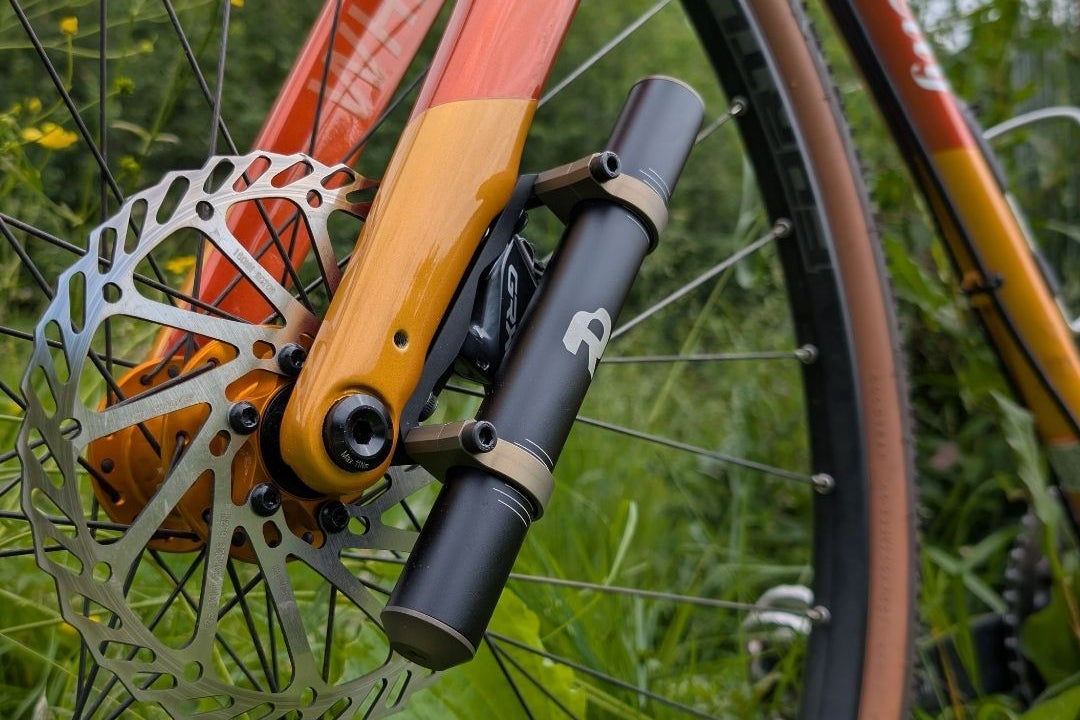
The tuned mass damper (TMD) in question is neither tuned, nor damped – a communication issue that I will explain shortly. It bolts onto a fork via a modified flat mount adapter, and is compatible with 140 mm or 160 mm rotors. It consists of a metal tube that houses a weight suspended between two springs. When your tire encounters a bump, as the fork is displaced upwards the weight inside the tube compresses the lower spring. This compression positions the weight relatively lower within the tube. The weight itself hasn’t necessarily moved, but everything around it has.

That’s what happens in the very first instance, anyway. Of course, the spring then rebounds, and the weight shifts back up the tube to compress the upper spring. In any given bump event, the suspended weight ends up oscillating between its two supporting and opposing springs.
And to what effect, exactly?
The concept is borne from a commonly used tool in engineering — the tuned mass damper. There is an important distinction between the Rimpact TMD, and actually tuned mass dampers that we see used on skyscrapers, and in ships, etc., but I’ll use those examples for now as they can help explain some of what is happening here.
Somewhere between the 87th and 92nd floors of the Taipei 101 tower, a 508-meter skyscraper, a 660-ton mass is suspended. It is connected to the structure via eight damper shafts filled with a viscous fluid, which perform as giant shock absorbers when the tower sways. High winds or earthquakes cause the tower to sway and when that happens the 660-ton mass inside it actually stays put initially, due to inertia. The relative movement between the mass and the structure is damped by the eight shock absorbers, allowing the mass to act as a sort of internal anchor to the skyscraper. I won’t pretend to understand the exact physics of how this works, but the result is that the amplitude of the tower’s swaying is decreased, and it settles out of its swaying oscillations more quickly, compared to how it would behave without the suspended mass.
In civil engineering use cases such as the aforementioned, the tuned mass dampers are targeting a specific frequency of vibration to be attenuated. Tuning to that specific frequency involves getting the right suspended weight – relative to the weight of the mass to be damped – and the correct level of damping.
In gravel cycling, the bike and rider are exposed to a vast array of vibrational frequencies, and so there is little to be gained in targeting any particular one.

Dan Hicks, the engineer behind the project, describes the Rimpact TMD (as it is unfortunately named) as more of an ‘energy delay’ device. Of course, energy cannot ever be created or lost, only converted into other forms. To be clear, Dan isn’t claiming that this device breaks the First Law of Thermodynamics, but he is claiming it reduces the initial peak force of energy experienced at the headtube following a given bump.
The team has been able to measure this using accelerometers mounted to the headtube. The experiments compared data from riding with real TMD, with the sprung mass, to a fake version that weighs the same but the mass inside it is static. Dan explained that the accelerometers measured the same total amount of energy at the headtube, but it’s arrival is smoothed out with a smaller, but broader peak.
In perhaps more relatable terms, it is designed to “take the edge off.”
The result, they say, is reduced rider fatigue over the course of a long ride. There is no shock absorption per se, given that the unit has no hydraulic damping. There is a very small amount of friction inside the unit, as with any sliding surface, but this is negligible.
Clearly, there is an issue with the naming of this product, as it is neither tuned, nor damped. That doesn’t mean it’s necessarily snake oil, though – it just means communication could be improved.
The reason I am hesitant to call it snake oil is because Rimpact’s TMDs have seen huge uptake in World Cup Downhill racing. The concept was first developed for downhill, and last season close to half the field of Elite riders were reportedly using their steerer-housed unit. Many other riders are using another TMD from a brand called CounterSycle. Clearly, there is a lot more to this product than meets the eye, but the brand has a mountain to climb in convincing consumers why, exactly, they would benefit from one.
Is The Gravel TMD Meant to Replace a Suspension Fork?
Absolutely not. Suspension offers traction in a way that no rigid fork can by allowing a wheel to move up and over bumps. It also (usually) contains hydraulic damping circuits that, through partially resisting displacement of the telescoping shaft, reduces the magnitude of the force that reaches the handlebar, and thus the rider.
It’s my understanding that the Rimpact unit is quite far down the list of components one would try in the search for comfort. A suspension fork would sit atop that list, followed by high volume tires. Engineer Dan Hicks says that, in terms of improving comfort, the TMD would sit in the realm of a compliant handlebar, for example.

Does it work?
Honestly, I have no idea. What I am is thoroughly intrigued. Make noise in the comments if you want me to lobby my colleagues at Velo (Josh Ross — I am looking at you) to test the Rimpact TMD against a fake version in a blinded, back-to-back experiment. I think this would be the best way to determine if this product is worthy of anyone’s cash.
Footnote: If all of this sounds familiar, it’s because it is. Time implemented a mass damping unit on the Aktiv fork of the Alpe d’Huez climbing bike – that one actually was damped, with a viscous fluid inside damping movement of the mass. Time has since been purchased by SRAM, and to my knowledge there is no current production version of that fork. The Rimpact engineer, Dan Hicks, tells us that he doesn’t think the Rimoact damper would be of much benefit in road cycling; it requires much larger bumps to get the mass inside moving effectively.
rimpactmtb.com


