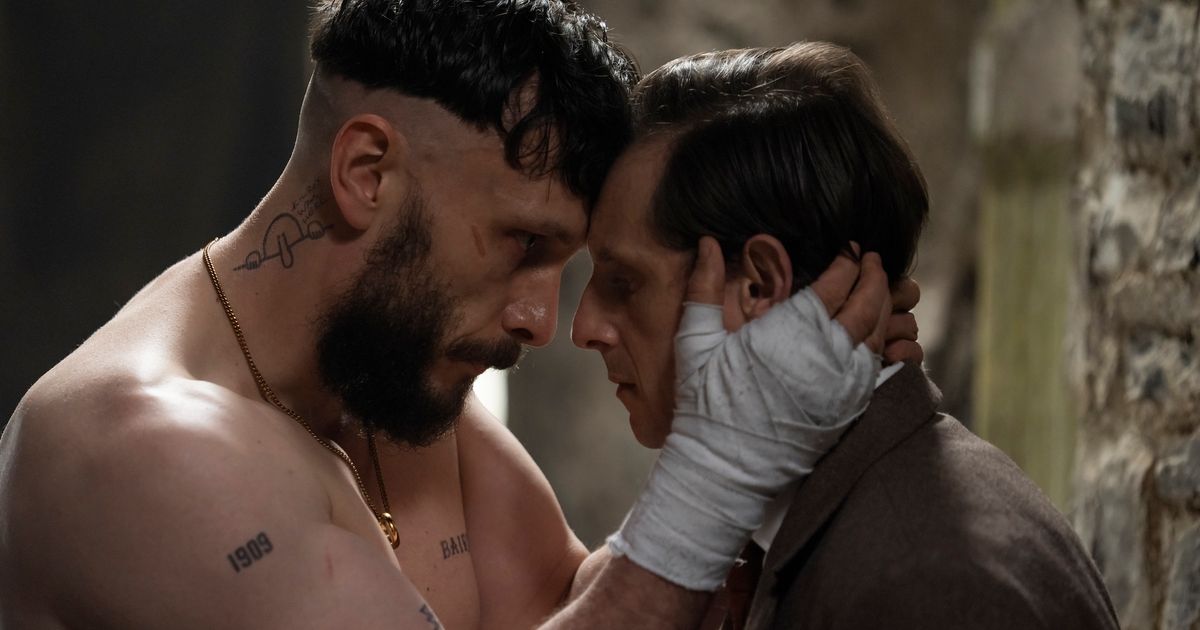
Half Man tracks how the initially wayward Ruben (Richard Gadd) and Niall (Jamie Bell) become more selfish over time, but it’s more transgressive when it drops the concerned patina and gets into the impossible-to-quantify nature of attraction.
Photo: Anne Binckebanck/HBO
In Half Man, older brother Ruben is always trying to grab his younger brother Niall’s dick. Ruben (played as a teen by the incredible Stuart Campbell and in adulthood by series creator and writer Richard Gadd) is bigger in physicality and personality, and through their decades together, he’s groped Niall (Mitchell Robertson, then Jamie Bell), pushed him down on the ground and got on top of him, or asked about what’s hiding in his pants. Whether this is bullying, joking, flirtation, or some uncomfortable mixture of the three is purposefully unclear, and an indication of how Half Man is most provocatively compelling when it paints in shades of gray, when Ruben and Niall are young and their instincts are unclear to each other and to themselves.
But as the miniseries exits adolescence, Half Man feels increasingly afraid of the messiness it initially embraced, and increasingly didactic. It’s as if the series is, like Niall, retreating into its own body and protecting its most sensitive parts, and like Ruben, getting tripped up by its own loud bravado. There’s something poetic about how the series insists that these two together make one whole that exhibits each of the brothers’ weaknesses. Yet extricated from that meta appreciation, the result is a work with a ton of questions about masculinity, sexuality, and self-loathing that are more interesting than any of its answers.
Premiering the first of its six episodes tonight on HBO, Half Man is Gadd’s follow-up to the phenomenal success of Baby Reindeer, the seven-part Netflix miniseries based on his autobiographical one-man show. Baby Reindeer was already a theatrical success when it became a smash for Netflix in 2024, and all that acclaim — including six Emmys — pretty much gave Gadd carte blanche to do whatever he wanted next. Half Man is clearly the work of a writer still enthralled and pained by the concepts that drove Baby Reindeer, from how bisexuality is dismissed or misunderstood, to the rigidity of gender roles in romantic relationships, to how masculine stereotypes can trap someone trying to follow them into their worst self. Although reckoned with less explicitly than they were in Baby Reindeer, abandonment and sexual abuse are again integral elements in a web of character dynamics; in both the series’ ’80s-era and present-day storylines, the hardest thing anyone can do is reveal who hurt them the most, because that might mean they’re capable of hurting others, too. That’s a familiar, if heartbreaking, observation about human nature that feels less so when Half Man filters it through the early stages of Niall and Ruben’s codependent and destructive relationship. Before Half Man goes off the rails with a too-on-the-nose reversal of fortunes (exacerbated by a Gadd performance that is overly reliant on his swoleness as a character trait), its attempts to understand how homoeroticism and homophobia complicate a boy’s transformation into a man are as immersive as they are disquieting.
In the mid-1980s, Robertson’s Niall is 15 years old, a former star student whose nascent disinterest in academics dovetails with increased bullying about his perceived gayness and unusual home life. His aspiring-writer father died when he was 8, and he lives with his mother, Lorraine (Neve McIntosh, wonderfully embodying the series’ most inscrutable character), and her friend Maura (Marianne McIvor). The two women have never fully explained their relationship to Niall, but to everyone who already makes fun of him at school, they’re lesbians, figures to be sexualized and mocked. That’s one thing for Niall to worry about, and another is that Maura’s son Ruben (Campbell), two years older than Niall, has been released from juvenile detention and is coming to live with them. For a decade or so, Ruben — sent away for biting off a grown man’s nose — made Niall feel inferior and small, and now he’s moving into Niall’s room and attending Niall’s school. Compared with the swaggy and charming Ruben, Niall might be the most awkward and dweeby kid alive.
How odd, then, when the two end up getting along. Ruben calls Niall his brother “from another lover,” and pulls a box cutter on Niall’s bullies. Niall grows accustomed to Ruben’s bombast, and admires the ease with which he launches into action. Half Man jumps around between timelines, starting off with Gadd’s older Ruben showing up unannounced at a grown Niall’s wedding and then moving backward, but Campbell and Robertson so fully inhabit these two contrasting teens that the show loses a bit of magnetism every time we leave their era. They’re especially powerful in the premiere episode’s most open-to-interpretation scene, when Ruben’s dad shows up in the middle of the night, yelling outside Niall and Ruben’s bedroom window, and Ruben tackles Niall to persuade him to stay quiet and not tell their mothers about the man’s appearance. The next morning, when Niall wakes up, he’s in a tangle of limbs with Ruben on a tiny twin bed, and there’s a large wet patch on the front of his boxers. Setting aside that overnight arousal, the visual metaphor of the two being intertwined is obvious — two boys who become more complete after finding each other — and Half Man keeps hammering home that point in increasingly clumsy ways, like when one person compares them to Dr. Jekyll and Mr. Hyde and another observes that Ruben needs a head while Niall needs a body. But when Half Man considers the evidence of Niall’s attraction to this boy he once claimed to hate, and who does still scare him, the series becomes a more layered narrative about how sexuality isn’t always defined by whether you like someone or even understand them. It’s a more mercurial, elemental manifestation of aspects of ourselves that we don’t entirely grasp, and that we might fear if we tried.
When Half Man documents the brothers’ discovery of themselves and each other, its storytelling feels charged and unpredictable. Too bad that Half Man quickly has these boys grow into adult characters whose new relationship is more explicitly antagonistic, for reasons that are simultaneously convoluted and formulaic. There are more supporting characters — long-term romantic partners, various professional enemies — in the later timelines as Niall and Ruben struggle with their mothers’ aging, their jobs, and the prospect of fatherhood. Yet the yearslong gaps between episodes makes it difficult to accept how changed these characters are from installment to installment, and the writing leans on emotional distress and big speeches a little too often. Worst of all, as Niall and Ruben get older, Half Man undermines Gadd and Bell’s dark comedic chemistry with hyperbolic stylization, as if their differing personalities weren’t already abundantly clear: Ruben in slow motion, his breathing distorted into an animalistic growl, and Niall frozen and staring straight ahead, fitting of the “Bambi” nickname Ruben gives him, are distracting rather than complementary exaggerations. Half Man wonders whether men can ever be honest with each other, but the series ultimately pulls back, unwilling to examine the elements of toxic masculinity that exist outside of this brotherly dynamic. Everything between the two goes back to trauma, and that feels both Zeitgeisty and copout-y, like Half Man worries we’ll stop caring about Niall and Ruben if their journeys don’t have the name-the-problem-work-the-problem rhythm of therapy.
We’re in the midst of a cultural fascination with how lonely boys become radicalized teens and then violent men, from Adolescence to Netflix’s upcoming Lord of the Flies adaptation, and Half Man slots itself right into that trend by tracking how the initially wayward Niall and Ruben become more selfish over time. But it’s more transgressive when it drops the concerned patina and gets into the impossible-to-quantify nature of attraction. When Half Man refuses to commit to how much Niall and Ruben are aware of the weighted space between them, it resembles pricklier stories about how sensuality develops in ultramale spaces, like Beach Rats, Beau Travail, and Femme, letting us interpret for ourselves, based on our own assumptions about masculinity, why the two brothers wanting to be each other could be interpreted as the two of them wanting to be together. That ambiguity is Half Man’s best attribute, because it allows us to more fundamentally interpret the characters’ central relationship based on how Campbell and Robertson perform it rather than how Gadd eventually overwrites it. Presenting Niall and Ruben as characters chasing individual fulfillment through what society tells them to want flattens them, and Half Man, like its central brothers, ultimately squanders its early potential in the pursuit of greatness.
See All


