I fell for Arsenal in the white‑and-black world of apartheid, where television was banned as a tool of communist propaganda and the club of my dreams was 6,000 miles away and mostly invisible to me. So it feels fitting that a surreal love story that began for a small boy in South Africa in 1969 will reach a new peak on Saturday night in eastern Europe. This 65-year-old Arsenal fan and his 25-year-old son, who is just as besotted by the Gunners, will be at the Champions League final in Budapest as we face the dazzling powerhouse of Paris Saint-Germain.
It’s the final game of Arsenal’s tumultuous grind of a season and we are as exhausted as we are still euphoric. We will remember that my last game of this campaign could have been Swindon’s 2-1 home defeat by Chesterfield in League Two. I have had my share of pain with Arsenal; but it would have been a far deeper burden to have spent 57 years supporting Swindon.
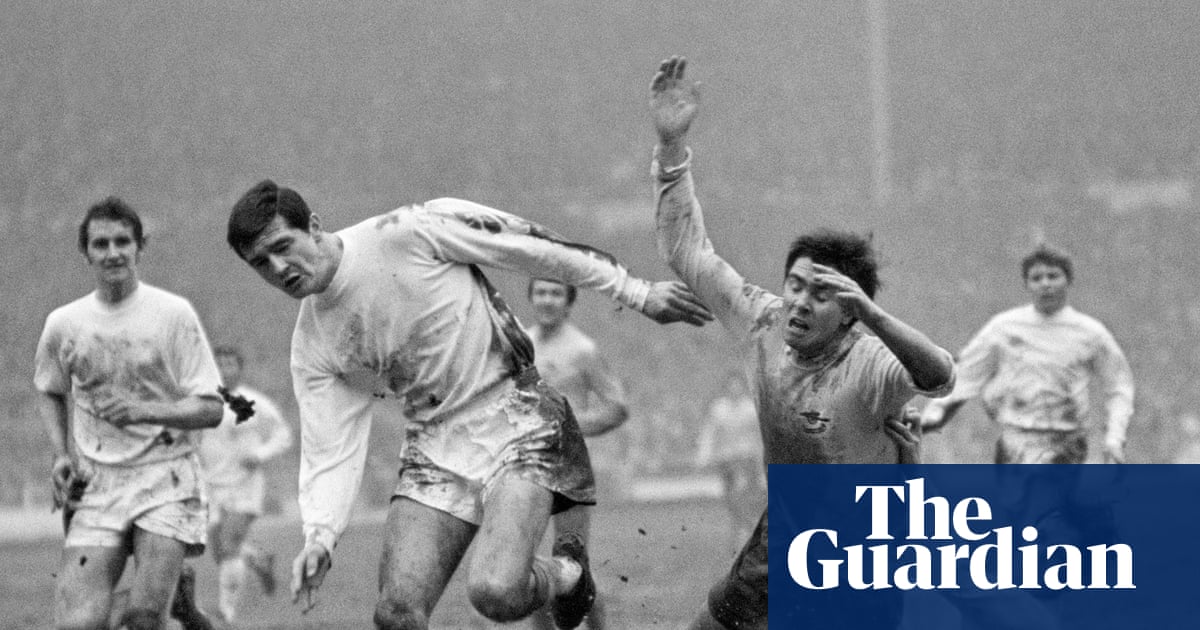
It could have happened because my eighth birthday party in April 1969 included a trip to the movies, where we initially watched a Pathé News bulletin featuring footage of the League Cup final between Arsenal and Swindon which had happened six weeks before. I’ve seen those two and a half minutes many times since and can understand why I was smitten.
But it’s more usual for a kid to back the winning team and, that day, Third Division Swindon beat Arsenal 3-1 with Don Rogers scoring two goals in extra time. “Swindon Town had come to town and beaten one of the country’s greatest football machines,” the posh old commentator rejoiced.
Perhaps that description of Arsenal shaped my choice. It didn’t matter that they lost. I was going to follow the mighty red machine for ever – obviously not knowing that, decades later, “second again, olé, olé” would become a haunting song for Arsenal.
I was just a kid back then and so my allegiance to Arsenal turned to adoration when the club won the league and FA Cup Double in May 1971. It was another trip to the movies in downtown Johannesburg, and footage of a long-haired Charlie George scoring the winning goal against Liverpool at Wembley, which entranced me and my Arsenal-mad friends. Once we got back to our suburban gardens we tried to emulate Charlie’s celebration in which he was spreadeagled on his back, arms stretched out in disbelief on the sun-kissed Wembley turf.
I fell in love with Arsenal in dreamy slow motion because I could never see them live or even on television. But I still watched great footballers such as George Best, Bobby Moore and Johnny Haynes, and more prosaic journeymen such as Roy Hodgson, as they broke the sports boycott and made lucrative trips to play in South Africa’s whites-only league.
The Gunners meant much more to me than my local team, Germiston Callies, and there was an almost delicious agony in the delayed gratification, or heartache, of Arsenal news. Most Sunday mornings I woke early without knowing what had happened the previous afternoon.
My run to the corner shop took less than 30 seconds. I trembled with excitement and, despite the shop-owner’s usual muttered instruction for me to buy the newspaper before reading it, flipped to the back pages and the English football results.
There was a mysterious power to the blunt news which read either gloriously:
Arsenal 3, Ipswich Town 1
Or, arriving with a sudden dark sadness:
Leeds United 1, Arsenal 0
I was soon transfixed by second-half commentaries of First Division games on the BBC World Service. Whenever Arsenal featured I could listen to them playing live and hear the score in real time. The brilliant commentator Peter Jones painted pictures with words so vividly that it lit up my imagination.
I was also sustained by copies of Shoot! magazine, which were shipped from England and arrived six weeks late. My friends and I read every article and studied every photograph. We could soon list the entire squads of middling First Division clubs such as Coventry and Southampton – and discuss the best bubble perm, moustache or comb‑over in 1970s football.
Television finally arrived in South Africa and occasional English football games were screened from 1978. The first Arsenal matches I watched in full were three successive FA Cup finals at Wembley. Sandwiched between dismal 1-0 defeats by Ipswich and West Ham, in 1978 and 1980, there was a glorious 3-2 win over Manchester United.
I already knew that I had to escape the army and apartheid and somehow get to England, where I would be saved by music, movies and Arsenal. But my understanding of football fervour caught fire when I spent two years in the 1980s teaching at a Soweto school.
Football came as a relief from apartheid for many of my students – some of whom had been tortured by the security police. One of those students, Lucas Radebe, would also move to England and become the captain of Leeds as they reached the semi‑finals of the Champions League.
In January 2000 I interviewed Radebe for the Guardian. During our emotional reunion he told me: “When I left Soweto six years ago I was very depressed. I was so homesick I wanted to give up.” I told Radebe I had also cried when I left South Africa, aged 23, in August 1984.
But I went to my first Arsenal game three weeks later, a 1-1 draw with Chelsea. I was on the North Bank alone, but at home. I followed Arsenal home and away; and I never felt lonely. I felt as if I belonged. Arsenal were my second family in a very different life.
In the 1980s you could still walk into Highbury at 2:45, pay £4 at the turnstiles and be on the North Bank before kick-off at 3pm. I usually stood in the same area and many faces became familiar. Every fortnight we would exchange nods and a few words. Sometimes we even hugged in delirium, without even knowing each other’s names, when a late winner was scored.
Arsenal were not very good when I arrived but everything changed with George Graham’s appointment in 1986. We soon had a great back four of Lee Dixon, Tony Adams, Steve Bould and Nigel Winterburn and a trio of black players who were as skilful as they were resilient. David Rocastle, Paul Davis and Michael Thomas were my favourite players.
Racism in English football was rife in the 1980s. I heard the chants and saw the bananas being thrown; but Arsenal were different. Arsenal were integrated. It didn’t matter if we were white or black – we all bled red.
There were last-minute league titles and cup wins and then, incredibly, the unforgettable Arsène Wenger years, when he transformed English football while we lost ourselves in the sublime artistry and steely grit of a team that contained Thierry Henry and Dennis Bergkamp, Patrick Vieira and Sol Campbell.
Arsenal had also kickstarted my sportswriting career when, at Highbury in December 1984, I made my first visit to a press box. As a journalism student I was meant to shadow David Lacey but the Guardian’s great football writer had not been assigned to Arsenal that day. I could have followed him elsewhere but I chose to watch Arsenal with Robert Armstrong, who eventually became this paper’s rugby correspondent.
After the game I ended up in the office of Don Howe, the manager, with Armstrong and three of his Fleet Street colleagues. Howe shouted cheerfully down the passage to the striker Ian Allinson, who had scored two goals in a 3-1 win over Luton, to make us some tea.
I have interviewed many famous Arsenal names since then – from Liam Brady, Graham, Adams and Paul Merson to Wenger, Bergkamp, Cesc Fàbregas and Bukayo Saka. Rather than making me tea, Saka, one of my favourite players, was accompanied by five PR people and agents.
I met Bergkamp near the end of the 2003-04 Invincible season when he and his teammates did not lose a single league match. The Dutch master told me that a few weeks earlier, when he returned home after Arsenal lost in the FA Cup semi-finals to Manchester United, he found his son, Mitchell, crying bitter tears. The five-year-old was devoted to Arsenal. “I had to try and comfort him,” Bergkamp sighed, “but it took a long time.”
A couple of years later I took my own son to his first Arsenal game. Jack was also five and, in October 2006, he saw Arsenal, with players such as Fàbregas, Henry and Robin van Persie, beat Watford 3-0 in just the fourth league game played at the Emirates Stadium.
A few months later, on Boxing Day, I took Jack to the return fixture at Watford’s rickety old Vicarage Road. After Watford’s Tommy Smith equalised Gilberto Silva’s opening goal, Arsenal conjured up an 83rd-minute winner from Van Persie. It was the best Christmas present ever for Jack and we went mad with the travelling Arsenal fans.
We remember all these facts because last year Jack gave me a beautiful present. In a black book, with a red ribbon, he laboriously wrote down all the details of every Arsenal match we had seen live together over the previous 19 years. It took him days of work and, while he could have printed all the details off the internet, he used a pen to write each date, each game, each goal and each player’s name as an old-school reminder of my other-worldly introduction to Arsenal.
We remembered how Jack had cried in February 2011 when we watched Arsenal lose the Carling Cup final at Wembley to Birmingham. In the distressed aftermath I wondered what I had done to my boy as, swallowing my disappointment, I promised that he would see Arsenal lift many trophies in the years to come. I would eventually be proved right as Arsenal have won four FA Cups since then – but the league remained painfully elusive until last week.
Jack is so obsessed by Arsenal that, for the past four years, he has lived opposite the Emirates Stadium. From his front door it takes 20 seconds before we are swept up in the chanting throng which, this season, has never felt far from a collective nervous breakdown.
There have been some beautiful moments as well. On 23 November, Jack and I were off our seats and jumping around, agog, between the North Bank and the halfway line. Eberechi Eze, a childhood fan of the club, scored a hat-trick against Spurs. Four days later, we were back as Arsenal rolled over Bayern Munich in a statement 3-1 victory.
In mid-March, when the 16-year‑old Max Dowman ran almost the length of the pitch, the ball staying magically close to his feet before he rolled it into the Everton net with an elegant caress to seal another late win, we were falling and laughing as we crashed into other jubilant fans.
I banged my bad knee hard and it was a beautiful feeling, the pain proving it was real.
There have been horrible moments too. After the Carabao Cup final, where we were dismantled by Manchester City, I was with the sombre Arsenal fans on platform two at Wembley Central. Opposite us the taunting City supporters sang: “Second again, olé, olé …”
Arsenal played well away against City in the league on my birthday, 19 April, but we lost 2-1. Our front room was crammed as screams of delight gave way to howls of anguish. The life‑size cutout of Mikel Arteta, given to me by my youngest daughter, Emma, stayed silent. The City juggernaut loomed over us and the league, once more, was in the balance.
We were at the Emirates for all our remaining home games: the excruciating 1-0 defeat of Newcastle, the 3-0 romp past Fulham and the decidedly painful 1-0 win over Burnley which followed the video assistant referee trauma of an away victory by the same score over West Ham.
I dreaded the prospect of needing a win, away to Crystal Palace, on the last day of the season. But joy came in a different way when, last week, City drew with Bournemouth. Arsenal were champions and, as soon as the game ended, Jack called me. He was crying, and laughing, as he asked a simple question: “What have you done to me, Dad?”
It was Jack’s first league title as an Arsenal fan. And now we are on our way to Budapest in the hope of seeing Arsenal win the Champions League for the first time.
We will watch the final together, in hope, while remembering how lucky we are that I chose the team who lost to Swindon all those years ago in a different century, on a different continent, as my world turned from black and white to the most beautiful colour of red.


