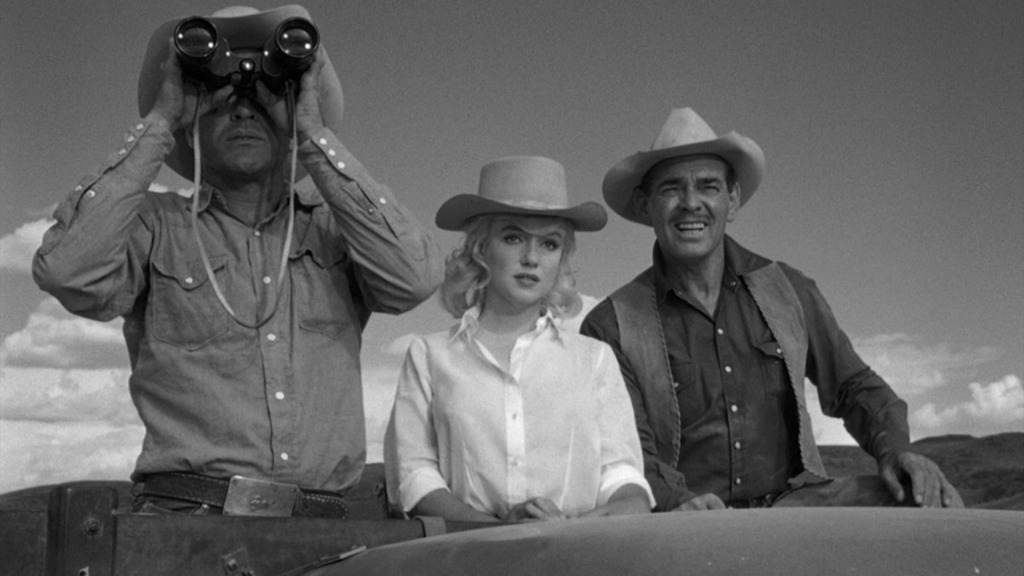
The first time Marilyn Monroe appears onscreen in The Misfits, her final completed film, she’s rehearsing. As Roslyn Taber, a soon-to-be divorcee on her way to the courthouse for a hearing, she’s going over her lines for the judge, perfecting her makeup, making sure she’s wearing the right dress. She needs to be exactly what the justice system wants her to be, a wronged woman in search of freedom, even if Roslyn herself doesn’t entirely believe it. A century after Monroe’s birth, it still stands as one of the most fascinating character introductions in Monroe’s filmography, because it reflects in many ways the entire process of making The Misfits—a tragic finale for Monroe, where a disintegrating marriage should’ve given way to a new beginning.
No one thought at the time that John Huston’s film, adapted by Monroe’s then-husband Arthur Miller from his short story of the same name, would mark Monroe’s swan song. It was never intended as a farewell. In fact, it was initially conceived as a kind of reintroduction for the star, who’d spent a couple of years away from the spotlight to concentrate on marriage and motherhood, the latter of which sadly never came to fruition. The Misfits was supposed to be Marilyn Monroe’s glorious return, cementing her not just as a movie star who could still pull in crowds, but as a serious actress capable of more than Hollywood had ever given her credit for. Instead, The Misfits was not the career relaunch or marriage-saving labor of love that the star had hoped it would be, but rather an unintentional curtain call that merely teased what her legacy could’ve been.
Despite its pedigree, including Huston and Miller behind the camera and Monroe, Clark Gable (who died 12 days after filming completed, making it his unintended swan song as well), Montgomery Clift, and Eli Wallach in front of it, The Misfits is not a great film. Years of rewrites, as Miller and Huston doubled back over the text time and time again, rendered it tonally rough. Characters spout long Millerian monologues about life rather than talking to each other, and the pacing, with the exception of the climactic sequence, often grinds the film to a halt. It’s a film caught between aching character drama about the death of a certain kind of American masculinity and romantic Western about a woman who offers a few lonesome cowboys a chance at redemption. No one is victimized by that dissonance more than Monroe.
Roslyn’s arc, when it’s working, is meant to challenge our conception of what a Marilyn Monroe character should be like. In that initial scene, she’s half-naked, putting on makeup, preparing to please one man (a judge) so she can escape the clutches of another (her soon-to-be ex-husband). She’s preoccupied with making everyone happy, getting everything just right. She’s also drop-dead gorgeous to the point that her landlady, Ms. Steers (Thelma Ritter), informs mechanic and pilot Guido (Wallach) that Roslyn can’t drive her car because men keep causing fender benders just to have an excuse to talk to her. When Guido finally lays eyes on her, he’s instantly obsessed, and that contagious obsession soon passes on to aging cowboy Gaylord (Gable) and rodeo rambler Perce (Clift). Right away, Monroe is back in the Sugar Kane, Some Like It Hot mold of an irresistible woman who could just use a hand and is instantly surrounded by men who’d like to lend that hand.


