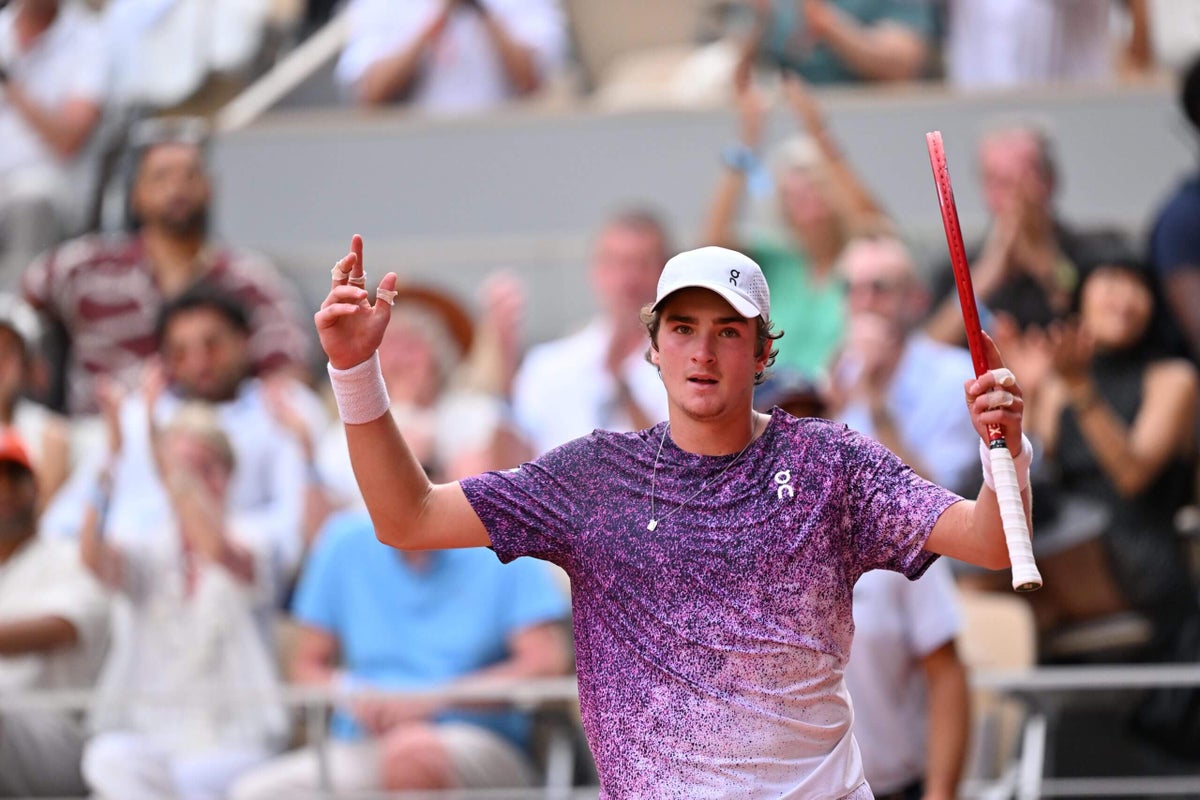
PARIS — Novak Djokovic’s hopes of a record-breaking 25th Grand Slam are over — for now. Rising Brazilian teenager João Fonseca knocked him out of the French Open Friday night in a five-set thriller, coming from two sets down to win 4-6, 4-6, 6-3, 7-5, 7-5 in four hours and 53 minutes.
At 39 years old, Djokovic may never get a better opportunity. With Carlos Alcaraz absent due to a wrist injury, and Jannik Sinner exiting the tournament Thursday, the path was seemingly clear for him to break the Grand Slam record that he jointly holds with Margaret Court. Sinner and Alcaraz had split the previous nine Slams, with Djokovic losing to one of them in six of those tournaments.
But on a sweaty afternoon in Paris, where temperatures again pushed 90 degrees Fahrenheit, Djokovic was reeled in from two sets to love by the boy from Brazil, who many have tipped for the very top.
In his first match against Djokovic, and his first on one of the four biggest Grand Slam courts, Fonseca, 19, became only the second man to beat the 24-time Grand Slam champion from two sets down. Jürgen Melzer was the first, at this tournament in 2010 — 301 other attempts ended in failure.
It was a remarkable feat of physical and mental endurance from Fonseca, and the presence of mind and then nerve he showed in the closing stages was extraordinary. First, to break Djokovic with a third drop shot of the game when everyone assumed he’d rely on his power and go for broke. And then to stare down a break point in the next game and produce three aces in a row to secure the win. “The fifth set was all heart,” Fonseca said afterwards in a news conference. “I couldn’t even think. I was just trying to go.”
The result leaves Djokovic ruing a missed opportunity — even if he said afterwards that he didn’t want to engage with that narrative — and nursing an ailing body. He had only played once since March 12 coming into Roland Garros, because of a shoulder injury, and he went through various states of discomfort as the Paris afternoon turned into evening.
“(There were) a couple times where I felt like I was barely standing on my legs towards the end of the match,” Djokovic said in his news conference. “And looking at the crowd and seeing them lift my spirits and support me was something really magical, honestly.”
Djokovic added that he was pleased with his performance and had simply been beaten by the better player on the day.
Despite this disappointment, Djokovic’s next opportunity may not be so far away. Alcaraz will miss Wimbledon, which starts June 29, with his wrist injury. Following his five-set defeat to Juan Manuel Cerúndolo in the second round, Sinner said in a news conference that he would need time to recover.
Djokovic said he didn’t know if he would play the French Open again.
João Fonseca of Brazil salutes Novak Djokovic of Serbia after their match at Roland Garros. (Antonio Borga / Eurasia Sport Images / Getty Images)
At the beginning of the match, it was Djokovic making his opponent do the running. He exploited Fonseca’s relatively weak movement with deadly drop-shot-lob combinations. When Fonseca tried to employ similar tactics, Djokovic had the dexterity to win volley-to-volley exchanges at the net. One such point in the second set was followed by a lob winner in the next, as Djokovic held for 2-2.
He broke the following game, which was all he needed to take a two-set lead. As they started the third, Djokovic had hit 26 winners to 13 for his much more powerful opponent. It was evidence of how much more aggressively Djokovic plays nowadays, and how effective he has become at doing so.
Fonseca was able to raise his level, though, and started to find the corners rather than the back fence with his flamethrower of a forehand.
As the match ticked into its third hour, Djokovic was clearly starting to feel the physical strain. At the start of the fourth set, after Fonseca fended off a break point and closed the third with consecutive aces, Djokovic was shaking out his hand, seemingly because of cramp. His breathing was heavy. The match was Djokovic’s longest clay-court match in history, and his longest of the decade outside of the 2023 Wimbledon final that he lost to Alcaraz.
Fonseca, 20 years his junior, looked primed to take advantage when he broke at the start of the set. Then the Brazilian started pulling off the Houdini shots that Djokovic had been coming up with for the first couple of sets. An arrowed backhand winner off a Djokovic smash was one of a few highlights.
Djokovic was able to break back that game, though, and had two break points to go up 5-3 and give himself the chance to serve out the match. But Fonseca saved them both, the second with an outrageously hard and accurate forehand winner following a strong first serve. He was starting to use the vocal Brazilian crowd support too, asking for more noise when he held for 4-4.
“The atmosphere on court was great,” Fonseca said. “The vibe was unreal. I was just enjoying it. I mean, every big point for him or for me, the crowd was going crazy. It was an amazing vibe.”
On the other side of the net, Djokovic looked on the verge of collapse. The stress not just of the match but of trying to get it done and conserve energy appeared to be weighing heavily on him. But he somehow kept finding a way to rouse himself. “The guy just doesn’t give up at any time,” Fonseca said. “He’s still, I don’t know, 39, 40, and I feel like he’s 20. It’s just unbelievable.”

Novak Djokovic overwhelmed João Fonseca in the first two sets before fading physically. (Ian MacNicol / Getty Images)
Djokovic was helpless when another forehand winner flew past him to set up a break point in the next game. He found a way to save it, and then a second with an ace that found the corner of the service box after taking in deep lungfuls of air. It felt as though if Djokovic didn’t find a way to escape and take the set and the match, Fonseca would be a big favorite in a deciding fifth set.
Djokovic was twice two points from the win in the next game, but Fonseca wouldn’t go away. A brilliant backhand winner down the line had Djokovic almost laughing at the sheer ridiculousness of the situation. How else would he want to be spending his Friday night?
There were more rueful smiles when Fonseca crunched a forehand winner up the line to earn a break point in the next game, which he took with another bruising forehand winner. Fonseca served out under pressure to take the match into a deciding set, and when Djokovic, a master of closing, pinched an early break for 3-1, Fonseca simply broke back immediately.
He did so again for 6-5, pushing Djokovic backward and then showing remarkable presence of mind to nail him with a third drop shot of the game. A neat encapsulation of how the roles had been reversed from those early stages, and an illustration of how much Fonseca has matured already. There was more drama to come, Fonseca staring down a break point as he served for the match. He produced an ace, and then two more, and that was that.
It was a truly extraordinary way to finish the match, and while much of the post-match discussion will center on Djokovic, this was a huge, possibly landmark victory for Fonseca. There were echoes of Roger Federer, also 19, beating Pete Sampras, then the record holder for men’s Grand Slams, at Wimbledon in 2001.
Fonseca had already shown remarkable consistency to become a top-25 player, and the extremely high ceiling he possesses, by demolishing Andrey Rublev, then in the top 10, at last year’s Australian Open. But this eclipses all of that. It was the kind of statement win that Fonseca has been threatening to produce for a while.
He will next play Casper Ruud, who beat Tommy Paul in five sets, in the fourth round on Sunday.


