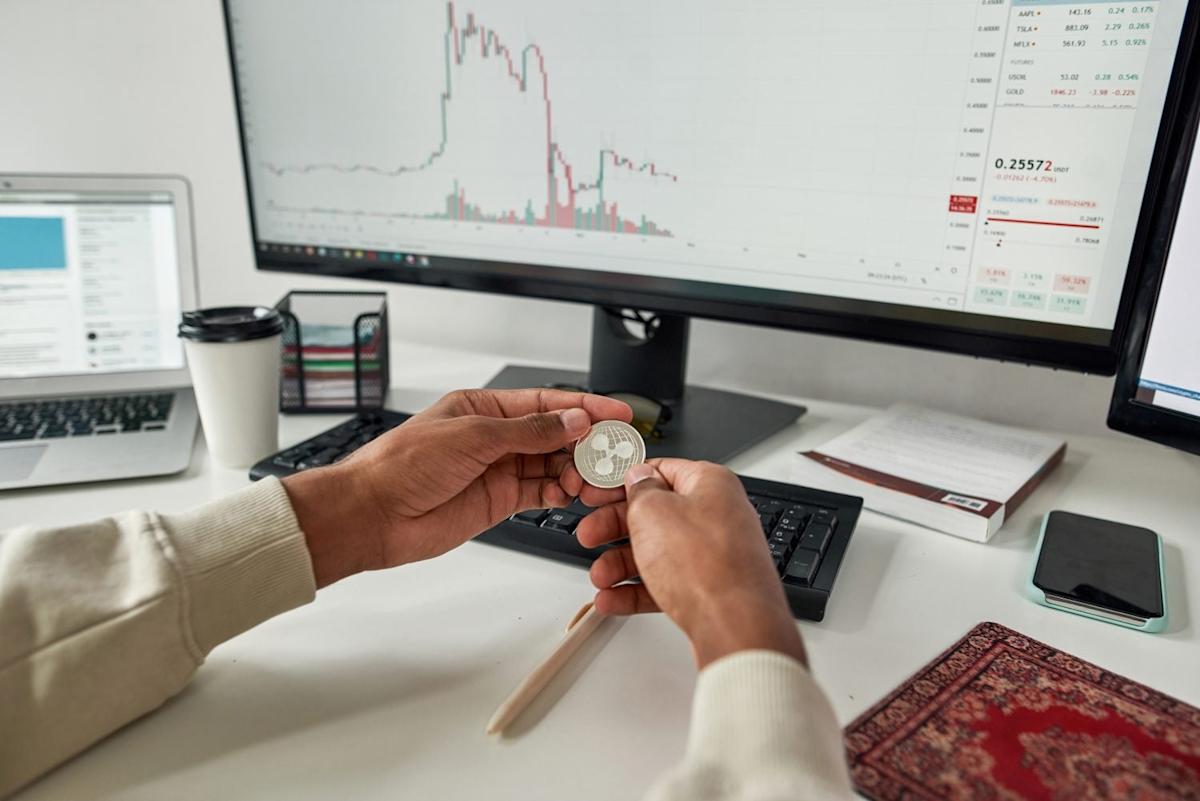
The Fed held rates at 3.50-3.75% in March 2026 and raised its inflation forecast to 2.7%, with JPMorgan warning the Fed may not cut at all this year.
XRP has pulled in $1.41 billion in ETF inflows across five live funds and completed a tokenized Treasury settlement with JPMorgan on May 6, yet the price is still stuck between $1.25 and $1.50.
Every positive XRP catalyst in 2026 has spiked the price for a day or two before high oil and persistent inflation pulled it back down, and today’s fresh strikes on Iran are doing it again.
Don’t wait: the analyst who called NVIDIA in 2010 just revealed his top 10 AI stocks. See the full list FREE now.
XRP (CRYPTO: XRP) dropped to around $1.28 today, after fresh U.S. strikes on Iran sent the entire crypto market lower. The reason the token keeps falling has almost nothing to do with Ripple, which has been winning institutional deals all year.
XRP completed a tokenized Treasury settlement with JPMorgan in May, has attracted $1.41 billion in ETF inflows, and earned a commodity classification from both the SEC and CFTC in March. By almost any measure, 2026 has been Ripple’s best year, and the XRP price hasn’t moved to match it because the reason lies outside the crypto market entirely.
Don’t wait: the analyst who called NVIDIA in 2010 just revealed his top 10 AI stocks. See the full list FREE now.
Why High Rates and Oil Are Holding XRP Down
Tamisclao / Shutterstock.com
After Israel struck Iran’s South Pars gas field on March 18, 2026, Brent crude pushed past $100 a barrel, which led the Fed to hold rates at 3.50-3.75% and raise its 2026 inflation forecast from 2.4% to 2.7%. As it stands, there is the possibility of only one rate cut left this year, and futures markets are pricing that cut for December at the earliest.
That said, JPMorgan has warned publicly that the Fed may not cut at all in 2026. This matters for XRP because when rates stay high and inflation persists, institutional capital stays cautious, and the token, which behaves like a higher-risk asset, stops attracting the institutional money that would push it higher.
Today proved the point again. Fresh U.S. strikes on Iran sent oil higher and risk assets lower, and XRP fell with the rest of the market regardless of how strong its own year has been.
Every positive catalyst in 2026 has followed the same pattern: XRP spiked for a day or two on the SEC and CFTC commodity classification in March, the JPMorgan Treasury settlement on May 6, and the CLARITY Act committee vote on May 14, then pulled right back each time as macro pressure absorbed the move.
It is not a sign of weak fundamentals, but one of a market where macro pressure is currently strong enough to override good news.
What XRP Has Going For It Right Now
Hi my name is Jacco / Shutterstock.com
The case for buying XRP in 2026 is stronger than at any point in the token’s history. The commodity classification from both the SEC and CFTC lifted the legal shadow that had kept large institutional funds cautious for years.
Moreso, XRP spot ETFs have now pulled in $1.41 billion in cumulative net inflows, and May is already on track to be the strongest monthly inflow period since launch.
Then, on May 6, JPMorgan’s Kinexys platform, Mastercard, Ripple, and Ondo Finance settled the first cross-border tokenized US Treasury transaction on the XRP Ledger, clearing in under five seconds across two continents outside normal banking hours. Traditional payment systems take one to three days to do the same. The XRP Ledger crossed $3.5 billion in tokenized real-world assets in late April, and daily transactions hit 3 million in March, three times the mid-2025 average.
Again, on May 14, the Senate Banking Committee passed the CLARITY Act in a 15-9 bipartisan vote, sending the bill to the full Senate floor where it still needs 60 votes before reaching President Trump for signing. The funds could see billions in ETF inflows if the bill becomes law, with most of it coming from institutional capital that has been waiting for permanent legal certainty rather than an agency ruling the next administration could reverse.
The Risk that Makes this A Harder Call
Alexandru Nika / Shutterstock.com
Polymarket currently puts the probability of passage in 2026 at roughly 63%, which means the bill stalling is still a real scenario. If that happens, Standard Chartered’s revised projection puts XRP between $1.50 and $2.50 for the rest of the year.
Beyond the legislative risk, there is the token demand problem. In the JPMorgan Treasury pilot, the payment ran through RLUSD, Ripple’s dollar stablecoin, while XRP itself only covered minimal network fees of around $0.00001 per transaction. Banks are using the ledger without needing the token.
On top of that, about 84% of current ETF inflows are still coming from small holders rather than the pension funds and asset managers whose capital would move the price meaningfully.
Is XRP Worth Buying Right Now?
XRP at today’s price is a reasonable position for investors who can hold through the next several months, but it is the wrong trade if you need a price move in the next 30 days. The macro environment has been the deciding factor all year. Catalysts spike the token for a day or two, then the broader market pulls it back, and today’s strikes are the latest proof of that.
The pattern will likely continue until either the Fed signals rate cuts or the CLARITY Act becomes law. Both of those are more likely in the second half of 2026 than the first, which is exactly why the timeline matters more than the entry price here.
Don’t wait: the analyst who called NVIDIA in 2010 just revealed his top 10 AI stocks. See the full list FREE now.