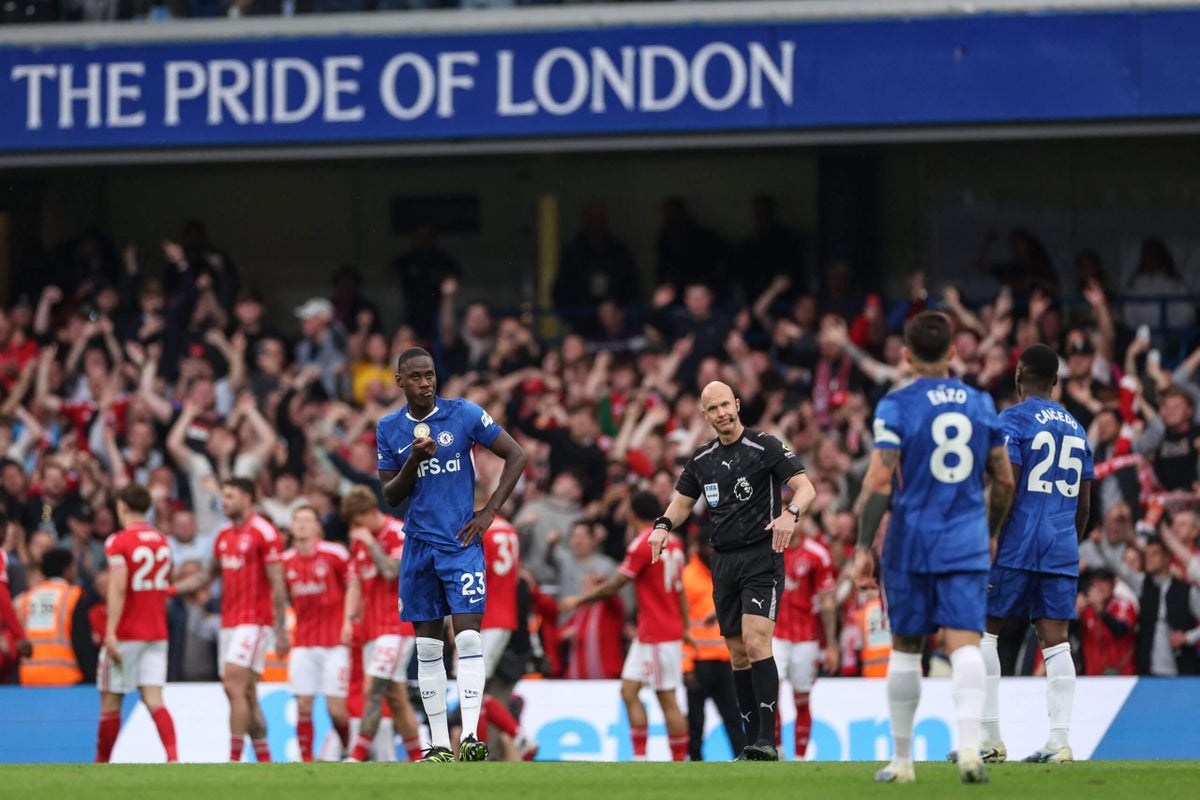
Not even the sickening sight of Jesse Derry being stretchered off on his Premier League debut could dull the half-time boos at Stamford Bridge.
Half-time is the best barometer of Chelsea fan unrest these days, because typically by the time the final whistle sounds, thousands have already left the stadium to start their sombre journeys home. This season is weeks beyond the tipping point whereby staying to the end of a match becomes the most reliable way to escape the rush to board your train.
Empty seats at Stamford Bridge as fans left early en masse (Justin Setterfield/Getty Images)
Nottingham Forest handed Chelsea their seventh home loss of this Premier League campaign on Monday, eclipsing the six home league defeats of BlueCo’s shambolic first season as owners, 2022-23. Here is a startling comparison, drawn from the height of the Roman Abramovich era: Chelsea lost five Premier League games at Stamford Bridge in seven years between August 2004 and May 2011.
That, clearly, is not the Chelsea that Clearlake Capital and Todd Boehly bought for £2.3billion in the summer of 2022. The rump of the Abramovich era was a story of steady Premier League decline, masked by a remarkable Champions League triumph in 2021. In the later years, the club were an underperforming and thoroughly unsustainable enterprise with no easy pathway to an urgently needed new stadium, and tainted by a hidden historical financial scandal.
But there the mitigation afforded by this relevant context ends, because BlueCo does not get to be “the new owners” forever. Four years in, more than enough time has passed — and money spent — for world football’s loudest project to stand or fall on its own merits, and it is falling fast.
“I think the first 15 minutes was unacceptable,” said interim head coach Calum McFarlane in his brief post-match press conference, referring to the two-goal lead Forest fashioned from Taiwo Awoniyi’s comically unchallenged header and the penalty kick Igor Jesus converted after Malo Gusto’s monumentally stupid foul.
Thoughts on the games upcoming and just gone are pretty much as far as McFarlane’s media remit goes and he wasn’t wrong, but his words felt a little small for the moment, because there is quite a lot more that is unacceptable for a club of Chelsea’s modern history, resources and ambitions right now.

Calum McFarlane appears out of his depth as Chelsea interim head coach (Justin Setterfield/Getty Images)
It is unacceptable that McFarlane, along with his fellow Kinetic Academy alumni Harry Hudson and Dan Hogan, have been put into the position of leading Chelsea’s first team for two stints this season, so soon after being promoted with dizzying speed to key leadership positions within the club’s hugely successful academy.
It is unacceptable that Liam Rosenior was plucked from Strasbourg, the BlueCo sister club where he was building his coaching career, in January and placed in a role in which he lacked the authority to even see out the campaign.
It is unacceptable that Enzo Maresca, a coach who ended his first season at the club with two trophies, felt his interests would be best served by leaving Chelsea at the turn of the year.
It is unacceptable that time has proven him right.
It is unacceptable that the joyful clarity and physical dexterity have been sucked out of Cole Palmer.
It is unacceptable that a midfield assembled for more than £250million in transfer fees can be so bad out of possession that Chelsea were played around and through by Forest duo Ryan Yates and Nicolas Dominguez yesterday.
It is unacceptable that, despite investing so many millions in new centre-backs, Chelsea’s recruitment mistakes have left them starting a Cobham graduate they have repeatedly tried to sell and a free agent signing from Fulham.
It is unacceptable that they are still searching for solutions on both wings and in goal.
It is unacceptable that this squad was so woefully under-equipped to handle the dual burden of Premier League and Champions League football this season, particularly in light of a heavily curtailed preseason.
It is unacceptable that despite an almost wholesale turnover of players and staff in the past four years, the closest thing to a grizzled, serial winner in the first-team building at Cobham is player support and development officer Willie Isa, formerly a rugby league star.
It is unacceptable that this is now almost certain to become the third out of BlueCo’s four seasons of ownership to end in failure to qualify for the Champions League.
It is unacceptable because Chelsea have spent far too much on players and coaches for annual participation in UEFA’s elite club competition not to be their baseline.
It is unacceptable because that record-breaking spending has been funded in part by vast loans and a growing pile of debt — debt which must one day be repaid with eye-watering interest, or at least refinanced.
It is unacceptable, in light of that financial reality, that BlueCo has never managed to secure a stable front-of-shirt sponsor at a reasonable market rate.
It is also unacceptable that, four years after making what was described as a “firm commitment” to build Chelsea a world-class stadium, there are no signs that any significant progress has been made towards doing so.
The above is by no means a comprehensive list, but it provides a broad understanding of why Chelsea supporters are planning further protests, on Wembley Way before the FA Cup final against Manchester City on May 16 and at Stamford Bridge against bitter rivals Tottenham in the league three days later.
At the very least, the angry noise these create will draw further attention to the pivotal summer that lies ahead.
Chelsea need a new head coach (again), but it is increasingly clear they need a lot more.
With every new defeat, that big shiny FIFA Club World Cup trophy won last July looks less like fitting validation for a winning strategy and more like fool’s gold.
Minor tweaks will not correct this course.


