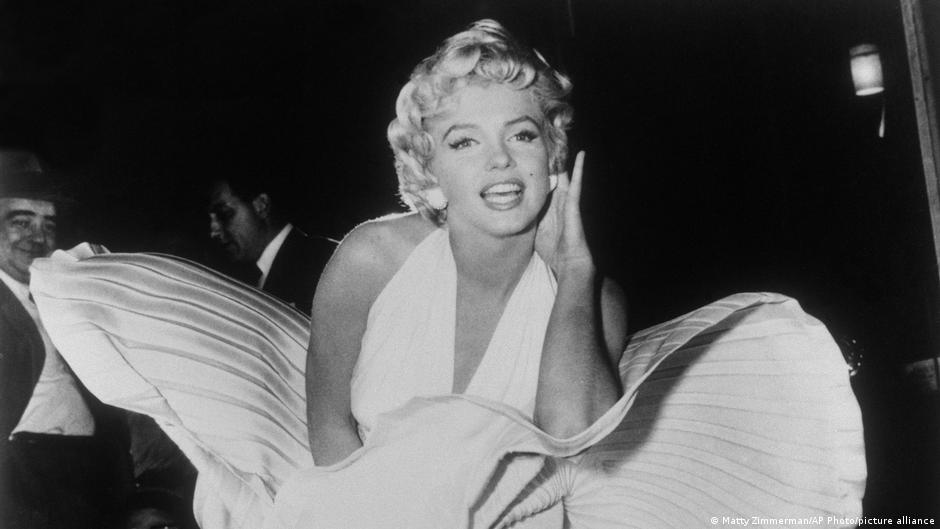
For decades,Marilyn Monroe’s white dress billowing above a subway grate, red lips and platinum-blonde hair have represented the epitome of Hollywood glamour. The iconic scene from the movie “The Seven Year Itch” (1955) is perhaps one of the most famous moments in film history. Very few women of the 20th century achieved the iconic status Monroe did while simultaneously being ferociously judged for their appearance.
This was clearly visible that September night in 1954, when the legendary subway grate scene was filmed in New York City. Hundreds of photographers and onlookers watched as Monroe repeatedly posed above the ventilation shaft, her dress swirling upward as she tried not to reveal too much, all the while looking as if she were having the time of her life. Ironically, the entire scene had to be reshot later in a studio due to excessive background noise in the recordings.
Now, 100 years after her birth and more than 60 years after her death, the world has a new image of Marilyn Monroe. She is no longer seen only as a 1950s sex symbol, but also considered an early figure of female self-determination in a film industry dominated by men — a woman who was contradictory, vulnerable, intelligent and often ahead of her time.
From Norma Jeane to Marilyn Monroe
Norma Jeane Mortenson was born on June 1, 1926, in Los Angeles. Her childhood was marked by foster homes, orphanages and instability. Early on, she learned that women in Hollywood were judged primarily by their looks.
After beginning her career as a model, she was discovered by film studios. Norma Jeane changed her name to “Marilyn Monroe,” a name that intentionally sounded like it belonged to a fictional character.
Hollywood shaped her into the role of seductive blonde: sensual, playful, seemingly naive. Films such as “Gentlemen Prefer Blondes” (1953), “The Seven Year Itch” and “Some Like It Hot” (1959) brought her global stardom.
Literature, politics, art
Behind the public image was a woman who wanted to be taken seriously as an actress and a person. While studios confined her to stereotypical roles, Monroe worked intensely on her acting training and read literature, taking a deep interest in politics, art and psychoanalysis.
In 1955, photographer Eve Arnold captured a moment that revealed this other side of Monroe: the star sitting on a playground, absorbed in James Joyce’s “Ulysses.” In Arnold’s photo book “The Retrospect,” she recalled that Monroe always kept the novel in her car and would read passages aloud because she loved the sound of the language, even if she, like many others, found the book challenging.
To this day, people still say Monroe posed with the book only for the camera. Yet she repeatedly refuted this claim, saying that people often preferred turning her into a character rather than taking an interest in who she really was.
Defying entertainment industry
Today, many feminists see Monroe as a woman who challenged the mechanisms of the entertainment industry long before others did. She understood exactly how her body and gestures defined the way she was marketed; at the same time, she used this strategically to advance her career. Monroe was not merely a victim of a sexist system, as she also tried to use this system’s restrictions to her advantage.
One important step came in late 1954, when she founded her own production company, a highly unusual move for an actress at the time. Monroe wanted greater control over her roles, better contracts and more serious material. She negotiated higher salaries, publicly contradicted producers and refused roles she disliked. In an era when studios almost entirely controlled their stars, this was a remarkable act of self-confidence.
Monroe nevertheless remained trapped in the contradictions of her era. The public celebrated her femininity and erotic appeal, yet these same qualities were later used against her. The media often described her as unstable, difficult or unprofessional — terms that today are still frequently directed at strong and outspoken women who defy expectations.
Her private life became a public spectacle. Her marriages to baseball star Joe DiMaggio and playwright Arthur Miller were relentlessly dissected in the media, as were her psychological crises and dependence on medication.
When Monroe died in 1962 at 36, the mythmaking began. While her death was officially ruled a likely suicide by sedative overdose, conspiracy theories persist to this day. Among the most enduring is the claim that she was silenced because of her connections to the Kennedy family, though there is no evidence to support this.
#MeToo and a new view of Monroe
In recent years, perceptions of Monroe have shifted once again. The #MeToo debate and wider discussions about abuse of power in Hollywood helped reframe her story. Many people now recognize the extent to which she suffered under a studio system that simultaneously idealized and controlled women.
The 2022 biopic “Blonde,” starring Ana de Armas, also embraced this perspective. The film portrayed Monroe above all as a vulnerable, traumatized woman. While some critics saw it as an unflinching reckoning with Hollywood’s treatment of women, others argued that it once again reduced Monroe to suffering and victimhood.
Monroe learned the cost of female visibility at an early age. She was desired but rarely respected. Famous but scarcely protected. Intelligent and educated yet reduced to a perpetual sex symbol.
But perhaps this is precisely her greatest feminist legacy: Even in the 1950s, Monroe revealed how complicated female self-determination can be in a world that both admires and controls women. The fact that her image remains globally recognizable a hundred years after her birth shows just how deeply she shaped modern pop culture.
This article was translated from German.


