Unlock the Editor’s Digest for free
Roula Khalaf, Editor of the FT, selects her favourite stories in this weekly newsletter.
“That mountain is not just a backdrop. You can walk all the way to the top,” said Todd Howard, executive producer of Bethesda Game Studio, while promoting the 2011 open-world RPG The Elder Scrolls V: Skyrim. This line has since become a meme, epitomising the hubristic promises of video games executives wishing to sell scale over anything else.
If you try to climb the mountains in Skyrim, you will quickly run into the limits of Howard’s pledge. Rather than ascending with the fluid motion of an actual alpinist, you must brute-force your way up diamond-shaped shards of vertiginous rock, character and terrain glitching as you ascend.
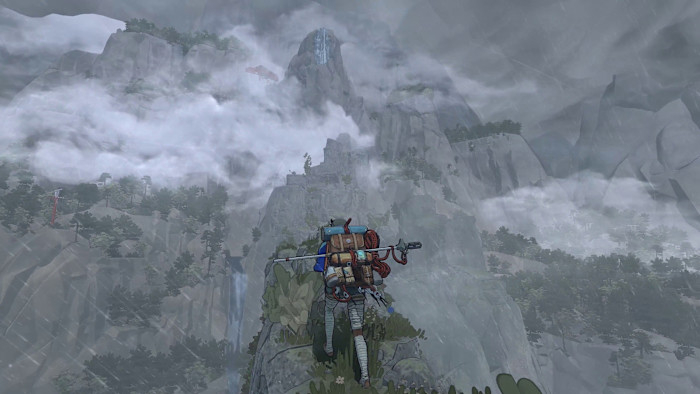
Cairn, a brilliant and bold new climbing game for PC and PlayStation 5, has only one scalable mountain: Mount Kami. This craggy beast towers above all surrounding peaks, glowing an ominous blood-red at sunset. When you walk up to the rock face, the protagonist Aava, a woman in her thirties, carefully places two hands on it. From there, you move a single limb at a time, methodically ascending while leveraging Aava’s body against deep fissures and clinging on to thin slithers of stone. If this expert mountaineer’s body is under particular duress, her arms and legs will tremble, and her breathing becomes shallower, more panicked. The views from Mount Kami are spectacular and the rock formations stupendous, but Cairn is a game, first and foremost, of heart-pounding, white-knuckle anxiety.
Alongside Jusant, Peak, Baby Steps and more, Cairn is part of a recent and burgeoning cohort of climbing games; together, they add friction and thoughtfulness to one of video games’ primary forms of interaction: movement. Typically, we bound or race through virtual environments: think of Mario’s finely tuned leaps across candy-coloured lands and Sonic’s high-speed sprints through vivid green hills.
Last year, Sword of the Sea had players sand-surfing across an endless desert, catching big air off cresting dunes and grinding along gigantic metal chains as an elegant blur of liquid motion. Games, even those in 2D, have long delivered the thrill of freedom by letting us defy the laws of earthly physics: we move at velocities and angles of pure fantasy.
The cadence of climbing games is different: mountain walls are to be puzzled over; progress is sometimes agonisingly slow — although if you are skilled, reading the rock in front of you as quickly as you can move your character, a nimble pace is possible. When this happens, it can feel as if instinct becomes one with conscious choice, just like climbing in the real world.
In Cairn, complex mathematics calculates the precise physiological tension Aava’s body is under at any single moment before deciding which limb she moves next. In the post-apocalyptic mountaineering adventure Jusant, each shoulder button on the controller operates a particular leg or arm. Both games have a locomotive ace up their sleeves: Jusant’s is the death-defying leap of faith its androgynous hero makes towards a distant handhold. Cairn’s is more understated: a full-body stretch as Aava lifts one leg off the rock to reach a ledge just a tantalising foot or so above her. Each action is as satisfying as anything in Mario’s moveset.
The lineage of this new crop of climbing games is varied. The punishing ascents of the Death Stranding series and Baby Steps add greater interactive depth to walking simulators of the late 2000s and early 2010s. Recently, experimental indie games such as White Knuckle, Peaks of Yore, and Lorn’s Lure have offered scrambling in first-person, the latter drawing on fan-made climbing and traversal mods of Counter-Strike that transform the popular online shooter into an unforgiving platformer.

The clambering challenge offered by these titles is greater than that in any action blockbuster. In those games, players typically follow prescribed paths highlighted with conspicuous yellow markings. The climbing may look treacherous, yet there is practically no peril.
Lorn’s Lure takes place in a vast subterranean megastructure; you feel small and insignificant; its vistas inspire dread. The lumpy mountains of Peak, which has sold more than 10mn copies, are more welcoming, yet its climbs can also turn nasty quickly. The weather might close in; your friend may fall down a jagged ravine. Its masses of rock are procedurally generated, the product of a carefully programmed algorithm. The process seems to have encoded some of nature’s terrible, unforgiving might in its mountains.
Game designers are right to home in on the masochism of climbing. The sport, particularly in an outdoor setting, demands gruelling commitment from its practitioners. Cairn may be the most brutal climbing game yet, more so than either Baby Steps or Death Stranding. As Aava ascends Kami, her toes and fingers become bloodied. While taking shelter in a bivouac, you can apply tape to her cut-up hands, the skin shredded by every gnarled crag and tor.
Aava climbs until she cannot. When her grip does eventually fail, we see her tumbling down the mountain for many hundreds of metres. In these moments, your mind may flash to the final seconds of real-life climbers — the existence-ending velocity at which they hurtle downwards to meet the ground with a deadening, final thud. Cairn lets players taste the wonder and ecstasy of alpinism: the rarefied sights of an atmosphere-scraping massif and the exultations of a route completed. It has the stomach to show us the terror, too.
‘Cairn’ is available on PC and PlayStation 5
Find out about our latest stories first — follow FT Weekend on Instagram, Bluesky and X, and sign up to receive the FT Weekend newsletter every Saturday morning


