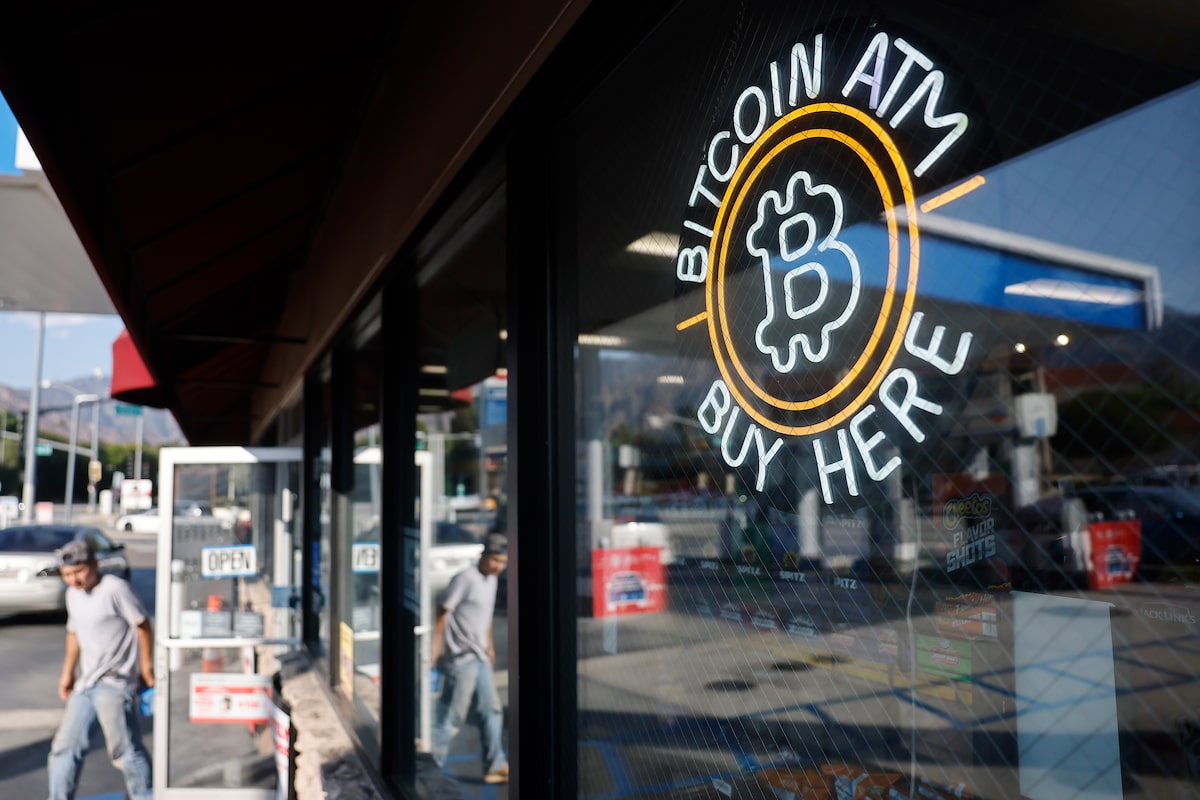
A sign advertises a Bitcoin ATM at a gas station near Pasadena, in July, 2025.Mario Tama/Getty Images
John Rapley is a contributing columnist for The Globe and Mail. He is an author and academic whose books include Why Empires Fall and Twilight of the Money Gods.
Bitcoin has lost its raison d’être.
Originally created in the wake of the 2008 global financial crisis to hack central bank policy, it exploited the flaws of the easy-money era. But now that period is ending, its lifeblood is draining and it will return to whence it came.
At the time of the crisis, the prevailing economic theory held that bailing out the bankers and flooding the economy with cheap money would quickly restore economic growth. However, the public hated that the culprits were seemingly being rewarded for their misdeeds, while ordinary people paid the price.
Amid this anger, someone (or possibly, some people) who went by the nom de guerre of Satoshi Nakamoto created bitcoin. Its logic was simple. By inventing a unit of currency that could be traded on the blockchain and thereby creating a “distributed ledger” that bypassed the banks, bitcoin could function as money. By fixing its total supply at 21 million, Nakamoto ensured that its price would rise against the fiat currency which easy money was then debasing.
Soon after bitcoin’s birth, I gave a public lecture in London in which I suggested that if my audience had a few pounds to spare, they could take a punt on this new toy, because I was sure it could ride the wave of cheap money. While loose monetary policy did little to revive economies, it sent asset prices soaring. In fact, where asset values rose much faster than the economy – as happened with house prices in Canada – so much money had to go toward paying rents or mortgages that less was left over for productive investment and spending, further hampering growth.
In the time since the financial crisis, the amount of money put into circulation by the world’s four biggest central banks tripled, from US$32-trillion to US$100-trillion. Yet the world economy less than doubled. Bitcoin was a major beneficiary of the resulting surge of asset values. At the time of my London lecture, it was trading at US$100. Thereafter it rose and rose, peaking late last year at more than US$125,000, delivering an annual rate of return of more than 80 per cent.
Why the blockbuster SpaceX IPO may spell more bad news for crypto
However, at the London soiree I also warned that when the cheap money era ended, bitcoin would fall back to earth. That moment may now have come. The growth of the world’s money supply, which exploded during the pandemic recession, slowed back down in late 2021 once then Federal Reserve chair Jerome Powell decided to put the term “transitory inflation” into retirement.
Since then inflation, which once seemed a relic of the past, has turned out to be a lot more tenacious than central bankers expected. Today we have to add in the effects of the war in the Middle East, possibly permanent disruptions to supply chains caused by rising trade conflicts and slowing labour supply growth in Western countries. Although interest rates set by central banks have come down from the high levels they reached in 2022, there’s little expectation they will come down further, at least for the time being.
Meanwhile, a long-term trend of rising interest rates on government debt appears to have taken hold, definitively ending the forty-year bull market in government bonds. From their early 1980s peak well into the double-digits, interest rates on government bonds fell slowly but inexorably until they ultimately bottomed last decade at under one per cent – negative, in real terms.
But then, with growing signs of inflationary pressures building in Western economies, interest rates began a slow rise which, while briefly interrupted by the pandemic, has since resumed. Today, with Western governments carrying huge debts, investors are starting to demand bigger premiums on the rates at which they lend to governments.
Bitcoin’s star fades as investors flock to lustre of AI and megacap IPOs
Bitcoin thrived amid ultra-easy credit. Now, money is returning to more traditional destinations, lured there by higher interest rates on comparatively secure investments. It doesn’t look like that will change. Having peaked last year, the cryptocurrency has now lost half its value.
It’s still possible that central banks will opt to inflate away the debts of Western governments by debasing their currencies, as U.S. President Donald Trump would like the Federal Reserve to do. If so, that would give bitcoin a stay of execution. But in the age of financial globalization, debasement is harder than it once was, because citizens who see the value of their money falling can easily move it to safer havens now, weakening the currency and thereby worsening inflation.
The more likely scenario is a long era of pricier money. In the years ahead, interest rates will probably go higher. Bitcoin has enough true believers that it will stick around for a while. It will rise and fall, but the broad trend will likely now see it returning to its origin. It had its day in the sun, but the easy-money sun is now dipping below the horizon.


