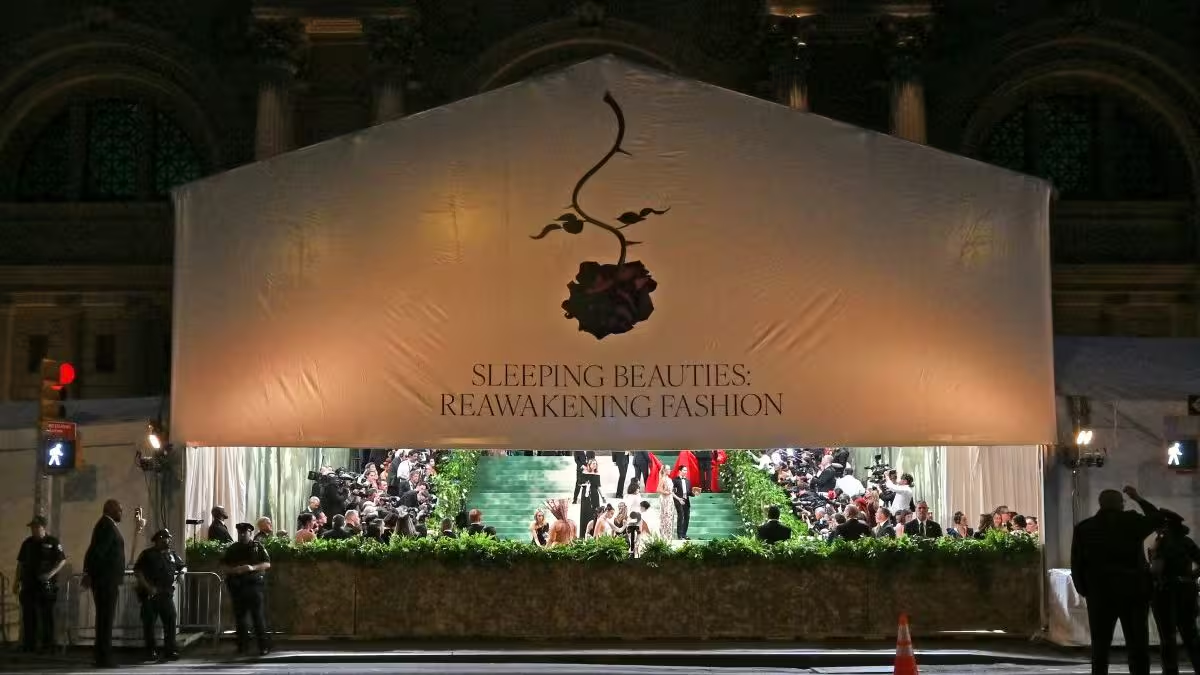
While the world watches celebrities glide into the Met Gala, 500 artisans in Alleppey are the ones who make that entrance possible — one hand-woven thread at a time.
Every first Monday of May, the world holds its breath. The cameras flash, the gowns billow, and fashion’s most powerful people ascend those famous steps at New York’s Metropolitan Museum of Art. But while the headlines go to the couture and the custom jewels, the unsung hero of the evening lies beneath everyone’s feet.
The Met Gala carpet — that vast, seamless surface on which fashion history is made — is not created in New York. It is handwoven in Cherthala, a quiet town in Alleppey district, Kerala. And in 2026, for the fourth time, it is being crafted by Neytt Homes by Extraweave, a company whose story is as richly textured as the fibres it works with.
A century of craft behind every thread
The roots of this Kerala enterprise go back to 1917, when Sivan Santhosh’s great-grandfather founded the Travancore Mats and Matting Company. The business evolved across generations, from coir foot mats to jute rugs, before Sivan’s father established Extraweave in the early 2000s. Sivan himself studied at Babson College in Boston before returning to India with his wife, Nimisha Srinivas. Together, they founded Neytt by Extraweave in 2020, going on to supply brands including Ralph Lauren Homes, Crate & Barrel, and Pottery Barn, while also becoming a long-term supplier to IKEA.
The Met Gala commission remains their most extraordinary chapter. The first invitation arrived shrouded in secrecy — it was only after months of creating prototypes that the team discovered, via a heavily NDA-covered brief, that the project they had been quietly working on was none other than the Met Gala. Since that first carpet in 2022, the collaboration has held, establishing Kerala’s craftsmanship on perhaps the most watched runway in the world.
90 days, 500 hands, one flawless surface
The scale of what Neytt produces is staggering. For 2026, the team produced 57 rolls of carpet, each measuring 4 by 30 metres, covering a total of 6,840 square metres. The process takes 90 days and involves nearly 500 artisans. The carpet is woven from natural sisal fibre sourced from Madagascar, chosen for its strength, texture, and sustainability. The fibre is hand-sorted, spun into yarn, twisted into a double ply, and sheared before thousands of bobbins are loaded onto looms to begin weaving.
The Met’s brief has always called for a blank canvas for artists to paint over, but with a crucial caveat: the carpet’s construction had to withstand the weight and spectacle of the extravagant looks set to parade across it. Getting the weave density right took multiple rounds of prototyping. This year, the fibre is finer and has gone through additional finishing processes to reduce abrasion. A softening agent has also been introduced so that trailing hems glide rather than snag. In a wall-to-wall installation of this scale, even a microscopic flaw is visible, which is why quality control at every stage is non-negotiable.
The brief: a white canvas for ‘Fashion is art’
The theme for 2026 is Fashion is Art, and Neytt’s brief was straightforward in concept, exacting in execution: deliver a seamless white base for painters in New York to transform. The carpet was shipped to New York in November 2025, months before the gala, so the final artistic layer could be applied on-site.
The 2025 carpet remains perhaps their most celebrated: a midnight blue surface dotted with white-and-yellow daffodils, painted by artist Cy Gavin. Inspired by a field of narcissus flowers, it captured themes of self-recognition and identity, echoing the Costume Institute’s exhibit Superfine: Tailoring Black Style. After each event, parts of the carpet are auctioned and the rest repurposed — which also explains the one year Neytt sat out: in 2024, the organisers simply used leftover rolls from previous years.
The association has changed the business in ways that go beyond the commission itself. It has brought global visibility to a craft long overlooked, and challenged the assumption that luxury Indian textiles can only come from the north. For a company rooted in a small Kerala town, that may be the most meaningful thread of all.
End of Article


