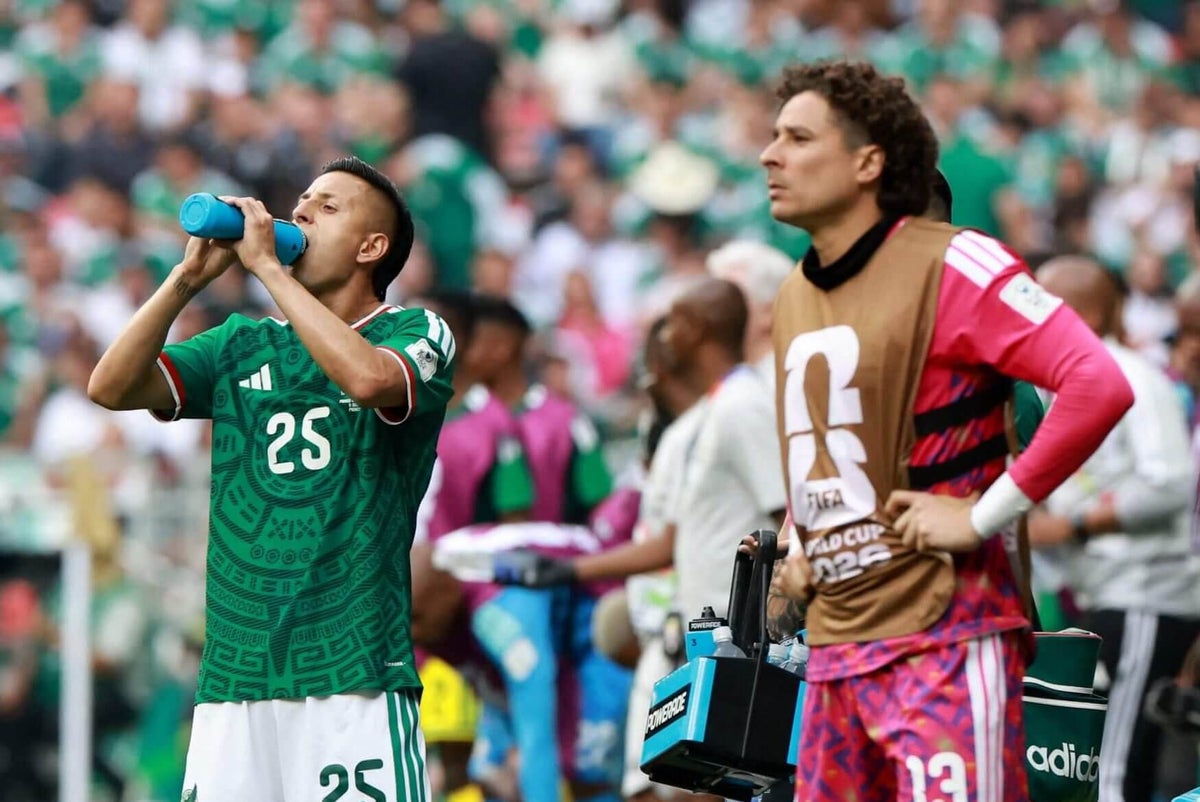
U.S. broadcaster Fox cut away to full-screen commercials during the hydration breaks that FIFA has introduced for the 2026 World Cup, and even missed some match action during the second half of the opener between Mexico and South Africa.
Not long after Raul Jimenez’s goal for Mexico in the 67th minute — an emotional moment that led to eruptions at Mexico City Stadium, throughout Mexico and in Mexican American communities throughout the U.S. — Fox’s broadcaster, Ian Darke, told viewers: “And that leads to the hydration break, powered to you by Powerade.”
After a brief montage of slo-mo fan reactions, Fox then cut to advertisements for around two minutes.
During that ad break, at the stadium, players had returned to the field. They were ready to resume around the 69:30 mark, but the referee, Wilton Sampaio, told South Africa to hold its kickoff.
Players were forced to wait around 40 seconds as Sampaio coordinated with someone on the sideline. And even when they did resume, Fox was still showing an Adidas commercial.
Fox cut back to the match several seconds after play restarted.
Telemundo, the Spanish-language broadcast rights holder in United States, did not cut away to commercials, and has said it will not throughout the tournament. Instead, its broadcast kept players on camera as commentators offered analysis, while an L-shaped Lays ad filled the left side and bottom of the screen.
FIFA, which organizes the tournament, announced back in December that it would introduce the three-minute breaks midway through each 45-minute half at the World Cup. It promoted the breaks as a “player welfare” measure, but said there’d be “no weather or temperature condition in place, with the breaks being called by the referee in all games.”
FIFA did not say whether broadcasters would be allowed to cut to commercials during the breaks, as they would during an NFL or NBA timeout.
Fox viewers missed some action after Jimenez’s second-half goal for Mexico. (Carl Recine / Getty Images)
The Athletic reported in March that full-screen ads would be permitted, but with some guardrails.
Three sources, including one at FIFA, said that broadcasters were told the ad break shouldn’t start within 20 seconds of the referee’s whistle pausing play, and that they should return to the match feed at least 30 seconds before play resumes.
Fox broke the latter rule during the first half of Mexico-South Africa, but did not miss any match action.
During both breaks, it showed around two minutes of ads, which is within the 2-minute, 10-second window theoretically allotted for those during the three-minute break.
The problem in the second half, it seemed, was that the hydration break began directly after Jimenez’s goal. Fox, presumably, was late to cut to the ad break, and still tried to fit in all the ads it had sold — a Verizon spot featuring David Beckham, a Bank of America commercial, and an Adidas ad featuring Lamine Yamal.
Fox declined to comment. The Athletic has approached FIFA for comment.
Many longtime soccer fans lamented the breaks. Even Carli Lloyd, the former U.S. women’s national team player who now works for Fox as an analyst, posted on X: “I hate it.”
How the rest of the world handled the breaks
Other broadcasters around the globe handled the hydration breaks in various ways. ITV in the United Kingdom did not cut to commercials; it stayed with players and commentators, plus some on-screen promotions.
In Germany, Magenta TV went to a full ad break.
In Argentina, Telefé went to a full break, but DirecTV Sports stuck with the match feed.
Australian and Danish broadcasters both stayed with the feed as well.
In Mexico City at the stadium, while broadcasters filled the breaks and while players huddled near the sideline, the Estadio Azteca DJ played the iconic Mexican party song El Sonidito.
The breaks also have sporting implications. Coaches will use them throughout the tournament to tweak tactics and instruct players in a way that they previously couldn’t midway through a half.


