Last Updated:
The vessel had stopped transmitting its signal around March 31, only to reappear near Indian waters this week.


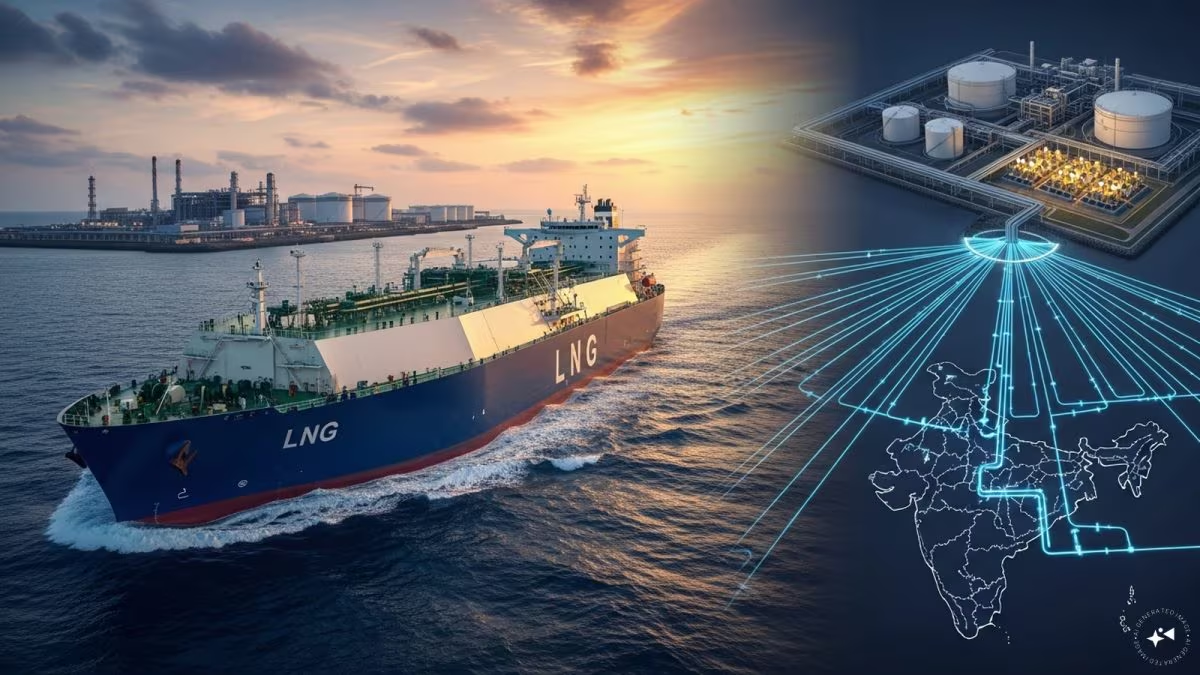
As per the data, The Mubaraz is heading to China and is likely to arrive in the second half of May. (AI-generated photo)
As a fragile ceasefire between Washington and Tehran holds for now, the first Liquefied Natural Gas (LNG) shipment has successfully crossed the Strait of Hormuz, marking the first such transit since the US–Israel launched a war against Iran in March.
Ship-tracking data shows the vessel The Mubaraz was spotted near India on Monday. The ship, carrying LNG loaded from Abu Dhabi National Oil Company’s Das Island facility in the United Arab Emirates in March, had remained stranded in the Gulf region since the outbreak of hostilities.
The vessel had stopped transmitting its signal around March 31, only to reappear near Indian waters this week, indicating a possible easing of tensions in one of the world’s most critical energy corridors.
As per the data, The Mubaraz is heading to China and is likely to arrive in the second half of May.
Why This Is Crucial
Iran brought the global energy markets to a halt after blocking all ship movements through the Strait of Hormuz. The US also imposed a blockade on the critical route, which handles roughly one-fifth of the world’s LNG supply.
Trump ‘Not Satisfied’ With Iran’s Proposal To End War; Araghchi Blames US For Failed Talks | Updates
Is Strait Of Hormuz Open?
On April 17, Iran briefly declared the Strait of Hormuz “fully open” to commercial traffic following a ceasefire in Lebanon. US President Donald Trump acknowledged the move, even as he maintained that the US naval blockade on Iranian-linked ports and shipping would remain in place. A handful of vessels transited the corridor soon after.
The reprieve proved short-lived. By the following day, Tehran reinstated restrictions, citing continued US blockade measures and alleged violations of the ceasefire. Several ships attempting to pass through the strait reportedly encountered warnings or hostile actions from Iran’s Islamic Revolutionary Guard Corps (IRGC), prompting a fresh drop in traffic.
Shipping data indicates the waterway remains effectively restricted, with only limited movement — roughly 19 vessels over a 24-hour period, far below typical levels. Transit risks remain elevated, including potential attacks, surging insurance costs, and the need for coordination with Iranian authorities. Meanwhile, the US continues to enforce its blockade on Iran-linked maritime activity.
Iran has introduced an informal “pay-to-pass” system in the Strait of Hormuz, seeking transit fees — in some cases exceeding $1 million to $2 million per vessel — for safe passage through the strategic waterway. The charges are understood to be applied on a selective, case-by-case basis, adding further uncertainty to already disrupted shipping routes. Vessels that have managed to cross are largely those backed by diplomatic or political arrangements, particularly ships linked to countries such as China. Tehran has reportedly allowed some non-Western vessels to transit via controlled “safe corridors,” even as restrictions remain in place for ships associated with the US and its allies.
April 28, 2026, 08:56 IST
Read More


