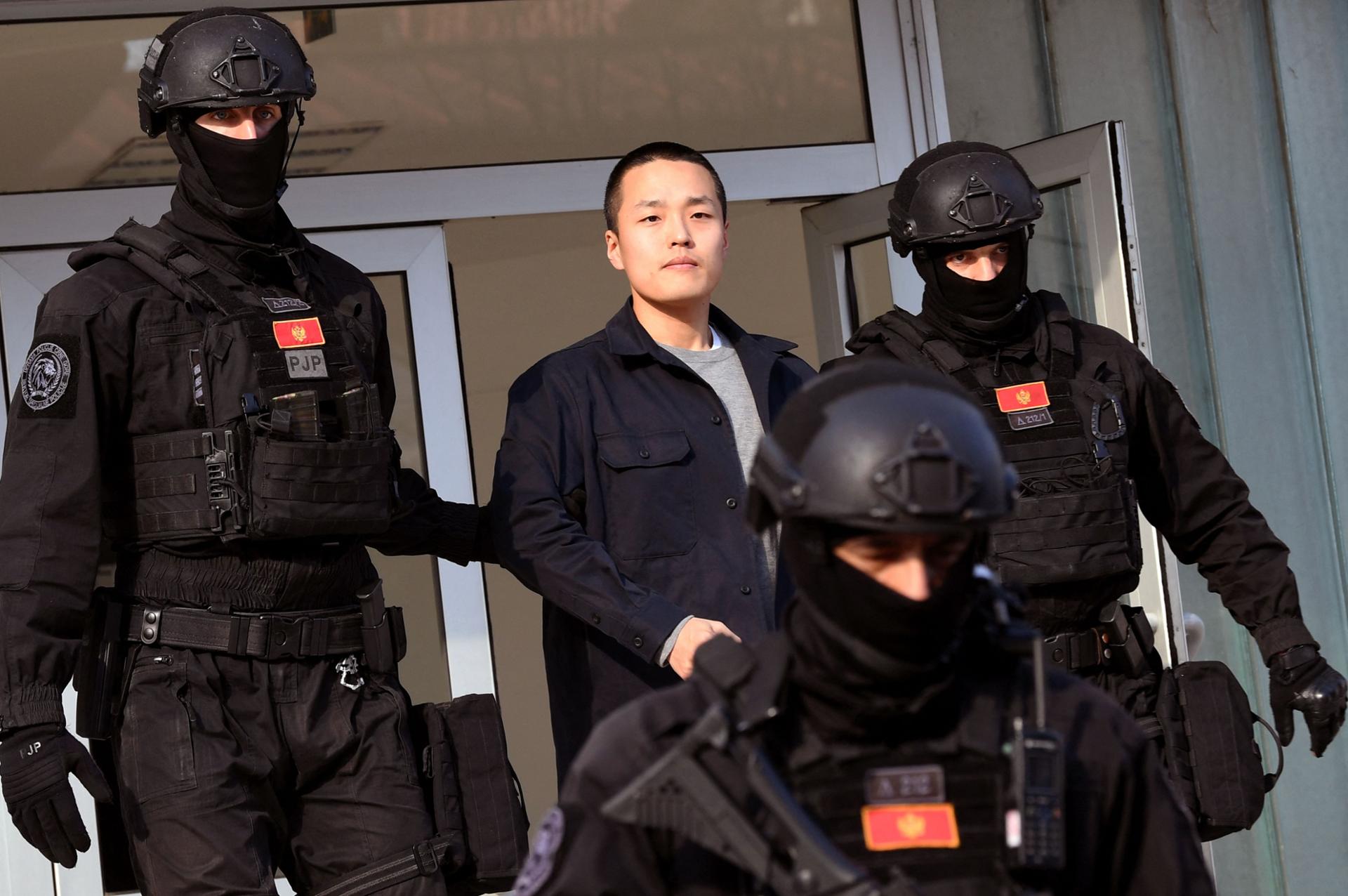
Police officers escort Korean cryptocurrency entrepreneur Do Kwon out of court in Podgorica, Montenegro, March 23, 2024. AFP-Yonhap
Do Kwon, the crypto tycoon at the center of the 2022 collapse of cryptocurrencies TerraUSD and Luna that caused an estimated $40 billion in investor losses, may face another trial and a jail sentence here if he is extradited to Korea in addition to the 15-year prison sentence given by a U.S. court, according to government officials and prosecutors Monday.
It is widely expected that the 34-year-old Korean national may apply to the International Prisoner Transfer Program after serving half of his 15-year sentence, with U.S. prosecutors agreeing not to oppose such a request as part of a plea deal.
This leaves open the possibility of his transfer to Korea.
After his arrest in Montenegro in March 2023, Kwon pursued legal action seeking extradition to Korea rather than the U.S. He was ultimately transferred to the U.S. on Dec. 31, 2024, and sentenced on Thursday (local time).
If sent back to Korea, Kwon would face a separate trial on charges including violations of the Capital Markets Act, and could receive additional punishment independent of the U.S. proceedings.
The joint financial crimes unit of the Seoul Southern District Prosecutors’ Office obtained an arrest warrant for Kwon in September 2022.
“A guilty verdict in Korea could lead to a sentence of more than 30 years,” a senior prosecutor said. “Prosecuting Kwon domestically would best serve efforts to compensate local victims.”
Authorities estimate there are about 200,000 victims in Korea, with total losses of roughly 300 billion won ($204 million). Ten alleged accomplices have been on trial in Korea for nearly three years.
Kwon, whose full name is Kwon Do-hyung, is the co-founder of the Singapore-based cryptocurrency firm Terraform Labs, which issued the TerraUSD stablecoin and its sister token, Luna.
Terraform Labs claimed Terra was designed to maintain a one-to-one peg with the U.S. dollar through its Terra Protocol, but the peg later collapsed.
When Terra fell below $1 in May 2021, Kwon said the protocol had restored its value. U.S. prosecutors later found, however, that an investment firm contracted by Terraform Labs had secretly purchased Terra to prop up its price. Both Terra and Luna plunged again in May 2022, inflicting massive losses on investors.
Kwon was convicted on nine counts in the U.S., including fraud and money laundering, prompting District Judge Paul A. Engelmayer to sentence him to 15 years in prison and order the forfeiture of $19 million in illicit gains.
Under the U.S. sentencing system, which allows penalties for multiple offenses to be combined, Kwon initially faced a potential sentence of up to 130 years. He pleaded guilty in August to conspiracy to commit fraud and wire fraud under a plea-bargaining agreement.
While prosecutors sought a 12-year sentence, the court imposed a longer term, citing losses of about $40 billion and describing the scheme as “a fraud on an epic, generational scale.”
“In the history of federal prosecutions, there are few frauds that have caused as much harm as you have, Mr. Kwon,” Engelmayer said during the sentencing hearing in Manhattan federal court.
During sentencing, Kwon’s defense team urged the court to cap the sentence at five years, arguing that he faces parallel investigations and potential prosecution in Korea.
Engelmayer rejected the argument, saying one court cannot base its ruling on speculation about what another court might decide, and declined to treat it as a mitigating factor.


