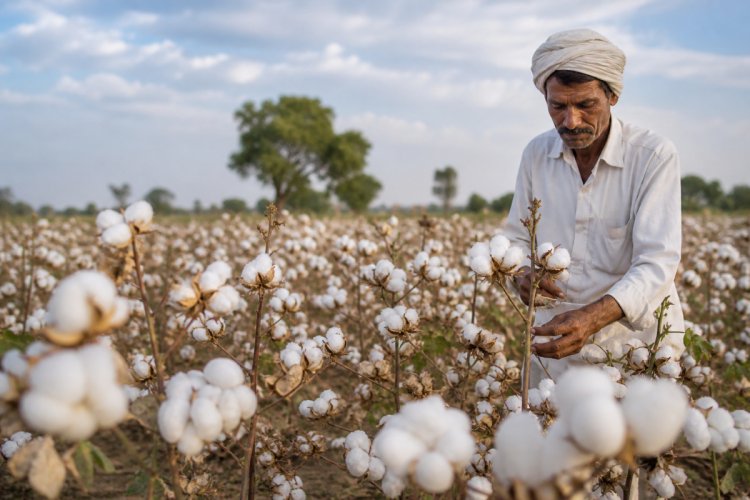
The Union Cabinet, chaired by Prime Minister Narendra Modi, has approved Rs. 5659.22 crore for the Mission for Cotton Productivity (2026–27 to 2030–31) to address bottlenecks, declining growth, and quality concerns in India’s cotton sector.
The Union Cabinet, chaired by Narendra Modi, has approved a Rs 5,659.22 crore outlay for the Mission for Cotton Productivity for the period 2026–27 to 2030–31, aiming to address stagnating yields, quality concerns, and structural bottlenecks in India’s cotton sector.
The mission is aligned with the government’s 5F vision (Farm to Fibre to Factory to Fashion to Foreign), and seeks to enhance productivity, improve quality, and strengthen India’s competitiveness in global textile markets.
At the core of the mission is the development of high-yielding, climate-resilient and pest-resistant cotton seeds, alongside the promotion of advanced production technologies. These include High Density Planting System (HDPS), closer spacing methods, and integrated crop management practices.
The initiative will also promote Extra Long Staple (ELS) cotton, which is crucial for premium textile production and exports.
Strengthening Value Chain and Infrastructure
The government plans to modernize ginning and processing units, improve contamination-free cotton supply, and upgrade cotton testing infrastructure with globally benchmarked, accredited facilities. Around 2,000 ginning and processing factories are expected to be covered under the mission.
A major push will be given to branding under Kasturi Cotton Bharat, aimed at establishing Indian cotton as a premium, traceable, and sustainable product in international markets.
The mission emphasizes digital integration of mandis, enabling transparent price discovery and better market access for farmers through e-platforms. It is expected to benefit nearly 32 lakh farmers, improving their income realization.
Sustainability and Fibre Diversification
In a bid to align with global sustainability trends, the initiative promotes cotton waste recycling and circular economy practices. It also encourages diversification into natural fibres such as flax, ramie, sisal, bamboo, banana, and milkweed to complement cotton production.
The mission will be jointly implemented by the Ministry of Agriculture and Farmers Welfare and the Ministry of Textiles. It will involve key research institutions, including the Indian Council of Agricultural Research and the Council for Scientific and Industrial Research, along with State Agricultural Universities.
Initially, 140 districts across 14 states will be targeted for technology upscaling and capacity building.
Production Targets and Long-Term Vision
The mission aims to increase India’s cotton production to 498 lakh bales (170 kg each) by 2031, while boosting lint productivity from 440 kg per hectare to 755 kg per hectare.
It also sets quality benchmarks such as reducing contamination levels to below 2 percent and enhancing traceability through certification systems.
The government described the initiative as a major step toward self-reliance in the cotton sector, positioning India as a global leader in sustainable and high-quality cotton production.


