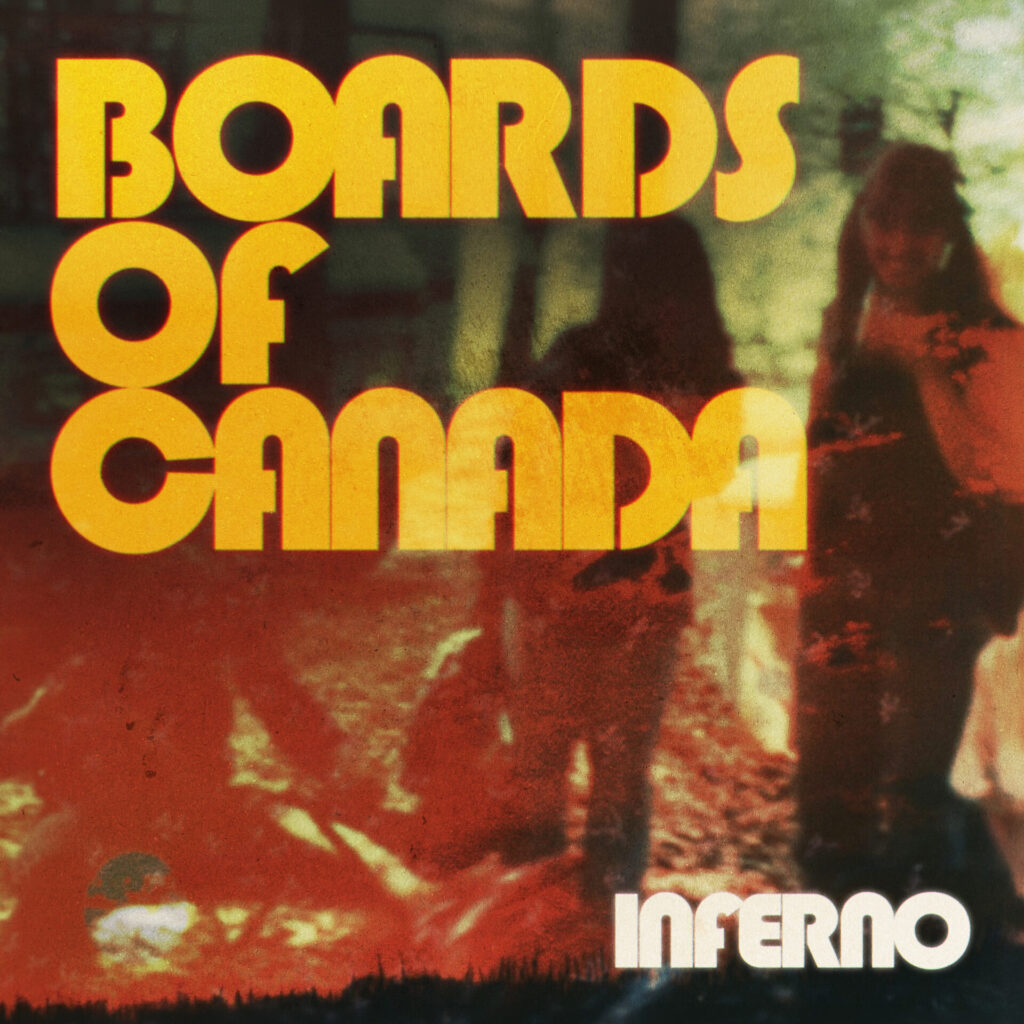
The marriage of heaven and hell took place last weekend at Judson Memorial Church. The New York City landmark was one of seven venues worldwide to host the Inferno Sessions, the global playback events accompanying Boards of Canada’s first album in thirteen years. Beneath the chancel’s Byzantine-styled rose window burned the projection of an ominous cluster of fiery hexagons – a fitting introduction to Inferno. The album provides a map to the hope-inflected ordeal hell is undergoing on here earth. Only a few hundred devotees could sit for the reckoning, each of them primed by weeks of successive unveilings that heralded the return of the band. The release of Inferno unfolded through an ARG-style campaign featuring mysterious VHS mailouts, wheat-pasted album artwork appearing in cities worldwide, and the eventual emergence of lead tracks ‘Introit’ and ‘Prophecy at 1420 MHz’.
‘Prophecy’ breaks the seal of the record, a serpentine meditation coiling outward from Phrygian flutes and hazy guitars before hardening into clockwork grooves upscaled from BoC’s earlier sound. The full breadth of the album’s contours burst forth from the start. Then it speaks: a vocoded Vox Dei taking vengeance upon mankind’s Promethean overreach, the “final boss of the Boards of Canada universe” as one YouTuber put it, the stark emanation of an energy system that has long haunted BoC’s discography. Obsessives quickly uncovered the source material and structural cipher embedded within the track: the vocoder’s prophetic utterance, right down to the last tip of its delay trails, runs exactly 72 seconds – the same duration as the Wow! Signal recorded by the Big Ear telescope on 15 August 1977. That singular narrowband transmission at 1,420 MHz, known as ‘the hydrogen line’, has never repeated since.
The void which followed ’Prophecy’ and subsequent selections at the Inferno Sessions was suffused with a vigilant stillness, an almost sacred quietude held across the room between each track. What unspooled into the hush was equal parts divine and demonic. We guests were merely the silhouetted people to come as seen in Inferno’s promo art, standing before the haloed edges of an apocalypse already arrived.
Inferno reveals the wreckage of history as the last frontier of BoC’s analogue aesthetic. Evolved from their early arcadian vibes and plaintive monosynth melodies, BoC confronts the fire of our times: modern civilization as failure, a post-psychedelic trip through the ruins, and The Great Conflagration now kindling in every corner of the Earth.
Tracks shift between kick-driven syncopated grooves and immersive chemical vistas that make the record feel like hard overlanding on the desert flats en route to Gehenna. Shelter is offered incidentally: chanting communes, end-times enclaves, shambling skunk works of the world’s last venture capitalists. The portents of Tomorrow’s Harvest have passed – it’s all hell from here out.
Inferno arises as a theophany of competing revelations. ‘Naraka’ exemplifies the evolution of BoC’s sound, integrating bone-needle percussion, sinuous synth lines, a sampled chorus of Hare Krishna adherents, and the relentless pull of a formless undertow beneath it all. ‘Into the Magic Land’ arrives as a voiceless Western ballad whose guitar chimes with a clean-tone solitude in a world given over to permanent detours. This is not the sun-baked sojourn of The Campfire Headphase; it’s the arrival of the fourth horseman, steel-string in hand, trailing a sombre synth sequence that invokes the more contemplative corners of Philip Glass’s Koyaanisqatsi score. Throughout the record, ambivalence abounds: crepuscular cadences and atmospheric shimmer cut Inferno’s leaden dread, a rift from an ominous nowhere disturbs the saccharine somewhere heard in ‘You Retreat In Time And Space’. The end of the world will not extinguish our longings. Shards of heaven have lodged themselves within the hell we’ve brought upon the land.
Boards of Canada have returned to a semblance of the aesthetic they helped to invent. Today we drift in a cultural milieu where lo-fi music, analogue synthesizers and retro aesthetics alike have become thoroughly absorbed by the mainstream, to say nothing of latter-day cassette revivals, infinite instalments of Stranger Things, Instagram filters simulating super-8 decay, and a gyre of objects remade under the dying amber glow of the 70s and early 80s. Inferno, however, surpasses the simple ubiquity of nostalgia. The ever-increasing sonic fidelity of the BoC sound has proven contentious, but it is precisely Inferno’s depth and hi-fi clarity that allows the album’s gods their fullest refulgence. Despite its sharpened resolution, the record thrives through its distillation of vintage influences, indulging a hypnotic assemblage of haunted media in ‘Tape 05’. BoC’s reclamation of their own hauntological sensibilities is more a testament to their archival acumen and control of the sonic palette than a remediation of nostalgic tropes.
However, Inferno’s ambitions exceed a mere recuperation of the band’s retro-inflected origins. Boards of Canada enjoin us to abandon ‘hauntology’, that tattered lens through which retrospective impulses have been refocused into rescues of lost futures. For as much as the band have been cast as harbingers of the Ghost Box sound, the mile markers from ‘Introit’ to ‘I Saw Through Platonia’ move past late capitalist spectrality, instead confronting the cosmic and chthonic forces that precede human inscription. This album yearns to see through a world of ongoing ruination straight to the archaic substrate that lies beneath it.
The final stretch of Inferno feels like a return to the cocoon, a desire for an incubation preceding selfhood, reconciling Music Has The Right To Children’s “cult of childhood” with the eschatological temper of BoC’s later catalogue. During the concluding tracks at the New York gathering, the burning hexagon projection gave way to a montage of home movies featuring kids playing safely beneath the gaze of the family. Was this gesture an expression of longing for an oceanic escape? Or was it meant as a final glimpse at the Sandison boys as they bid us farewell?
Perhaps Inferno’s departing message is one of love, a theme easily overlooked in the brothers’ work. From the iconic innocence of the “I…love…you” sample from Music Has The Right to the fractured agape stuttering throughout ‘Father And Son’ and the heartbeat that closes ‘I Saw Through Platonia’, locating the lost pulse of love is Inferno’s most avowed and yet most subtle transmission.


