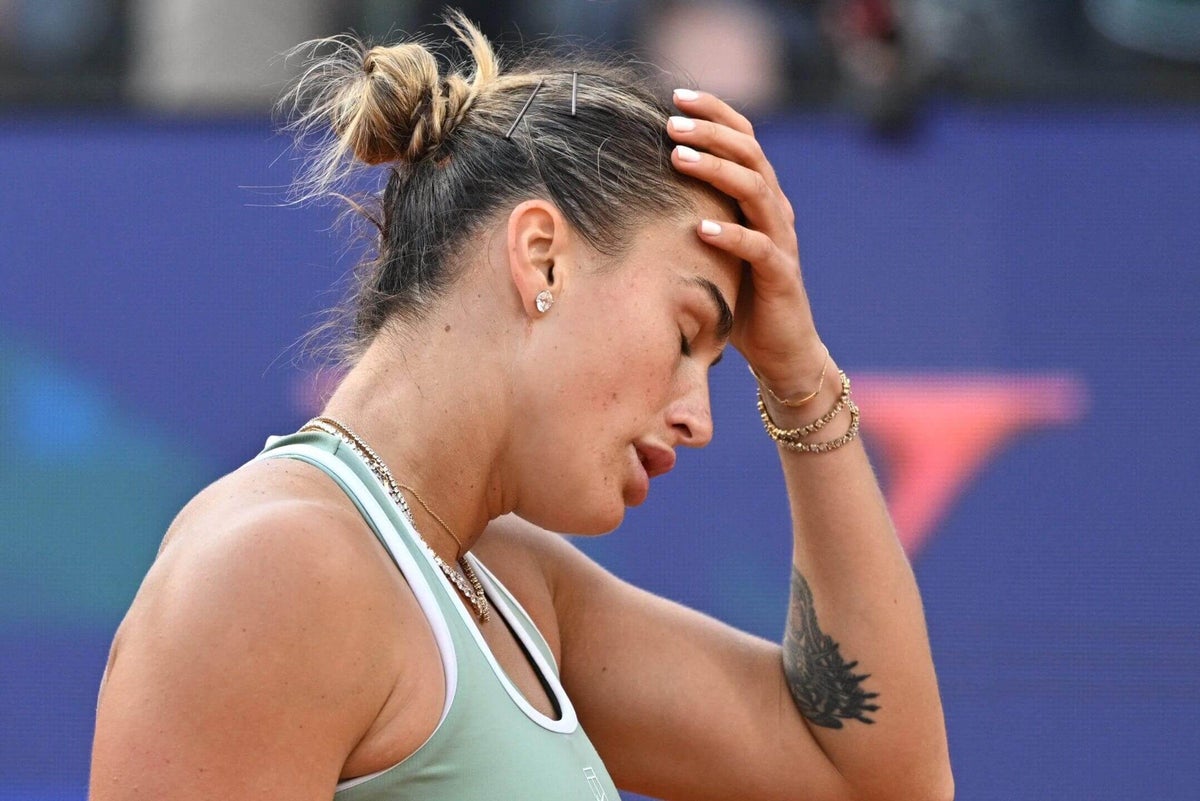
ROME — Aryna Sabalenka, the women’s world No. 1, has suffered her earliest tournament exit in 15 months after a third-round defeat to Sorana Cîrstea at the Italian Open.
Sabalenka appeared on course for a routine win on Saturday when she was a set and 2-0 up, but some erratic hitting, and an inspired opponent, conspired to leave Sabalenka coming to terms with only a third defeat of the year. She also required a medical timeout for a lower-back and hip problem midway through the third set, which is a potential concern with the French Open starting in a couple of weeks on May 24.
Because of the injury, Sabalenka did not hold a news conference.
“I’d say that probably it’s like my lower back, connected to the hip, which (was) kind of like limiting me from the full rotation,” she said in an interview with the WTA Tour.
“I guess we (are) just going to have some days off. We’re going to spend it on recovery. That’s the plan I believe for now. I felt like my body was limiting me from performing on the highest level. She stepped in and played incredible tennis. Didn’t really give me many opportunities.”
The Qatar Open, in February 2025, was the last time Sabalenka lost earlier in a tournament; the Dubai Tennis Championships in the same month was the last time she didn’t make the quarterfinals of an event, which she had done 17 times in a row before Saturday.
Coupled with last week’s Madrid Open quarterfinal loss to Hayley Baptiste, Sabalenka has now lost two of her last three matches, both from a set up. She’ll head to Paris with a 4-2 record on clay this year.
As inconsistent as Sabalenka was, Cîrstea deserves a huge amount of credit for playing so fearlessly to ultimately prevail 2-6, 6-3, 7-5. It’s not uncommon for Sabalenka to perform sluggishly in the early rounds of tournaments, but she is almost always able to find a way through, normally in straight sets. To stand a chance, Cîrstea had to refuse to be intimidated by Sabalenka’s phenomenally powerful hitting and considerable aura.
Fortunately for Cîrstea, defiance is one of her defining characteristics. Aged 36 and in her final year on the tour, the Romanian world No. 27 has built a reputation as a fearsome competitor. At the Australian Open in January, she complained to the umpire about Naomi Osaka saying “come on” to herself between her first and second serves and then gave the four-time Grand Slam champion a very frosty handshake after losing the match. Sabalenka called her “a fighter” after the match.
Cîrstea demonstrated that in the way she dragged herself back into the match when down 6-2, 2-0 and looking as though she was heading for a swift defeat. At this point her suddenly immaculate ballstriking helped her take over the match, neutralizing Sabalenka’s serve and dominating from the baseline with the accuracy and weight of her shots. From the first to the second set, Sabalenka went from winning 68 percent of her first serve points to 39. Sabalenka ended the match with a tally of 59 percent first serve points won, her lowest of the year.
With one of her biggest weapons blunted, Sabalenka started to go for too much and ended up making wild errors, the kind she used to before becoming the absurdly consistent winning machine of the last few years.
After battling back to win the second set, Cîrstea broke immediately at the start of the decider. Sabalenka broke back, but Cîrstea did so again. Even shrugging off the disappointment of missing a sitter of a backhand when up break point a couple of points earlier. Sabalenka was furious, asking her team to give her some encouragement.
Sabalenka appeared to suffer a lower-back injury (Tiziana FABI / AFP via Getty Images)
After holding for 4-3, Sabalenka took that medical timeout, while Cîrstea went over to her support team, which included her good friend Belinda Bencic, the world No. 12. Sabalenka was wincing in pain as she returned to the court and initially looked far from comfortable. She somehow managed to find a second wind and broke back for 5-5, with Cîrstea failing to serve out the match having been two points from victory when up 5-4, 30-30.
Not for nothing is Sabalenka regarded as one of the toughest competitors in the sport. But Cîrstea earned herself a second chance to serve it out, breaking once more to leave Sabalenka railing at her box again at the change of ends. This time there was no mistake, a Sabalenka backhand sailing long to end the contest after two hours and 12 minutes.
“I’ve played quite a few matches against the top girls lately where I was a little bit short,” Cîrstea said in a post-match news conference. “I felt I missed a little bit maybe of being a little bit more brave in the end or taking a little bit more risk in those important moments. I think I’ve learned from those losses.
“Today in important moments I tried to play aggressive, I tried to play on my terms. Against the top girls, you can just not play safe. They are not going to give it to you. You have to earn it.
“Today I knew if I wanted to beat Aryna, I had to earn it.”

Cîrstea came back from a set down on Saturday (Julian Finney / Getty Images)
Cîrstea has spoken about wanting to enjoy her final year on tour, and she certainly revelled in her role of giantkiller on Saturday. This win also made her the oldest player to defeat a world No. 1 on clay, as well as the oldest to do so from a set down on any surface. It was her 26th career win against top-10 opposition, 18 years after her first. Playing with this kind of freedom and clarity she’s someone no one on the tour will relish facing. She’ll next face the world No. 13 Linda Nosková in the fourth round on Monday.
“It’s kind of like it’s sad to see her leaving because I feel like she’s one of those players that’s fighting no matter what,” Sabalenka said.
“I felt like she could stay for longer. It’s her choice. We all respect that. I just wish her the best season to finish her career.”
Cîrstea’s victory here followed her title win at the Transylvania Open in her home country in February and reaching the Rouen Open semis last month, in what has been a very profitable final year on tour so far. At her last event in Madrid she led the world No. 3 Coco Gauff by a set and a break. On the temptation to continue, Cîrstea said her plans had not changed but that “a little door is there always open because you never know how things go in life.”
For Sabalenka, the premature loss here and the relatively early defeat in Madrid represents the worst form she’s been in since those disappointing results last February. Throw in the injury concern and suddenly the world No. 1 has a fair amount to contend with going into the second Grand Slam of the year. A tournament she’s yet to win, after losing in last year’s final to Gauff.


