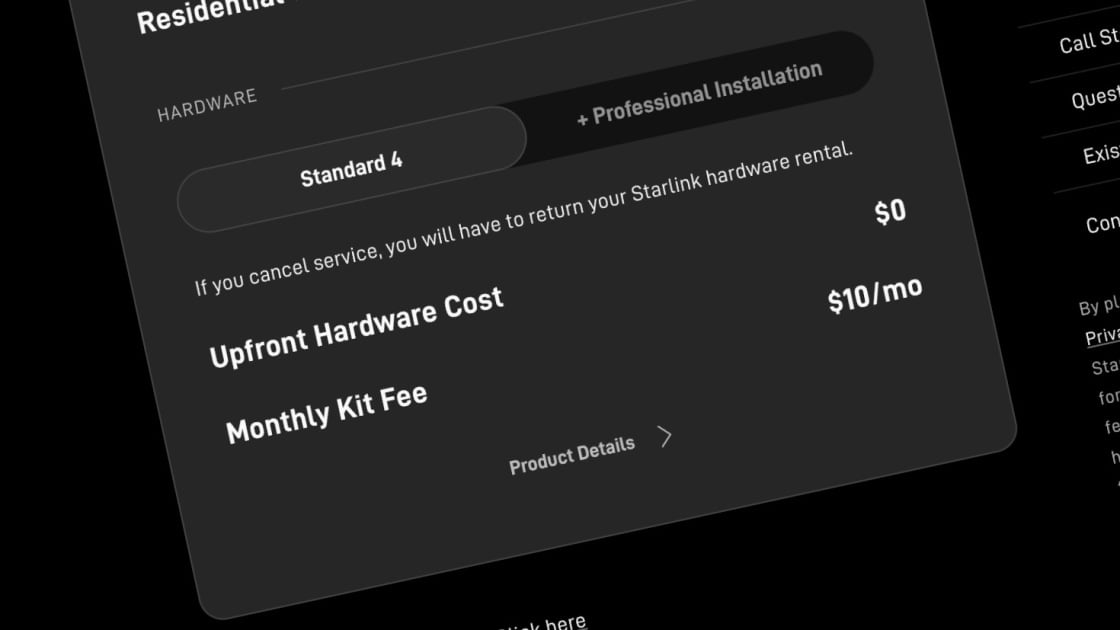
The cost of Starlink is going up for new users. The satellite internet service has quietly introduced a “monthly kit fee” that adds $ 10 per month to a Starlink Residential subscription.
Users spotted the new fee on Monday. It applies to the standard Starlink dish that SpaceX sends with a new Residential subscription and appears to be rolling out globally, popping up on Starlink.com for new customers in the US, Canada, the UK, France, Australia, and Mexico.
It’s a notable change considering Starlink had been offering the standard dish as a free rental for new Starlink Residential users. That approach meant SpaceX could advertise a “$0” up-front cost for its satellite internet service, making it more appealing to prospective customers.
But now the company is demanding that new users pay extra to join, adding a $10 price hike to all three Residential plans: the $55/month 100Mbps, $85/month 200Mbps, and $130/month Residential Max options.
(Credit: Starlink.com)
Over the long term, the $10 monthly fee isn’t a great deal either, since it means forking over $360 during a three-year subscription. The standard dish currently retails for $349 at retailers such as Best Buy and Walmart, but it’s been discounted to $199 or even $89.
The other bad news is the Residential Max plan is losing two key perks introduced back in January. Subscribers no longer get access to a free Mini dish as a rental, or the 50% discount to the Roam tier plans like before. “The Optional Mini Kit for Travel was available only to customers in select countries with an active Residential Max plan. It is not available to new customers at this time,” Starlink now says.
SpaceX didn’t immediately respond to a request for comment about why it introduced the changes. But a support page notes that customers can request to purchase their dish rather than rent it. “Renting provides a flexible option to use Starlink internet in select countries,” the page adds. “Starlink kits may only be rented for Residential service plans.”

(Credit: PCMag)
This comes a few weeks after Starlink raised prices for its monthly plans by $5 or $10, prompting some customers to claim SpaceX was resorting to a cash grab. The new fee might spark speculation about whether the ongoing AI-driven memory shortage played a role or if SpaceX is simply intent on raising revenue as it prepares to go public this Friday.
Recommended by Our Editors
As a publicly traded company, SpaceX will face more pressure to post a strong financial outlook and earnings each quarter. The regulatory filing for the company’s IPO shows Starlink had 10.3 million paid subscriptions in Q1, up from 5 million a year earlier. However, the average revenue per user decreased to $66 per month in Q1, down year over year from $86.
It’s also possible that the new rental fee is part of SpaceX’s effort to roll out next-gen dish models. On Monday, SpaceX CEO Elon Musk teased two new dishes, which could be successors to the standard Starlink dish and the portable Starlink Mini.
Editor’s note: This story has been updated to note the Residential Max plans is losing two key perks as well.
About Our Expert

Michael Kan
Principal Reporter
Experience
I’ve been a journalist for over 15 years. I got my start as a schools and cities reporter in Kansas City and joined PCMag in 2017, where I cover satellite internet services, cybersecurity, PC hardware, and more. I’m currently based in San Francisco, but previously spent over five years in China, covering the country’s technology sector.
Since 2020, I’ve covered the launch and explosive growth of SpaceX’s Starlink satellite internet service, writing 600+ stories on availability and feature launches, but also the regulatory battles over the expansion of satellite constellations, fights with rival providers like AST SpaceMobile and Amazon, and the effort to expand into satellite-based mobile service. I’ve combed through FCC filings for the latest news and driven to remote corners of California to test Starlink’s cellular service.
I also cover cyber threats, from ransomware gangs to the emergence of AI-based malware. In 2024 and 2025, the FTC forced Avast to pay consumers $16.5 million for secretly harvesting and selling their personal information to third-party clients, as revealed in my joint investigation with Motherboard.
I also cover the PC graphics card market. Pandemic-era shortages led me to camp out in front of a Best Buy to get an RTX 3000. I’m now following how the AI-driven memory shortage is impacting the entire consumer electronics market. I’m always eager to learn more, so please jump in the comments with feedback and send me tips.
Read Full Bio


