Last Updated:
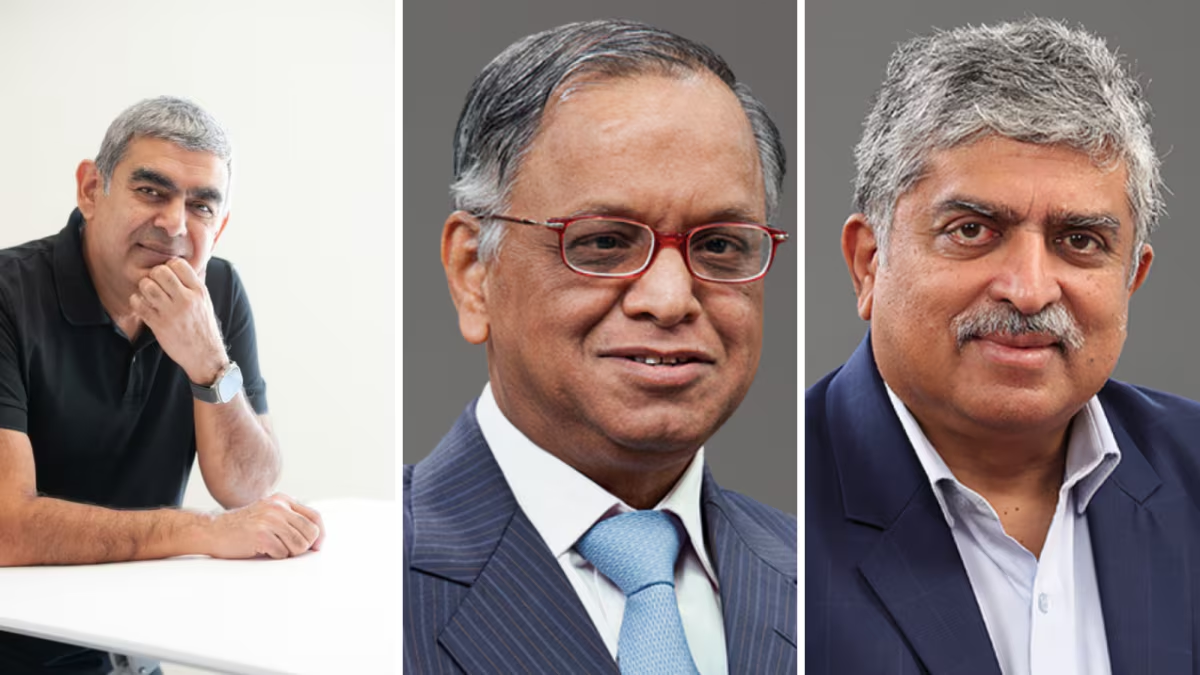
An AWS executive criticised Nandan Nilekani and Narayana Murthy’s approach to AI, saying India needs more leaders like former Infosys CEO Vishal Sikka.


News18
India’s AI future has become the centre of a heated discussion after an Amazon Web Services executive openly criticised the views of Infosys founders Nandan Nilekani and Narayana Murthy. His comments have now sparked a larger conversation around whether India should focus on building advanced AI technology or continue using AI mainly to improve services and productivity.
The debate started after Girish Dilip Patil, Head of Technology – Generative AI at AWS Singapore, shared a strong opinion on X. He argued that India needs leaders who push innovation and product-building in AI rather than sticking to older IT services thinking.
AWS Executive Questions Current AI Thinking
Patil reacted to a recent Economic Times opinion piece written by Nandan Nilekani and former Microsoft India chairman Ravi Venkatesan. In the article, they argued that India should focus more on using AI widely across sectors rather than competing with countries like the US and China to build the world’s most advanced AI models.
Nilekani and Venkatesan said India’s strength has always been in adopting and scaling technology for large populations. They pointed to projects like Aadhaar, UPI and India Stack as examples of how India successfully used technology to solve large-scale problems.
They also explained that building top AI models requires massive investment, computing power and talent, areas where countries like the US and China currently have a major advantage. According to them, India should instead use existing AI tools to improve healthcare, education, agriculture and public services.
Patil, however, strongly disagreed with this idea. “Nandan, I love you for what you have done. But, your ideas are outdated,” he wrote on X.
“You have a typical IT services sales guy mindset. Nothing wrong with that. That greatly helped in India in the 1990s and 2000s, but it will lead it into a ditch in the rest of the 21st century.”
He also praised Aadhaar while suggesting that India now needs a different approach to technology leadership.
“India needs more Vishal Sikkas and not Nandan Nilekani or Narayan Murthy,” he added.
Nandan, I love you for what you have done. But, your ideas are outdated.You have typical IT services sales guy mindset. Nothing wrong with that. That greatly helped in India in 1990s and 2000s, but it will lead it in a ditch in rest of 21st century.
Thank you for everything… https://t.co/GCNXmqHIyj pic.twitter.com/wAIrRCZRNL
— GDP (@bookwormengr) April 29, 2026
Why Vishal Sikka Entered The Discussion
Patil’s post brought renewed attention to former Infosys CEO Vishal Sikka, who had earlier pushed the company towards AI, automation and platform-based technology.
Sikka became Infosys CEO in 2014 and was the company’s first non-founder chief executive. During his time there, he repeatedly spoke about moving beyond traditional labour-based IT services and preparing for the future of AI-driven technology.
Under his leadership, Infosys reportedly began to focus more on automation and AI products. Sikka often warned that companies depending only on manpower-based services could struggle in the long run as technology changed.
However, his tenure also saw internal disagreements with Infosys founders over management decisions, executive pay and company governance. In 2017, Sikka resigned from the company.
As per Moneycontrol, in his resignation letter, he wrote, “It is clear to me that despite our successes over the last three years, and the powerful seeds of innovation that we have sown, I cannot carry out my job as CEO and continue to create value, while also constantly defending against unrelenting, baseless/malicious and increasingly personal attacks.”
Users Split Over India’s AI Future
Patil’s comments quickly drew mixed reactions online. Some users agreed with him and said India cannot continue depending only on low-cost IT services in the AI era.
“There is a reason we should have a retirement age, whether it be politics or corporate governance,” a person wrote.
Another said, “Had Infosys invested the $1B in OpenAI under Vishal Sikka’s leadership, that investment’s current value ($70-$80 billion) would be worth more than Infosys’s current market cap.”
Others supported Nilekani’s practical approach and argued that India currently lacks the infrastructure and resources needed to compete directly with global AI giants. “Nandan’s approach is more practical for India context,” a user commented.
Another person summed up the debate by saying India now faces a choice between becoming an “AI-producing nation” or an “AI-adopting nation.”
Read More


