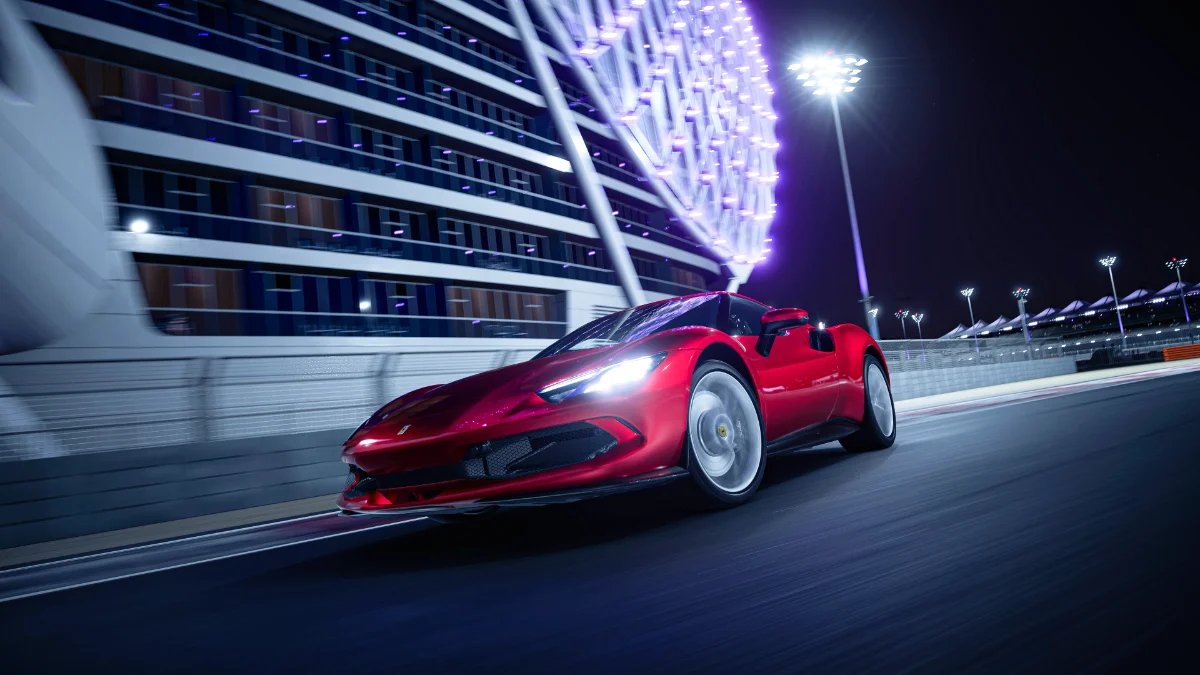
Gran Turismo 7 celebrated its fourth anniversary last week, and it’s worth taking a look back at how the game has evolved since its release. What started as a somewhat turbulent launch has quietly turned into one of the longest-supported titles in franchise history, and the past 12 months in particular have been some of the most transformative yet.
Table of Contents

A Look Back
Gran Turismo 7’s first year was defined by growing pains: the infamous extended outage, debates over the always-online requirement, and a rare roadmap that set fan expectations for what would follow. PSVR2 support also arrived just before the year was out.
Year two delivered “Spec II”, the largest update at that time, with sweeping quality-of-life improvements and more cars and events than any prior patch. The monthly content cadence became the standard fans expected, even if Polyphony Digital had never promised it.
Year three kept the ball rolling without quite hitting the highs of the previous two. The PlayStation 5 Pro received dedicated graphics enhancements, My First Gran Turismo arrived as a demo, and content continued at roughly the same pace. Circuits, in particular, were a sore point, with the game going a full calendar year without a new track location by the time the third anniversary rolled around.
That set the stage for what would come next…
Year Four: Spec III and the Power Pack
If the third year was about maintaining momentum, the fourth was about making a statement.
Gran Turismo 7 received eight content updates between its third and fourth anniversaries, but the headline act was undeniably the massive Spec III update in December 2025.
Spec III was one of the largest updates in the game’s history and arguably the most significant since launch, bringing two brand-new circuits, eight new cars (a single-update record), permanent Invitations, the Data Logger telemetry tool, and a long list of quality-of-life improvements. It felt like Polyphony Digital had been saving up.
Perhaps even more consequential was what accompanied it: the Power Pack, Gran Turismo 7’s first-ever paid DLC. Priced at $29.99 and exclusive to PS5, the Power Pack added 50 races against a new “Sophy 3.0” AI and finally brought back proper practice and qualifying sessions, as well as endurance races lasting up to 24 hours in real time (a feature not seen since Gran Turismo 5).
It was the kind of structured, challenging single-player content the community had been asking for since launch, and the inclusion of undocumented mid-race saves showed a studio thinking about how people would actually play these longer events.
Not everyone was thrilled about paying for content in a game that already sells microtransactions, but the depth on offer won over many skeptics. The Power Pack may end up being the most important thing to happen to GT7’s long-term future, because it proved there’s a viable model for premium expansions within the existing game.
Beyond Spec III, the year’s regular updates continued to push GT Sophy forward. The “2.1” upgrade allowed the AI to race in Custom Races with player-tuned cars, a huge step that transformed it from a curated novelty into something approaching a proper sparring partner. A comprehensive Gr.3 BOP overhaul just before the World Series qualifiers also shook up the competitive landscape in a big way.

Year Four: The Cars
The fourth year brought 33 new vehicles to the game, and the mix told an interesting story about where Polyphony Digital sees the series heading.
The most historically significant addition was the Xiaomi SU7 Ultra, which in January 2026 became the first Chinese car ever to appear in a Gran Turismo game. A Xiaomi Vision GT concept followed shortly after, with the Yangwang U9 Xtreme also confirmed. Polestar made its series debut, too. These aren’t just new cars; they represent an expansion of Gran Turismo’s geographic and cultural footprint that would have been hard to imagine a few years ago.
Fan favorites weren’t neglected, either.

The Renault Espace F1, absent for 25 years since Gran Turismo 2, drew gasps from the live crowd at the Los Angeles World Series event. The Ferrari 296 GT3 finally arrived to satisfy years of wishlists. The NISMO R34 GT-R Z-Tune and the Mine’s BNR34 GT-R both made their series debuts. And the FIAT Panda, spotted on a monitor during Giorgetto Giugiaro’s studio visit months earlier, turned out to be one of the update’s most charming additions.
At the other end of the spectrum, the Suzuki Carry kei truck, the Renault Kangoo van, and the Renault Avantime continued the tradition of wonderfully oddball additions that make the series what it is.

Year Four: The Tracks
After a circuit drought that stretched back well over a year, Spec III finally delivered the goods with two brand-new locations: Circuit Gilles-Villeneuve in Montreal and Yas Marina Circuit in Abu Dhabi.
Both are current F1 venues, and Yas Marina in particular carried extra significance as the host city for the (now-cancelled) first-ever GT World Series event in the Middle East. It still wasn’t the volume of tracks fans had been hoping for, but after the barren stretch that preceded it, two genuine new locations felt like meaningful progress.

Year Four: Esports
The Gran Turismo World Series had one of its most eventful seasons yet.
Jose Serrano was the story, sweeping all three preliminary rounds and the World Final in Fukuoka to claim his first solo Nations Cup title and complete a rare Manufacturers/Nations double. Only Takuma Miyazono in 2020 had previously managed that. Porsche, meanwhile, became the first non-Japanese brand to win the Manufacturers Cup.

The season visited four brand-new cities, with the LA event setting what we considered a new standard. The inaugural “Gran Turismo Fan Fest” blended a car show, content reveals, and a live performance from Lil Yachty into something that felt less like an esports event and more like a celebration of car culture. It was a blueprint for what the World Series can and should be.
Not everything went smoothly. A race-rigging scandal hit the Manufacturers Cup qualifiers, four-time champion Coque Lopez announced his retirement citing unsustainable demands and the absence of prize money, and the 2026 season opener in Abu Dhabi was cancelled due to regional security concerns. The series also embraced esports teams for the first time with a dedicated competition at the Fukuoka finals, hinting at a broader competitive vision even as structural questions remain.

Year Four: The Bigger Picture
Some of the most interesting developments this year weren’t about what happened inside the game, but around it.
Kazunori Yamauchi revealed at the World Finals that GT7 was maintaining over two million monthly active users, and that the number is still growing. That’s an almost unheard-of trajectory for a game more than three years post-launch. The franchise also officially passed 100 million copies sold worldwide, celebrated with a musical “Arigato” performance by the Polyphony Digital team at their year-end party, with PlayStation founder Ken Kutaragi in attendance.
Yamauchi was forthcoming in interviews throughout the year, discussing the challenges of implementing B-Spec mode with neural network AI, the future of engine sounds, and the philosophy behind native steering wheel support. Honda Racing Corporation converted a retired GT500 NSX chassis into a fully functional GT7 simulator. The first-ever fully FIA-sanctioned esports event was confirmed to use Gran Turismo 7. The game’s reach continues to extend well beyond the console.

Year Five?
As Gran Turismo 7 enters its fifth year, the question that defined its third anniversary (“what about GT8?”) feels even more complicated.
Gran Turismo 5 and Gran Turismo 6 were both supported just over four years post-release, and GT Sport made it all the way to six years old before Polyphony Digital pulled the plug. In other words, GT7 is getting on in age by franchise standards.
However, with over two million monthly active players and the Power Pack proving there’s a model for premium content within the existing framework, there is no obvious pressure to move on. The pipeline of confirmed cars from Xiaomi and Yangwang suggests the studio’s partnership ambitions are far from exhausted, and the 2026 World Series still has Milan, a TBA third round, and the Tokyo final on its calendar.
That said, Gran Turismo’s 30th anniversary arrives in December 2027, and if Polyphony Digital wants to mark that occasion with something truly special, the clock is ticking. Whether that means Gran Turismo 8, a further evolution of GT7, or something else entirely remains to be seen.
What we do know is that, four years on, Gran Turismo 7 is still very much alive.


