It can’t be easy running the Metropolitan Opera right now. A severely depleted endowment, a dwindling audience and donor base, Timothée Chalamet questioning the relevance of the art form — even a round of layoffs and a potential bailout from Saudi Arabia may not be enough to save the institution from potential crisis.
Excitement over a starry new production of Wagner’s Tristan und Isolde must be a relief for the Met’s administration, with performances selling out so quickly that an extra matinee performance was added before the show even opened. Much of the hype has centred on the Norwegian soprano Lise Davidsen, but these performances also serve as a test run of sorts for a planned Ring cycle designed around Davidsen and the director Yuval Sharon.
Sharon has a reputation for being America’s most experimental opera director, achieving critical success in Los Angeles and Detroit and with credits including a La bohème that ran backwards and a Götterdämmerung in a car park. But Sharon’s Tristan production is not too esoteric to capture a wide audience; it combinines deep intellect with impressive stagecraft.
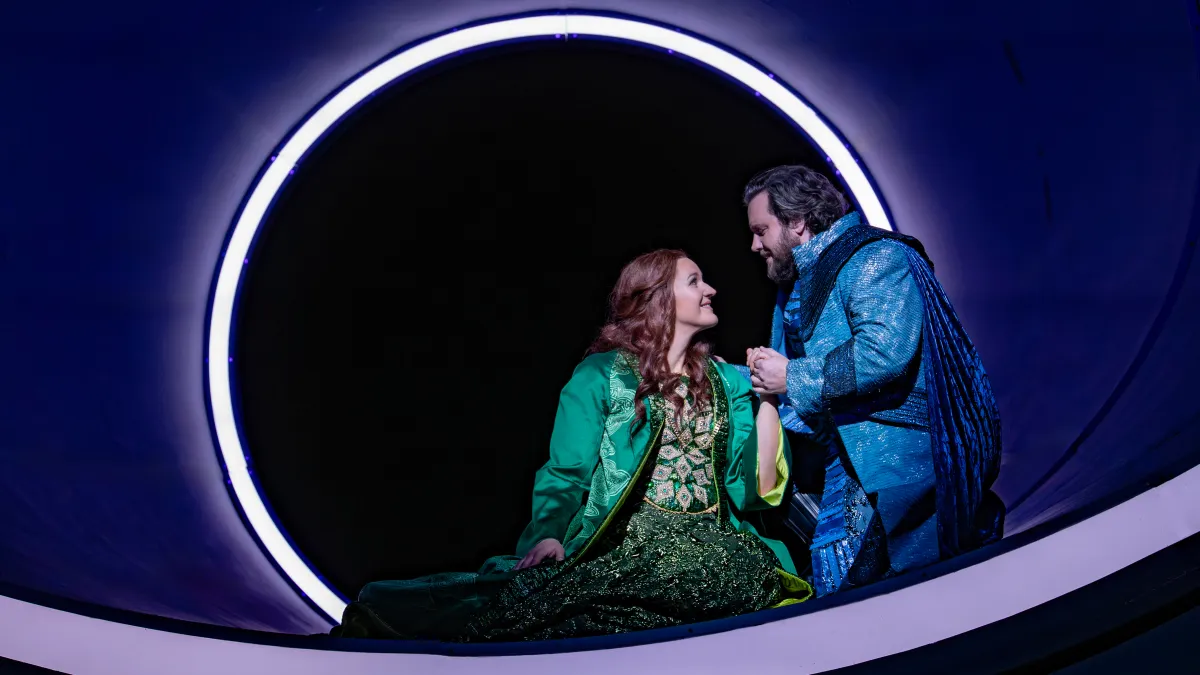
Tristan is really a metaphysical drama. Sharon and the set designer Es Devlin respond to this challenge by placing the characters amid a pair of shifting, interlocking tunnels behind sliding panels that open and close like a camera’s aperture. Lighting effects by John Torres are breathtaking, although the costume designer Clint Ramos saddles Davidsen with a hideous green gown reminiscent of Shrek. More concerning are the jarring acoustics of the set, not aided by Yannick Nézet-Séguin’s thundering though undeniably gorgeous conducting of the Met Orchestra.
The singer who suffers the most is Ekaterina Gubanova, who sings most of Brangäne’s Act II lines floating in the middle of the stage. She’s inaudible in much of the act, with a worryingly loose vibrato otherwise. On the opposite end of the spectrum the bass-baritone Ryan Speedo Green is loud but unsubtle as King Marke. He’s a commanding stage presence but his tone turns dry under pressure and he makes little of the text. It’s concerning that he has been lined up to sing Wotan in Sharon’s forthcoming Ring cycle, when the Met has singers such as Nicholas Brownlee or, indeed, Tomasz Konieczny on its roster. Konieczny’s Kurwenal is marvellously sung and acted, with impeccable projection and diction.
But Tristan depends on its lead couple, and the Met has a pairing that stands with the greats of the past. Davidsen’s titanic voice is made for Isolde, and indeed the wild fury of her Act I narrative and curse pins the audience to the back of its seats. But equally impressive are her floated high notes in the Liebestod, and she blends beautifully with Michael Spyres’s Tristan in their long, sensual duet. Spyres, making his role debut, is a marvel, with a gorgeous baritonal sound and impeccably secure high notes. Tristan’s death scene, which takes up most of the third act, is usually as much a trial for the audience as for the tenor, but Spyres maintains both tonal beauty and dramatic commitment.
Sharon’s biggest innovation is setting Isolde’s Liebestod not as a deluded fantasy over Tristan’s dead body. Instead, she addresses it to their newly born infant, transforming it into a moment of optimism and rebirth — a hopeful metaphor for the Met itself.
★★★★☆
290min
Metropolitan Opera, New York, to Apr 4; live in cinemas on Mar 21 and in the UK on Radio 3/BBC Sounds, metopera.org
Love classical music and opera? Get access to exclusive interviews and join the conversation in our Facebook group


